Why CPG Label Compliance Is Critical for Brand Success
Every CPG brand eventually has a moment where compliance becomes real. For some it's a buyer at a major retailer who spots a labeling issue and pulls the order. For others it's an FDA warning letter that requires halting sales and reprinting every label in the portfolio. For others still it's a class action lawsuit filed over a 'natural' claim on a product that contains a synthetic ingredient. The common thread: the cost of non-compliance is always higher than the cost of getting it right upfront.

Michael Wu
| Co-founder at Truli

The business case for CPG label compliance isn't abstract. It's denominated in dollars, lost distribution, and brand equity — each of which can be quantified with uncomfortable precision when things go wrong. Understanding the risk landscape is the starting point for building a compliance function that protects the business rather than just checking regulatory boxes.
The Direct Cost of Getting Compliance Wrong
Product recalls are the most visible compliance failure in the CPG industry. The FDA classifies food recalls into three classes based on health risk, but even lower-risk recalls generate significant operational costs. A Class II recall — "may cause temporary adverse health consequences" — still requires notifying all distribution partners, retrieving product from retail shelves and warehouses, destroying or reconditioning affected units, issuing a public press release, and documenting the entire process for FDA.
Industry estimates for average food recall costs range from $8 million to $12 million in direct expenses, including notification, retrieval, destruction, and administrative costs. That figure excludes the revenue loss from the product being off market during the recall period, the cost of reformulation or label correction, the legal costs if personal injury claims follow, and the long-term impact on retail placement.
The most frequent cause of FDA food recalls — undeclared allergens — is directly preventable through systematic label compliance and supply chain auditing. A brand that confirms allergen declarations against both its formulation records and its contract manufacturer's allergen management procedures is eliminating the most common recall trigger at its source.
FDA warning letters carry costs that don't appear on a balance sheet but are real. A warning letter requires a written response within 15 business days documenting the corrective actions the brand has taken or will take. It becomes part of FDA's public database, searchable by any retailer buyer, investor, or journalist who wants to evaluate the brand. It can trigger follow-up inspections, import alerts, and — if the corrective actions are deemed inadequate — referral for injunctive relief.
Retailer delistings follow labeling violations more commonly than brands anticipate. Major natural and specialty retailers including Whole Foods, Target, and Walmart have their own compliance review processes. A product that fails retailer label review is removed from shelves until the issue is corrected — a process that can take months and results in lost distribution, lost velocity data, and damaged buyer relationships that take years to rebuild.
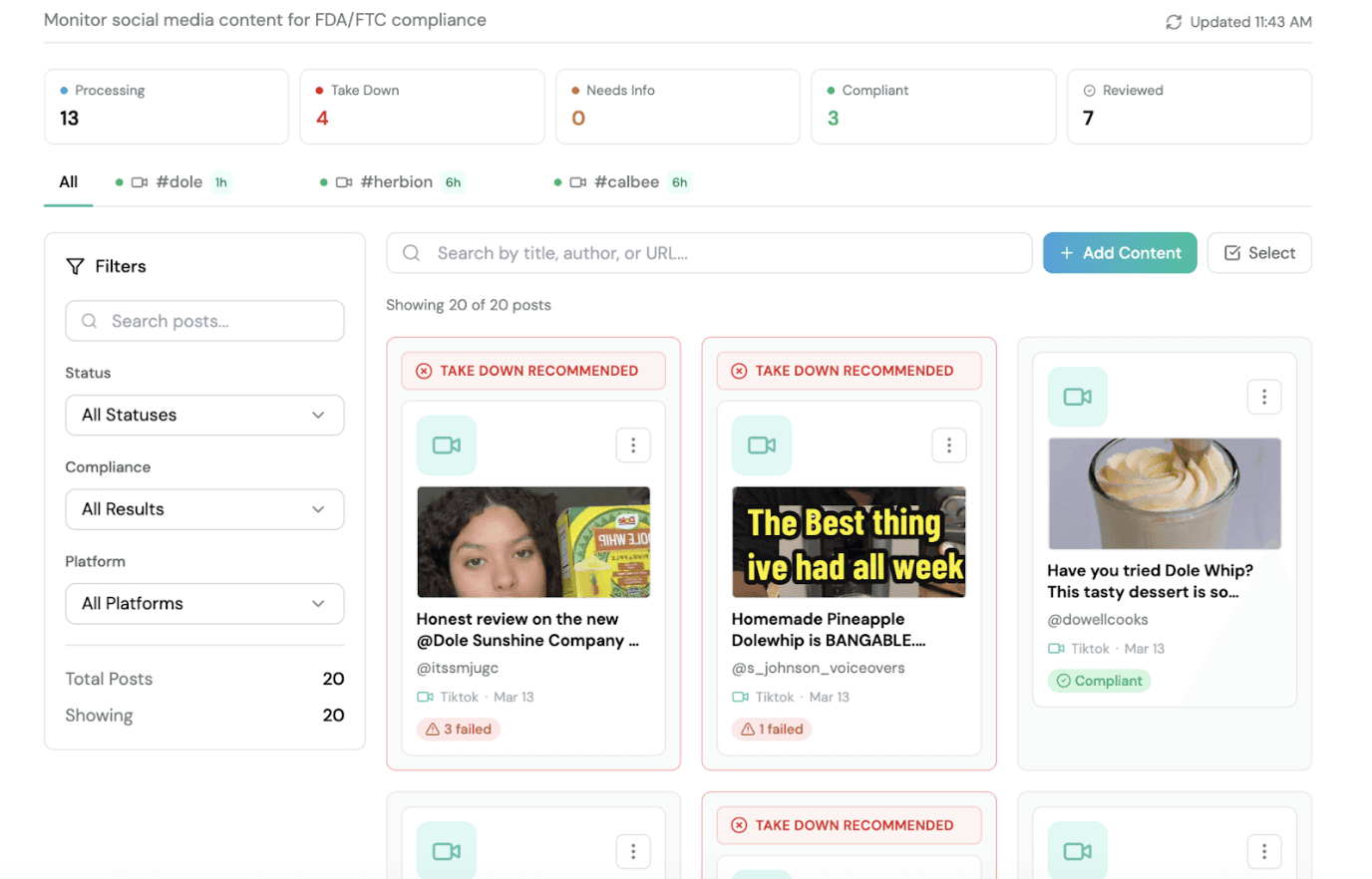
Class action litigation over label claims has been one of the most active areas of consumer product litigation for the past decade. The targets are predictable: "natural" claims on products containing synthetic ingredients, "non-GMO" claims without third-party certification, "healthy" claims that don't meet FDA's definition, "made in USA" claims on products with significant imported components. The litigation risk isn't primarily about FDA enforcement — it's about plaintiffs' attorneys who monitor label claims across the industry and file class actions when they find gaps between what a label promises and what a product delivers.
The Retail Compliance Layer
Beyond FDA and FTC, major retailers impose their own label requirements that function as a de facto compliance layer for brands seeking national distribution.
Whole Foods Market publishes a list of unacceptable ingredients that explicitly bars products containing certain artificial colors, sweeteners, preservatives, and additives — regardless of their FDA approval status. A brand with an FDA-compliant label may still fail Whole Foods' buyer review if the formulation contains a banned ingredient. Whole Foods also requires specific label formats for claims like "organic," "non-GMO," and "gluten-free."
Amazon applies its own compliance screening to supplement listings. Products making disease claims in titles, descriptions, or bullet points are suppressed or removed. Amazon uses automated detection combined with competitor complaint mechanisms — a competitor can report a disease claim on a rival's listing and trigger suppression faster than FDA would act on the same violation. For brands with significant Amazon revenue, this creates an immediate business disruption that doesn't require any FDA involvement at all.
Category buyers at natural channel retailers conduct label reviews as part of onboarding. A product that fails buyer review at the submission stage doesn't get the meeting to discuss placement — the compliance failure is an invisible barrier to retail access that most brands don't track as a compliance cost.
The Brand Equity Dimension
The longest-lasting cost of compliance failure is reputational. A brand that builds its positioning around claims — "the cleanest protein powder on the market," "clinically proven cognitive support," "the only supplement with peer-reviewed backing" — and then faces a warning letter, recall, or class action over those exact claims has a positioning problem that goes beyond the specific legal matter.
Consumers who purchased the product based on the claim, and then learned the claim was either legally non-compliant or factually contested, don't return. The reviews that product generated during the period of non-compliance become evidence of the misleading claim. The influencers who promoted the product using the claim become potential liability if FTC scrutinizes their disclosures.
Conversely, brands that maintain rigorous, documented compliance create a durable competitive advantage. In the supplement and functional food categories, where consumer skepticism about product claims is high and growing, being able to demonstrate that claims have been reviewed against the regulatory standard — and that the marketing copy is conservative, substantiated, and defensible — builds the kind of trust that survives market cycles.
Building Compliance Into the Business — Not Onto It
The brands that handle compliance most effectively don't treat it as a legal function that activates when something goes wrong. They build it into product development, marketing review, and supply chain management as a continuous workflow.
At product formulation: every ingredient is assessed against the allergen list, the GRAS (generally recognized as safe) framework for novel ingredients, and the relevant GMP requirements for the manufacturing context.
At label development: every claim is evaluated against the regulatory framework before artwork is finalized — not after the product is in distribution and a buyer flags a problem.
At marketing: every channel where claims appear — website, social, influencer, retail — is reviewed against the same standard as the physical label, under the understanding that FDA's and FTC's definition of "labeling" and "advertising" extends across all of them.
At supply chain: every ingredient supplier change is reviewed for allergen implications, and every co-manufacturer is assessed for their allergen segregation and cross-contact management procedures.
This isn't a resource-intensive process for a focused brand — it's a systematic workflow that, once established, runs alongside product development rather than creating friction against it.
Compliance as a competitive moat
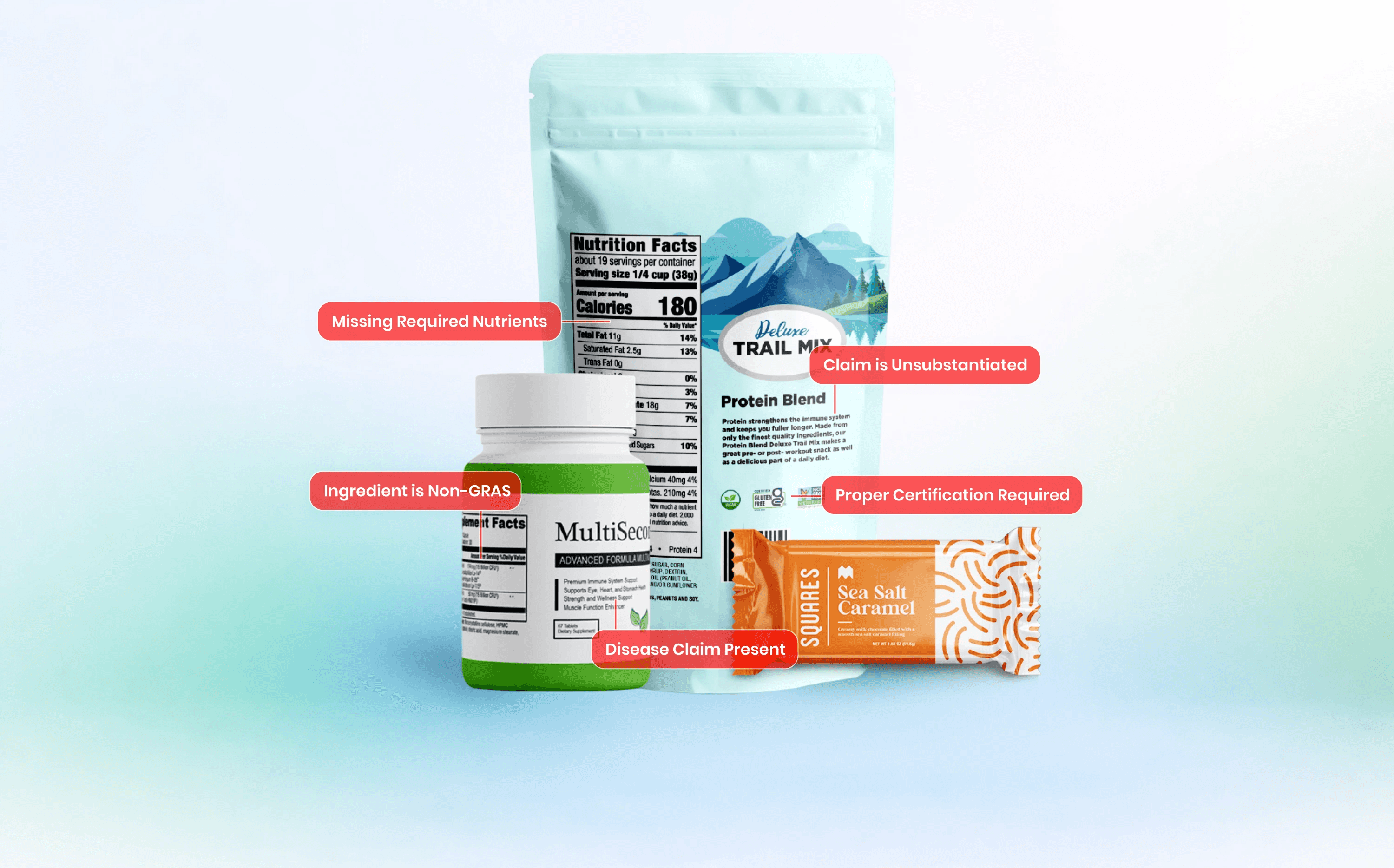
The brands that invest in systematic label compliance aren't just avoiding enforcement risk — they're building a defensible position in a market where consumers, retailers, and regulators are all applying increasing scrutiny to what CPG products actually deliver. Truli's label compliance platform runs the regulatory review that makes this workflow tractable: scanning label claims against FDA's framework, verifying required elements, and flagging issues before they reach retail.
A note from Truli: Truli is not a law firm, and this article does not constitute or contain legal advice or create an attorney-client relationship. When determining your obligations and compliance with respect to relevant laws and regulations, you should consult a licensed attorney.
About

Truli is an AI compliance platform for food, beverage, and supplement brands. Automate FDA/FTC label reviews, claims validation, and post-market monitoring — 10x faster.

Platform
See Truli in action
If regulatory delays are consuming months and thousands in fees, see how Truli delivers fast and continuous compliance coverage at a fraction of the cost.
Book a demo