27 CFR Part 7 — TTB Malt Beverage Labeling Requirements
27 CFR Part 7 sets the federal labeling rules for malt beverages — beer, ale, porter, stout, lager, malt liquor, and flavored malt beverages — under the Federal Alcohol Administration Act. The part only reaches products fermented from malted barley with hops; hard seltzers fermented from sugar are labeled under FDA food rules instead, even though they are alcoholic. Part 7 was recodified in 2022, so legacy section numbers no longer apply.

Catherine Zhou
| Co-founder at Truli

27 CFR Part 7 contains the Alcohol and Tobacco Tax and Trade Bureau's (TTB) labeling and advertising regulations for malt beverages, issued under the Federal Alcohol Administration (FAA) Act. Like Part 5 for distilled spirits, Part 7 was comprehensively recodified in 2022 (T.D. TTB-176), reorganizing the part into subparts and renumbering its sections — older citations such as § 7.22 or § 7.29 are obsolete. Part 7 also has the most unusual jurisdictional boundaries of the three FAA Act commodity parts, both in what counts as a "malt beverage" and in when a label approval is actually required.
What Is a Malt Beverage — and What Is Not
Under 27 CFR 7.1, a malt beverage is a beverage made by the alcoholic fermentation of an infusion or decoction, in potable brewing water, of malted barley with hops (or their parts or products), with or without other malted or unmalted cereals, other carbohydrates, carbon dioxide, or other wholesome food-suitable products. Both elements are essential: no malted barley, or no hops, means no malt beverage under the FAA Act.
This definition is narrower than the Internal Revenue Code definition of "beer" (26 U.S.C. 5052), which covers fermented beverages made from malt or any substitute for malt, including sugar. A product can therefore be "beer" for federal excise tax purposes but not a "malt beverage" for labeling purposes. Under 27 CFR 7.6(b), beer products not made with both malted barley and hops are outside Part 7 entirely, and their bottlers and importers should refer to FDA's food labeling regulations at 21 CFR Part 101. Common examples:
Hard seltzers fermented from sugar — taxed as beer, but FDA-labeled (ingredient list, allergen labeling, serving facts) because they contain no malted barley or hops
Beers made from sorghum, rice, or wheat without malted barley — including many products marketed as gluten-free — are FDA-labeled
A "gluten-removed" beer brewed from malted barley with hops remains a TTB-regulated malt beverage, because the definition turns on ingredients, not finished-product gluten content
Regardless of which agency governs the label, the health warning statement under 27 CFR Part 16 applies to any of these products at 0.5 percent alcohol by volume or more.
The COLA Requirement — Conditioned on State Law (§ 7.21)
Malt beverages have a unique certificate of label approval trigger. Under 27 CFR 7.21(b), a bottler shipping malt beverages into a state needs a COLA only if that state's law requires malt beverages sold there to be labeled in conformity with Part 7's requirements (subparts D through I). The same conditioning applies to Part 7's substantive labeling rules generally (§ 7.4). Because the overwhelming majority of states have adopted such requirements, national brewers treat the COLA as effectively mandatory — but the state-law hook matters for purely intrastate sellers and for a handful of states without conforming laws.
Mandatory Label Statements (§ 7.63)
27 CFR 7.63(a) requires malt beverage containers to bear labels with the following:
Requirement | Section | Notes |
|---|---|---|
Brand name | Required on all containers | |
Class, type, or other designation | Subpart I (§§ 7.141–7.144) | "Beer," "ale," "porter," "stout," "lager," "malt liquor," or a statement of composition for specialty products |
Alcohol content | Mandatory only if any alcohol derives from added nonbeverage flavors or other added nonbeverage ingredients (other than hops extract) | |
Name and address of bottler or importer | § 7.66, § 7.67, or § 7.68 | May be blown, embossed, or molded into the container |
Net contents | May be blown, embossed, or molded into the container |
§ 7.63(b) adds four conditional ingredient disclosures:
FD&C Yellow No. 5 — a statement such as "Contains FD&C Yellow No. 5" if the coloring is present
Cochineal extract or carmine — a statement using the common name, such as "contains carmine"
Sulfites — "Contains sulfites" (or equivalent) if sulfur dioxide or sulfiting agents are present at 10 ppm or more measured as total sulfur dioxide
Aspartame — the capital-letter statement "PHENYLKETONURICS: CONTAINS PHENYLALANINE.", separate and apart from all other information
Alcohol Content — Optional Unless Required (§ 7.65)
Part 7's most distinctive rule: unlike wine over 14% ABV and all distilled spirits, alcohol content on a standard malt beverage label is optional. Under 27 CFR 7.65(a), alcohol content may be stated unless prohibited by state law, and where a state requires a statement, the state's format governs. Federal law once banned strength claims on beer entirely — a prohibition struck down on First Amendment grounds in Rubin v. Coors Brewing Co. (1995) — which is why the permissive structure survives today. Alcohol content becomes mandatory under § 7.63(a)(3) when any of the beverage's alcohol is derived from added nonbeverage flavors or other added nonbeverage ingredients (other than hops extract) containing alcohol — the typical flavored malt beverage scenario.
When stated, alcohol content must follow § 7.65(b): expressed as a percentage of alcohol by volume, to the nearest 0.1 percentage point for beverages at 0.5% ABV or more, in a format such as "4.2% alc/vol." A tolerance of ±0.3 percentage points applies (§ 7.65(c)) — but a product labeled at 0.5% ABV or more may never actually fall below 0.5%, regardless of tolerance.
Low-strength descriptors carry their own hard limits:
Term | Rule | Section |
|---|---|---|
"Low alcohol" / "reduced alcohol" | Actual content must be under 2.5% ABV — no tolerance can push it to 2.5% or above | § 7.65(d) |
"Non-alcoholic" | Must appear with "contains less than 0.5 percent (or .5%) alcohol by volume" immediately adjacent, readily legible, on a completely contrasting background; no tolerance | § 7.65(e) |
"0.0 percent" claims | A malt beverage may not be labeled 0.0% ABV unless it is also labeled "alcohol free" and contains no alcohol | § 7.65(e) |
"Alcohol free" | Only for malt beverages containing no alcohol at all; no tolerance | § 7.65(f) |
This alcohol-content regime is squarely in TTB's rulemaking crosshairs: the proposed Alcohol Facts rule (Notice No. 237, January 2025, comment period extended by 120 days after industry requests) would require per-serving alcohol content, calorie, and nutrient disclosures on malt beverage labels — ending the optional status. A companion proposal would require major food allergen labeling. Both remain proposed rules, not final requirements, as of August 2026.
Prohibited Practices (§§ 7.122, 7.129)
Subparts G and H prohibit false and misleading label practices. 27 CFR 7.122 states the general prohibition: labels, containers, and packaging may not contain any statement or representation, irrespective of falsity, that misleads consumers as to the age, origin, identity, or other characteristics of the malt beverage or any other material factor. Surrounding sections address disparagement, obscenity, implied endorsements, and misleading guarantees.
27 CFR 7.129 governs health-related statements. Labels may not carry health-related statements that are untrue or create a misleading impression about the health effects of alcohol consumption. Specific health claims require case-by-case TTB evaluation, FDA consultation, scientific substantiation, and prominent disclosure of alcohol's health risks — conditions no commercial beer label realistically satisfies. Even health-related directional statements (pointing consumers to a third party for health information) are presumed misleading unless neutral and paired with the required disclaimer: "This statement should not encourage you to drink or to increase your alcohol consumption for health reasons."
How Truli Helps with Malt Beverage Label Compliance
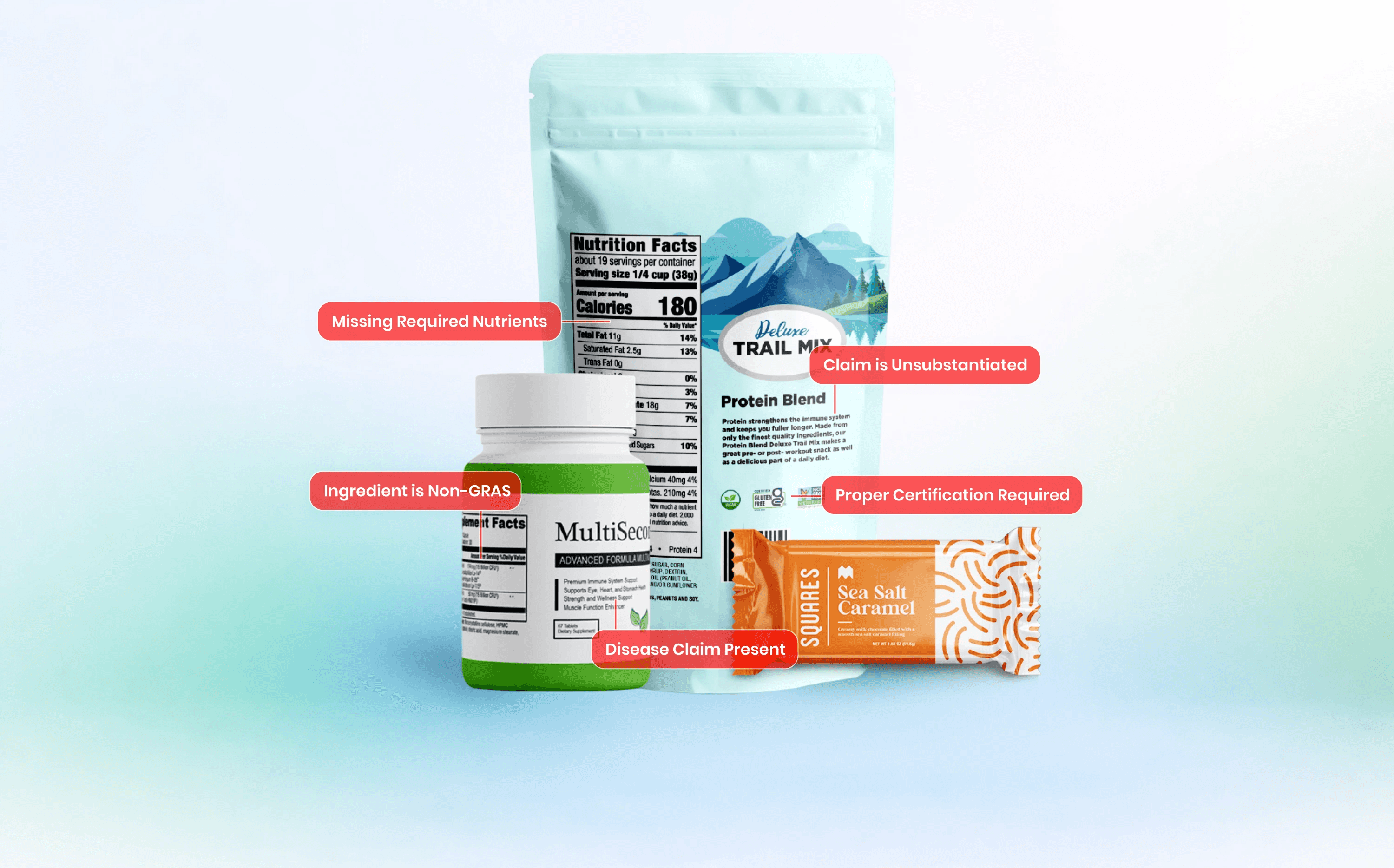
Jurisdiction routing: Truli's AI agents determine whether a product is a Part 7 malt beverage or an FDA-labeled beer (sugar-brewed seltzers, no-barley brews) and scan it against the correct rulebook, citing the governing regulation per finding
Mandatory statement checks: Truli verifies brand name, class designation, name and address, net contents, and the § 7.63(b) disclosures — sulfites, FD&C Yellow No. 5, carmine, and the aspartame phenylalanine warning
Alcohol content and descriptor review: Truli flags out-of-format ABV statements, tolerance issues, and misuse of "low alcohol," "non-alcoholic," "0.0%," and "alcohol free" under § 7.65(d)–(f)
COLA-readiness and rulemaking watch: Truli screens labels for § 7.122/§ 7.129 prohibited practices before COLA submission and tracks the pending Alcohol Facts and allergen proposals that would reshape malt beverage labels
Related Regulations
27 CFR Part 4 — Wine Labeling — TTB's parallel labeling rules for wine
27 CFR Part 5 — Distilled Spirits Labeling — TTB's parallel labeling rules for distilled spirits
27 CFR Part 16 — Health Warning Statement — The GOVERNMENT WARNING required on all alcoholic beverages at 0.5% ABV or more, including FDA-labeled beers
27 CFR Part 13 — COLA Label Approval — How TTB issues, revokes, and appeals certificates of label approval
The FAA Act — Federal Alcohol Administration Act — The statute behind Parts 4, 5, and 7 and the source of the malt beverage definition
Frequently Asked Questions
Is my hard seltzer regulated by TTB or FDA for labeling?
It depends on the base. A seltzer fermented from sugar contains no malted barley or hops, so it is not an FAA Act malt beverage — its label follows FDA food rules (21 CFR Part 101) under § 7.6(b), even though it is taxed as beer. A malt-based seltzer brewed with malted barley and hops is a Part 7 malt beverage. Either way, the Part 16 health warning applies at 0.5% ABV or more.
Do I have to put alcohol content on my beer label?
Generally no — under § 7.65 it is optional unless your state requires or prohibits it. It becomes federally mandatory under § 7.63(a)(3) if any alcohol in the product comes from added flavors or other added nonbeverage ingredients containing alcohol, as with most flavored malt beverages. TTB's pending Alcohol Facts proposal would make alcohol content mandatory across the board if finalized.
Can I label my non-alcoholic beer "0.0%"?
Only if it is also labeled "alcohol free" and contains no alcohol whatsoever — § 7.65(e) prohibits a 0.0% ABV statement otherwise, and no tolerance applies. A beer at, say, 0.3% ABV may be labeled "non-alcoholic" with the required "contains less than 0.5 percent alcohol by volume" statement, but not "0.0%" or "alcohol free."
Why did TTB reject my label for a health-adjacent claim like "fit" or "recovery"?
Section 7.129 defines health-related statements broadly, reaching implied wellness claims, nutritional-value statements, and imagery that suggests health benefits from drinking. TTB evaluates these case by case at COLA review and routinely requires deletion or qualification of language that creates a misleading health impression.
A note from Truli: Truli is not a law firm, and this article does not constitute or contain legal advice or create an attorney-client relationship. When determining your obligations and compliance with respect to relevant laws and regulations, you should consult a licensed attorney.
Last updated: August 2026. Reflects 27 CFR Part 7 as of August 2026. Truli monitors TTB rulemaking and enforcement, including the pending Alcohol Facts proposal. Book a demo to see how.
About

Truli is an AI compliance platform for food, beverage, and supplement brands. Automate FDA/FTC label reviews, claims validation, and post-market monitoring — 10x faster.

Platform
See Truli in action
If regulatory delays are consuming months and thousands in fees, see how Truli delivers fast and continuous compliance coverage at a fraction of the cost.
Book a demo