27 CFR Part 13 — COLA Certificates of Label Approval
Before a bottler fills a single bottle or an importer clears customs, most wine, distilled spirits, and malt beverage labels must be approved by TTB through a Certificate of Label Approval (COLA). 27 CFR Part 13 is the procedural rulebook for that system — how COLAs and exemption certificates are applied for and issued, which revisions are allowed without a new certificate, and what happens when TTB denies or revokes approval.

Catherine Zhou
| Co-founder at Truli

27 CFR Part 13 — "Labeling Proceedings" — governs the issuance, denial, and revocation of Certificates of Label Approval (COLAs), certificates of exemption from label approval, and distinctive liquor bottle approvals. The underlying mandate comes from the Federal Alcohol Administration Act: under 27 U.S.C. 205(e), it is unlawful to bottle distilled spirits, wine, or malt beverages, or to remove them from customs custody for sale in interstate commerce, without a certificate of label approval issued by TTB. The substantive label content rules live in 27 CFR Part 4 (wine), Part 5 (distilled spirits), and Part 7 (malt beverages); Part 13 supplies the process.
Who Needs a COLA
A COLA is required before bottling (for domestic producers) or before removal from customs custody (for importers) when the product will be introduced into interstate or foreign commerce. Under the definitions in 27 CFR 13.11:
A certificate of label approval is issued on TTB Form 5100.31 and authorizes bottling or packing of wine, distilled spirits, or malt beverages, or removal from customs custody, provided the product bears labels identical to those on the certificate or labels changed only within TTB's allowable revisions
The applicant must be the relevant TTB permittee or brewer — meaning the bottler or importer, not a designer or distributor, holds the certificate
A distinctive liquor bottle approval, also issued on Form 5100.31, authorizes bottling of distilled spirits in a bottle of distinctive shape or design, provided the bottle conforms to the photographs attached to the approved form
Products at the jurisdictional edges are a common trap: wines under 7% ABV and beers made without both malted barley and hops fall outside the FAA Act's commodity definitions, so they take FDA food labeling instead of a COLA — but they still need the Part 16 government warning. Malt beverages sold purely intrastate are likewise outside the FAA Act's interstate trigger.
Certificates of Exemption for Intrastate Products
For wine and distilled spirits that will never enter interstate commerce, 27 CFR 13.11 provides a certificate of exemption from label approval — issued on the same Form 5100.31 — on the condition that the product "will under no circumstances be sold, offered for sale, shipped, delivered for shipment, or otherwise introduced" into interstate or foreign commerce. Exemption-labeled products are marked for sale in the named state only. There is no exemption certificate for malt beverages: intrastate-only beer simply is not subject to FAA Act labeling, so nothing needs exempting.
Applying: TTB F 5100.31 and COLAs Online
Under 27 CFR 13.21, applicants submit TTB Form 5100.31, "Application for and Certification/Exemption of Label/Bottle Approval," following the form's instructions. In practice nearly all filings go through COLAs Online, TTB's electronic filing portal, with label images uploaded as exhibits. Key mechanics:
TTB must approve or deny within 90 days of receipt, extendable once by an additional 90 days in unusual circumstances, with written notice to the applicant explaining the issues
If TTB issues a qualified approval, the qualifications are set out on the form itself — a common example is approval conditioned on a change made before printing
If no decision arrives within the allowed period, the applicant may treat the inaction as appealable under § 13.25
Applications may be withdrawn at any time before decision under 27 CFR 13.22
The 90-day ceiling is a statutory backstop, not the norm: TTB's published processing times in 2026 have generally run in the range of a few business days to roughly two weeks depending on commodity, with malt beverages fastest and distilled spirits slowest.
Formula approval comes first for many products. Where a product requires formula approval or pre-COLA product evaluation — flavored spirits, many specialty wines and flavored malt beverages, and other non-standard products — the formula must be approved on TTB Form 5100.51 (filed through Formulas Online) before the COLA application can be approved. Filing a COLA on an unapproved formula is one of the most common causes of rejection and resubmission.
Allowable Revisions Without a New COLA
An approved COLA covers labels identical to the certificate — plus a defined list of changes TTB permits without a new application. The list of allowable revisions appears on the COLA form itself and on TTB's allowable revisions page, and currently runs to more than 40 permitted changes, including for example:
Changing the label size, shape, or proportionate spacing of text
Adding, deleting, or changing awards, medals, and similar accolades
Adding, deleting, or changing a website address, phone number, or zip code
Repositioning label elements or changing background color or type color, so long as legibility and required contrast are maintained
Deleting non-mandatory information
Anything outside the list — a new brand name, class/type change, revised alcohol content format, or new claims — requires a new COLA before use. Treating the allowable revisions list as a general license to redesign is a frequent compliance failure.
Denial and Appeals (13.23–13.27)
Step | Section | What happens |
|---|---|---|
Notice of denial | TTB issues a written notice stating the grounds for denial | |
First appeal | Applicant may appeal the denial or qualification to the appropriate TTB officer | |
Decision | TTB issues a written decision on the appeal | |
Second appeal | A further appeal produces TTB's final agency decision |
The appeal path also covers qualified approvals the applicant disputes, and inaction beyond the § 13.21 deadlines. Informal conferences with TTB are available under 27 CFR 13.71.
Revocation of Issued COLAs
Approval is not permanent. Two subparts cover revocation:
Revocation of specific certificates (13.41–13.45): TTB may revoke an individual COLA — for example, one issued in error or covering a label later found misleading. The process runs notice of proposed revocation (§ 13.42), a decision after the holder responds (§ 13.43), an appeal (§ 13.44), and a final decision (§ 13.45)
Revocation by operation of law or regulation (13.51–13.54): when a statute or new regulation makes previously approved labels non-compliant, affected COLAs are revoked as a class as of the new rule's compliance date, without individual proceedings
Effective dates and the consequences of revocation, along with surrender of certificates, are addressed in 13.72–13.74. Third parties may also submit comments challenging issued certificates under 13.62. Note for planning: TTB's proposed Alcohol Facts and allergen labeling rules, if finalized as drafted, would trigger exactly this kind of class-wide label transition, with a proposed five-year compliance runway.
One More Gate: the Government Warning
Under 27 CFR 16.30, TTB will not approve any COLA or exemption certificate unless the label bears the health warning statement required by Part 16 — making the GOVERNMENT WARNING a de facto element of every COLA application.
How Truli Helps with COLA Compliance
COLA-readiness checks: Truli's AI agents review label artwork against the Part 4/5/7 mandatory information rules and the Part 16 warning before you file, citing the specific regulation behind each finding
Allowable revision triage: Truli assesses whether a label change fits TTB's allowable revisions list or requires a new COLA, so redesigns do not silently invalidate an existing certificate
Rejection-pattern screening: Truli flags the issues that most often drive TTB rejections — class/type mismatches, alcohol content format errors, missing name-and-address statements, and prohibited claims
Portfolio monitoring: Truli tracks TTB rulemaking (including the proposed Alcohol Facts and allergen rules) against your approved labels so class-wide revocation risk surfaces early
Related Regulations
27 CFR Part 4 — Wine Labeling — The substantive label content rules a wine COLA is checked against
27 CFR Part 5 — Distilled Spirits Labeling — Mandatory label information and standards for spirits labels
27 CFR Part 7 — Malt Beverage Labeling — Label content rules for beer and other malt beverages
27 CFR Part 16 — Government Warning Statement — The health warning TTB verifies on every COLA under § 16.30
FAA Act — The Federal Alcohol Administration Act Explained — The statute whose section 205(e) makes COLAs mandatory
Frequently Asked Questions
Do I need a COLA if I only sell within my own state?
For wine and distilled spirits, you still need to file Form 5100.31, but you may qualify for a certificate of exemption from label approval by certifying the product will never enter interstate or foreign commerce. For malt beverages there is no exemption certificate because purely intrastate beer is outside the FAA Act's labeling requirement — though state rules and the federal Part 16 warning still apply.
How long does TTB take to approve a COLA?
The regulation allows TTB 90 days, extendable once by 90 more with written notice. In practice, 2026 processing has typically run from about one business day for malt beverages to under two weeks for distilled spirits, with spikes when new rules drive resubmission volume.
Can I change my approved label without filing again?
Only within TTB's list of allowable revisions — more than 40 specific changes such as repositioning elements, updating contact details, or adding awards. Changes to the brand name, class and type designation, alcohol content statement, or any new claim require a new COLA before the revised label is used.
Can TTB take back a COLA it already issued?
Yes. TTB can revoke a specific certificate through the notice-and-appeal process in §§ 13.41–13.45, and entire categories of COLAs are revoked by operation of law under §§ 13.51–13.54 when a regulatory change makes previously approved labels non-compliant.
A note from Truli: Truli is not a law firm, and this article does not constitute or contain legal advice or create an attorney-client relationship. When determining your obligations and compliance with respect to relevant laws and regulations, you should consult a licensed attorney.
Last updated: August 2026. Reflects 27 CFR Part 13 as of August 2026. Truli monitors TTB rulemaking and enforcement. Book a demo to see how.
About

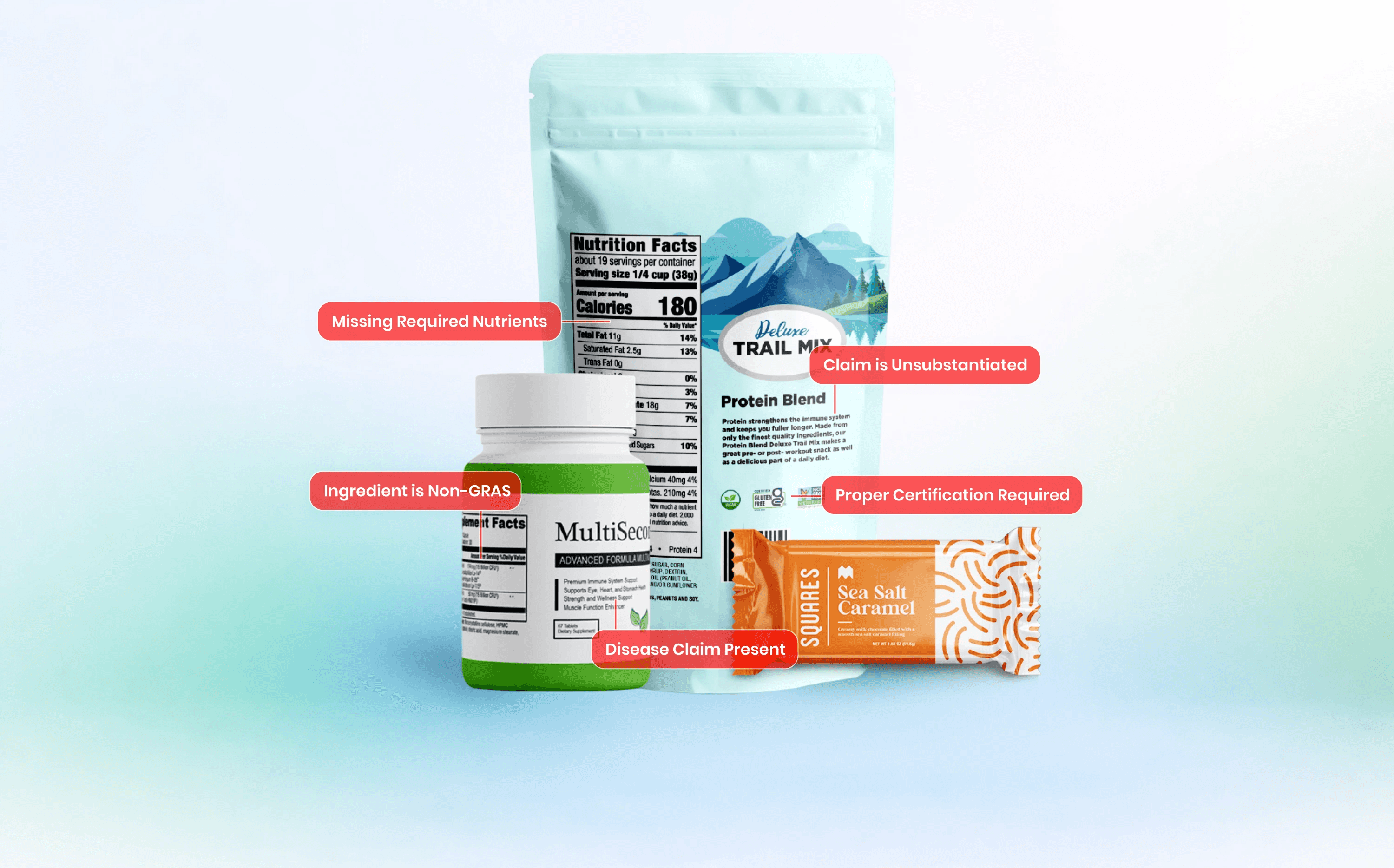
Truli is an AI compliance platform for food, beverage, and supplement brands. Automate FDA/FTC label reviews, claims validation, and post-market monitoring — 10x faster.

Platform
See Truli in action
If regulatory delays are consuming months and thousands in fees, see how Truli delivers fast and continuous compliance coverage at a fraction of the cost.
Book a demo