27 CFR 7.65 — Malt Beverage Alcohol Content Statements
27 CFR 7.65 governs when and how alcohol content may — or must — appear on malt beverage labels. Its baseline is unique in alcohol labeling: ABV is optional unless a state requires it or the product's alcohol partly derives from added flavors. The section also polices the strength descriptors, from low alcohol to alcohol free, with hard numeric limits and no-tolerance rules.

Catherine Zhou
| Co-founder at Truli

27 CFR 7.65 is the malt beverage alcohol content section — and the most historically distinctive provision in Part 7. Federal law once prohibited strength statements on beer labels outright, a ban the Supreme Court struck down on First Amendment grounds in Rubin v. Coors Brewing Co. (1995). The permissive structure that survives — alcohol content may be stated, subject to format rules when it is — makes malt beverages the only FAA Act commodity where ABV is generally optional. Distilled spirits and most wines must state it; beer, by default, need not.
The Baseline: Optional Unless State Law Says Otherwise — § 7.65(a)
Under § 7.65(a), alcohol content (and the percentage and quantity of original gravity or extract) may be stated on any malt beverage label, unless prohibited by state law. Where a state requires an alcohol content statement and prescribes its manner, the state's format governs; where the manner is not required under state law, the federal format in § 7.65(b) applies. Practically, three regimes coexist: states that require ABV on some or all malt beverages, states silent on it, and product-specific restrictions — so multistate brands must clear each destination's rules, not just TTB's.
When ABV Becomes Mandatory: the Added-Flavor Trigger — § 7.63(a)(3)
The optional baseline flips for one product family. Under 27 CFR 7.63(a)(3), alcohol content is mandatory for malt beverages that contain any alcohol derived from added nonbeverage flavors or other added nonbeverage ingredients (other than hops extract) containing alcohol. That is the typical flavored malt beverage: a brewed malt base plus flavor extracts whose carrier is ethanol. Related limits live in § 7.5, which restricts how much of a malt beverage's alcohol may derive from added flavors and other nonbeverage ingredients — and, notably, the labeling tolerance discussed below does not apply when determining compliance with those § 7.5 percentage limits.
Format Rules — § 7.65(b)
When alcohol content is stated — whether mandatory or optional — § 7.65(b) controls the format:
Alcohol by volume, always: the statement must be expressed as a percentage of alcohol by volume. Other truthful representations (such as alcohol by weight) are allowed only together with, and as part of, the ABV statement
Precision: at 0.5% ABV or more, state to the nearest 0.1 percentage point (subject to tolerance); below 0.5% ABV, to the nearest 0.1 or 0.01 percentage point, with no tolerance
Approved formats: "Alcohol __ percent by volume," "__ percent alcohol by volume," or "Alcohol by volume: __ percent," with abbreviations "alc," "%," "/" for "by," and "vol" permitted, with or without periods and parentheses
Compliant examples from the rule: "4.2% alc/vol," "Alc. 4.0 percent by vol.," "Alc 4% by vol," "5.9% Alcohol by Volume"
Type size is bounded in both directions by § 7.53: mandatory statements must be at least 2 mm (1 mm on containers of a half pint or less), and any alcohol content statement — required or optional — may not exceed 3 mm on containers of 40 fl oz or less, 4 mm above 40 fl oz. That maximum matters commercially: hard seltzer and FMB brands that market strength ("5% alc/vol") often want the ABV as a design element, and the cap is why it cannot become billboard-size type on the front of a can. Larger-than-cap strength messaging generally has to live in brand or descriptive copy that satisfies the prohibited practices rules, not in the alcohol content statement itself — and remember that sugar-based hard seltzers are FDA-labeled and outside § 7.65 entirely.
Tolerance: ±0.3 Points, with a 0.5% Floor — § 7.65(c)
For malt beverages at 0.5% ABV or more, § 7.65(c) permits a tolerance of 0.3 percentage points above or below the stated alcohol content — a 4.5% ABV beer may test between 4.2% and 4.8%. Two hard limits cut across it:
A product labeled at 0.5% ABV or more may never actually contain less than 0.5% ABV, regardless of tolerance — the line between alcoholic and non-alcoholic cannot be crossed by rounding
The tolerance does not apply in determining compliance with § 7.5's limits on alcohol derived from added nonbeverage flavors and ingredients
Strength Descriptors: Low, Non-Alcoholic, 0.0%, Alcohol Free — § 7.65(d)–(f)
Term | Rule | Section |
|---|---|---|
"Low alcohol" / "reduced alcohol" | Only on malt beverages under 2.5% ABV; actual content may not equal or exceed 2.5% regardless of tolerance | § 7.65(d) |
"Non-alcoholic" | Permitted only with "contains less than 0.5 percent (or .5%) alcohol by volume" immediately adjacent, readily legible, on a completely contrasting background; no tolerance | § 7.65(e) |
"0.0 percent alcohol by volume" | Prohibited unless the product is also labeled "alcohol free" and contains no alcohol | § 7.65(e) |
"Alcohol free" | Only for malt beverages containing no alcohol at all; no tolerance | § 7.65(f) |
The non-alcoholic beer boom makes these the most-tripped rules in the section. A 0.4% ABV NA beer may say "non-alcoholic" with the required adjacency statement, but may not round to "0.0%." A true zero-alcohol product may claim 0.0% only when paired with "alcohol free" — and because no tolerance applies below 0.5%, the stated figure must hold analytically.
The Proposed Alcohol Facts Rule Would End the Optional Era
TTB's proposed Alcohol Facts rule (Notice No. 237, January 2025, with the comment period extended by 120 days after industry requests) would require a standardized per-serving panel — alcohol content, calories, and nutrient information — on malt beverage labels, ending ABV's optional status, alongside a companion proposal for major food allergen labeling. Both remain proposed rules, not final requirements, as of August 2026, but brewers designing label systems today should reserve panel space: if finalized as proposed, every § 7.65-optional label becomes non-compliant at the end of the compliance transition period.
How Truli Helps with Alcohol Content Compliance
Format and precision checks: Truli's AI label scans validate ABV statements against the § 7.65(b) formats, precision rules, and § 7.53 minimum and maximum type sizes, citing the exact paragraph on each finding
Trigger detection: Truli flags when added flavor systems make alcohol content mandatory under § 7.63(a)(3), so FMBs and hard seltzers do not ship with an optional-era label
Descriptor policing: scans catch misuse of "low alcohol," "non-alcoholic," "0.0%," and "alcohol free" — including the missing adjacency statement and impossible tolerance assumptions — before COLA submission
Rulemaking watch for the alcohol vertical: Truli tracks the Alcohol Facts and allergen proposals and shows which current labels would need redesign if the rules finalize
Related Regulations
27 CFR Part 7 — TTB Malt Beverage Labeling Requirements — The parent guide to the full malt beverage labeling part
27 CFR 7.63 — Mandatory Statements on Malt Beverage Labels — The mandatory list, including the flavored-alcohol ABV trigger
27 CFR 7.141–7.142 — Malt Beverage Class and Type Designations — Class designations, which carry their own 0.5% ABV threshold
27 CFR Part 16 — Health Warning Statement — The GOVERNMENT WARNING required at 0.5% ABV or more
27 CFR Part 13 — COLA Label Approval — Where alcohol content statements are reviewed for approval
Frequently Asked Questions
Can I state alcohol by weight instead of alcohol by volume?
Not on its own. Under § 7.65(b), the alcohol content statement must be expressed as a percentage of alcohol by volume; other truthful representations such as alcohol by weight are permitted only when they appear together with, and as part of, the ABV statement.
My beer is labeled 5.0% but tested at 4.8% — am I compliant?
Yes, on the federal tolerance: § 7.65(c) allows 0.3 percentage points above or below the stated content for beverages at 0.5% ABV or more, so 4.7%–5.3% actual is within tolerance for a 5.0% label. The exceptions: a product labeled at 0.5% or more may never actually fall below 0.5%, "low alcohol" products may never reach 2.5%, and no tolerance exists below 0.5% ABV.
Why was my COLA flagged for an oversized ABV callout?
Section 7.53(b) caps alcohol content statements — even optional ones — at 3 mm of type on containers of 40 fl oz or less (4 mm above 40 fl oz). Strength-forward designs that enlarge "5% ALC/VOL" beyond the cap are routinely corrected at COLA review; the maximum exists precisely to prevent strength marketing through the ABV statement.
A note from Truli: Truli is not a law firm, and this article does not constitute or contain legal advice or create an attorney-client relationship. When determining your obligations and compliance with respect to relevant laws and regulations, you should consult a licensed attorney.
Last updated: August 2026. Reflects 27 CFR 7.65 as of August 2026. Truli monitors TTB rulemaking and enforcement, including the pending Alcohol Facts proposal. Book a demo to see how.
About

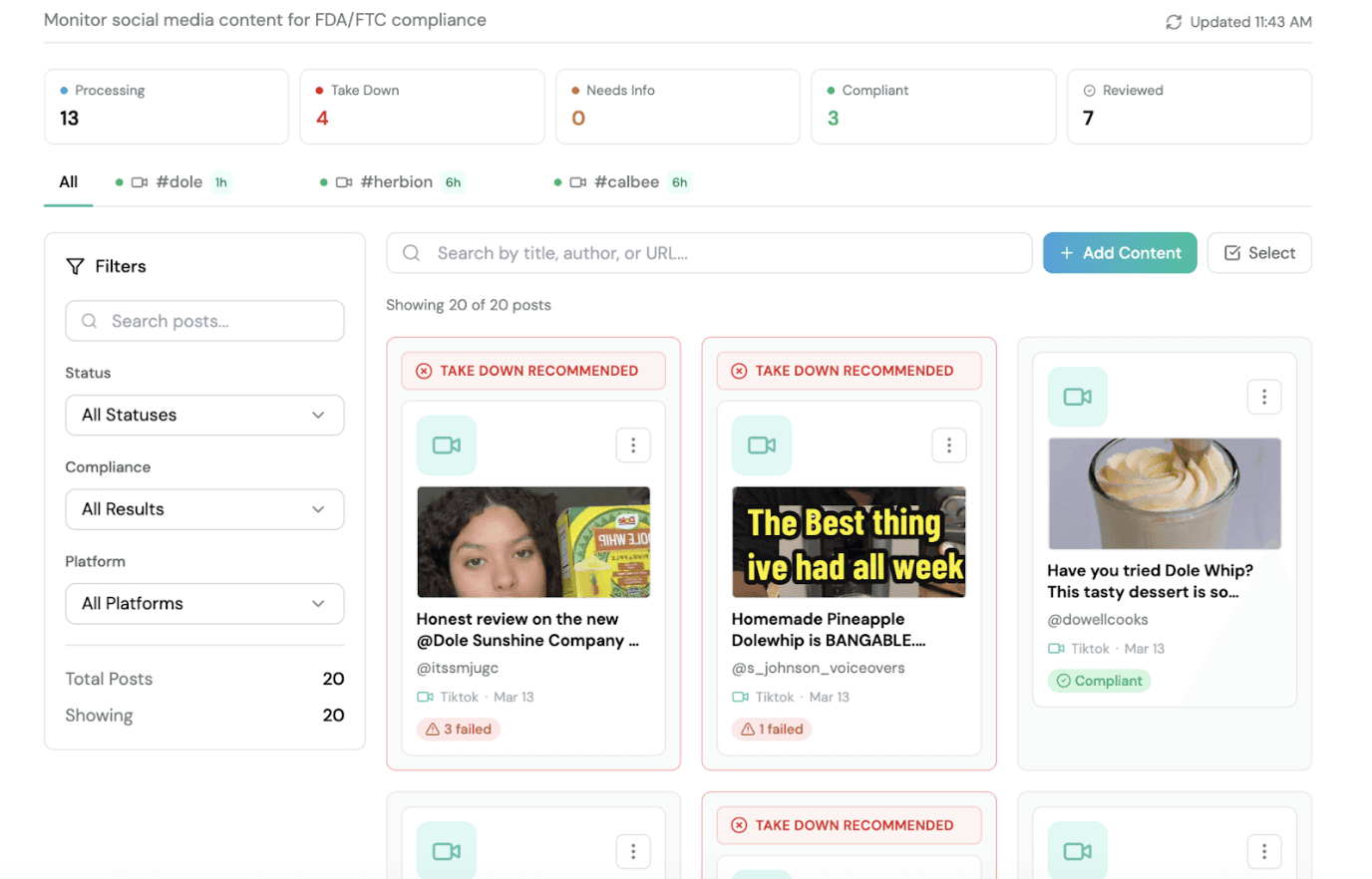
Truli is an AI compliance platform for food, beverage, and supplement brands. Automate FDA/FTC label reviews, claims validation, and post-market monitoring — 10x faster.

Platform
See Truli in action
If regulatory delays are consuming months and thousands in fees, see how Truli delivers fast and continuous compliance coverage at a fraction of the cost.
Book a demo