27 CFR 5.65 — Spirits Alcohol Content and Proof Statements
Alcohol content is the most tightly formatted statement on a spirits label. 27 CFR 5.65 dictates not just that ABV must appear, but exactly how it may be phrased, where an optional proof statement may sit, and how far actual content may drift from the label. The tolerance is just 0.3 percentage points in either direction — tighter than any other TTB commodity.

Catherine Zhou
| Co-founder at Truli

27 CFR 5.65 governs alcohol content statements on distilled spirits labels under the post-2022 recodification of Part 5. It is one of the three items that must appear within the same field of vision under § 5.63(a), alongside the brand name and class/type designation — and unlike most label copy, its wording is prescribed nearly verbatim. The section has three parts: the general requirement, the permitted formats, and the tolerance.
The Mandatory ABV Statement (§ 5.65(a))
Alcohol content must be stated on the label as a percentage of alcohol by volume on every distilled spirits container. There is no de minimis exception and no proof-only alternative — a label showing "80 Proof" with no ABV statement is noncompliant, no matter how conventional it looks.
The section carves out one special case: products containing a significant amount of material that may absorb spirits after bottling — the regulation's example is solid fruit — must state the alcohol content at the time of bottling, in the form "Bottled at ____ percent alcohol by volume." This covers products like brandied fruit and pickle-backed or fruit-in-bottle specialties, where the fruit slowly soaks up alcohol and the shelf ABV drifts below the fill ABV.
Permitted Formats (§ 5.65(b))
Section 5.65(b)(2) allows exactly three sentence patterns:
"Alcohol ____ percent by volume"
"____ percent alcohol by volume"
"Alcohol by volume ____ percent"
Formatting flexibility is then layered on top: "alcohol" may be abbreviated "alc", "volume" may be abbreviated "vol", the percent symbol % may replace "percent," a slash / may replace the word "by" between alcohol and volume, abbreviations may appear with or without periods, and words or symbols may be enclosed in parentheses. The section's own compliant examples: "40% alc/vol", "Alc. 40 percent by vol.", "Alc 40% by vol", and "40% Alcohol by Volume." Anything outside the pattern — "ABV 40%", "40% ABV", "Alcohol volume 40%" — is not among the authorized formats, and "ABV" as an abbreviation appears nowhere in the section.
Other truthful, accurate, and specific factual representations of alcohol content, such as alcohol by weight, are permitted — but only if they appear together with, and as part of, the ABV statement, never standing alone.
Optional Proof Statements
Proof is optional, never a substitute. Under § 5.65(b)(1)(i), alcohol content in degrees of proof may be stated on the label as long as it appears in the same field of vision as the mandatory ABV statement. Once that anchored proof statement exists, additional proof statements may appear elsewhere on the label without the field-of-vision constraint — which is how a bourbon can carry "90 Proof" prominently on the front and repeat it on the neck and back.
The arithmetic is fixed by definition: U.S. proof is twice the percentage of alcohol by volume at 60 degrees Fahrenheit. A 40% alc/vol vodka is 80 proof; a 62.5% alc/vol barrel-proof bourbon is 125 proof. Because proof is derived, a label whose proof and ABV disagree (say, "43% alc/vol" alongside "90 Proof") is internally inconsistent and will draw a correction.
The ±0.3 Percentage Point Tolerance (§ 5.65(c))
Section 5.65(c) is a single sentence: a tolerance of plus or minus 0.3 percentage points is allowed for actual alcohol content that is above or below the labeled alcohol content. A spirit labeled 40% alc/vol must measure between 39.7% and 40.3%. The section states no product-specific exceptions — the tolerance runs both directions and applies across classes. (Its practical companion is the "bottled at" rule in § 5.65(a): for fruit-in-bottle products, the tolerance is judged against content at bottling, since post-bottling absorption is expected.)
This is dramatically tighter than the wine tolerances in Part 4, which run 1.0 to 1.5 percentage points depending on ABV. For distillers, the compliance burden lands on the proofing bench: water-addition errors, temperature-correction mistakes, and alcohol pickup or loss during filtration and bottling can each consume a share of the 0.3-point budget. TTB market-compliance sampling tests actual bottles against labeled ABV, so this is one of the few label rules verified by laboratory measurement rather than by reading.
Barrel Proof and Cask Strength (§ 5.87)
High-proof releases use vocabulary regulated separately, in § 5.87:
"Barrel proof" or "cask strength" may be used only for spirits stored in wood barrels where the bottling proof is not more than two degrees lower than the proof when the spirits were dumped from the barrels — minimal dilution is tolerated, meaningful proofing-down is not
"Original proof," "original barrel proof," "original cask strength," or "entry proof" may be used only if the spirits were stored in wooden barrels and the entry proof and bottling proof are the same — a stricter claim, since barrel proof typically drifts from entry proof during aging
A "cask strength" label on a whiskey proofed down five degrees from dump proof is a § 5.87 violation even though the § 5.65 ABV statement itself is accurate.
The Proposed Alcohol Facts Rule
TTB's Alcohol Facts proposal (Notice No. 237, January 2025) would add a standardized per-serving panel to spirits labels — alcohol content, calories, and nutrient information — alongside a companion major-allergen labeling proposal. If finalized, the ABV statement would do double duty: today's § 5.65 statement plus a per-serving alcohol declaration inside the new panel. As of August 2026 the rule remains proposed, not final — current labels need only § 5.65 compliance, but brands designing packaging with multi-year shelf lives should leave room for a facts panel.
How Truli Helps with Alcohol Content and Proof Compliance
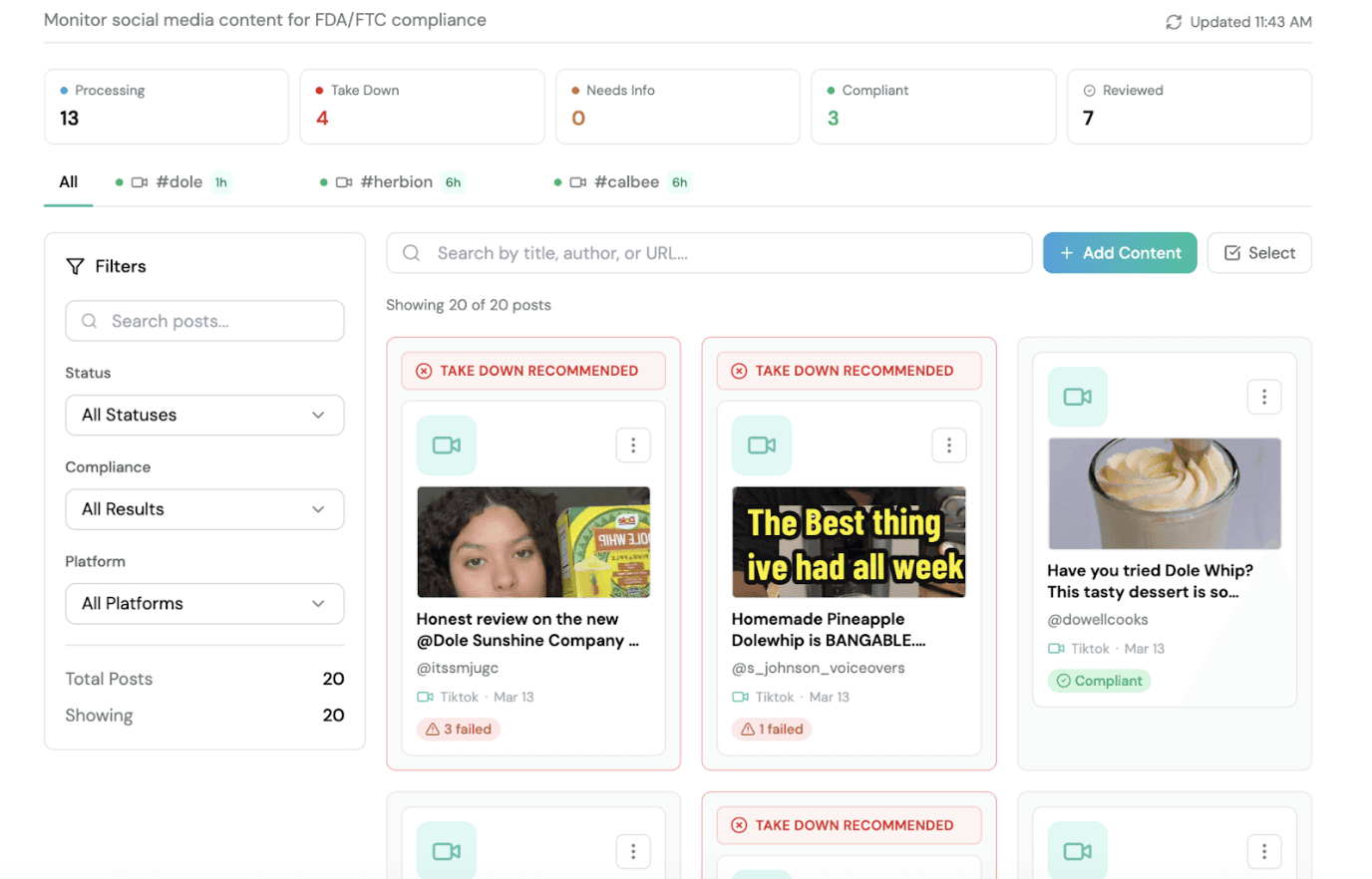
Format validation: Truli's AI label scans parse the alcohol content statement against § 5.65(b)'s authorized patterns and abbreviations, flagging nonconforming formats like "40% ABV" that read naturally but are not among the permitted forms
Proof/ABV consistency checks: Truli verifies that proof statements equal twice the labeled ABV, sit in the same field of vision as the mandatory statement, and that barrel-proof and cask-strength claims are consistent with § 5.87's dump-proof and entry-proof conditions
Placement verification: Truli confirms the ABV statement shares a field of vision with the brand name and class/type designation as § 5.63(a) requires
COLA-readiness and rulemaking watch: Truli's alcohol vertical screens labels for the alcohol-content errors that drive TTB corrections and tracks the proposed Alcohol Facts rule so label templates can adapt if it finalizes
Related Regulations
27 CFR Part 5 — TTB Distilled Spirits Labeling Requirements — The parent guide to the full distilled spirits labeling framework
27 CFR 5.63 — Mandatory Spirits Label Information — The field-of-vision rule the ABV statement must satisfy
27 CFR 5.143 — Whisky and Bourbon Labeling — Class rules with their own minimum-proof requirements
27 CFR 5.129 — Spirits Health Statements — The restrictions surrounding nutrition-adjacent claims today
27 CFR Part 16 — Health Warning Statement — The GOVERNMENT WARNING required alongside alcohol content
Frequently Asked Questions
Can I label my whiskey with proof only, like "90 Proof"?
No. The mandatory statement is percentage of alcohol by volume under § 5.65(a). Proof is optional and, if used, must appear in the same field of vision as the ABV statement — additional proof statements may then appear elsewhere on the label.
Is "40% ABV" an acceptable alcohol content statement?
It is risky. Section 5.65(b) authorizes specific patterns and abbreviations — "alc," "vol," "%," and "/" — and its compliant examples are forms like "40% alc/vol" and "Alc 40% by vol." The abbreviation "ABV" is not among the authorized forms, so use one of the section's own patterns.
How much can my actual ABV differ from the label?
By 0.3 percentage points in either direction under § 5.65(c). A spirit labeled 45% alc/vol must measure between 44.7% and 45.3%. Products with spirit-absorbing solids (like fruit in the bottle) instead state content at bottling using the "Bottled at ____ percent alcohol by volume" form.
A note from Truli: Truli is not a law firm, and this article does not constitute or contain legal advice or create an attorney-client relationship. When determining your obligations and compliance with respect to relevant laws and regulations, you should consult a licensed attorney.
Last updated: August 2026. Reflects 27 CFR 5.65 as of August 2026. Truli monitors TTB rulemaking and enforcement, including the pending Alcohol Facts proposal. Book a demo to see how.
About

Truli is an AI compliance platform for food, beverage, and supplement brands. Automate FDA/FTC label reviews, claims validation, and post-market monitoring — 10x faster.

Platform
See Truli in action
If regulatory delays are consuming months and thousands in fees, see how Truli delivers fast and continuous compliance coverage at a fraction of the cost.
Book a demo