27 CFR 4.39 — Prohibited Practices on Wine Labels
Most of Part 4 tells you what a wine label must say. 27 CFR 4.39 is the inverse: the list of statements, designs, and devices that may never appear — on the label, the carton, or anything accompanying the container to the consumer. It reaches false statements, implied endorsements, cocktail names, simulated government stamps, and health claims, and TTB applies it at COLA review and in market enforcement.

Catherine Zhou
| Co-founder at Truli

27 CFR 4.39 sets out the prohibited practices for wine labeling under the FAA Act. Its scope is broad by design: paragraph (a) applies not just to the label but to containers of wine, any label on such containers, any individual covering, carton, or other wrapper, and any written, printed, graphic, or other matter accompanying the container to the consumer. A compliant front label does not save a noncompliant gift carton or insert card. This guide walks through each prohibition in the order the section presents them.
False or Misleading Statements (§ 4.39(a)(1))
The foundational rule prohibits any statement that is false or untrue in any particular — and, critically, any statement that irrespective of falsity tends to create a misleading impression directly, or by ambiguity, omission, or inference, or by the addition of irrelevant scientific or technical matter. Literal truth is not a defense if the overall impression misleads. A technically accurate statistic presented out of context, or scientific-sounding language that implies a quality difference that does not exist, can violate paragraph (a)(1) on its own.
Disparagement, Obscenity, Analyses, and Guarantees (§ 4.39(a)(2)–(5))
Four related prohibitions follow. Labels may not contain any statement disparaging of a competitor's products — comparative marketing that runs down another producer belongs nowhere on a TTB-regulated label. Obscene or indecent statements, designs, devices, or representations are barred. Statements or representations relating to analyses, standards, or tests are prohibited, irrespective of falsity, where TTB finds them likely to mislead the consumer — the classic example being selective lab results deployed as marketing. The same standard applies to representations about guarantees, with one carve-out written into the rule: money-back guarantees are not prohibited.
Implied Endorsements: Names of Persons and Organizations (§ 4.39(a)(6))
A trade or brand name that is the name of a living individual of public prominence or an existing private or public organization — or that simulates or abbreviates such a name, or any graphic or emblematic representation of them — is prohibited if it is likely to falsely lead the consumer to believe the product was endorsed, made, used by, produced for, or supervised by that individual or organization. The rule contains two provisos: it does not apply to the name of a person actually engaged in the wine business as producer, bottler, importer, or similar, and it grandfathers trade or brand names in use by the person or their predecessors before August 29, 1935. Celebrity-adjacent branding on wine gets reviewed under this paragraph; genuine, documented celebrity ownership or authorization is what separates a lawful label from an implied-endorsement violation.
Distilled Spirits References and Simulated Designations (§ 4.39(a)(7)–(9))
Three prohibitions police the wine/spirits boundary and the integrity of the designation system:
(a)(7): no statement, design, or device that creates the impression a wine contains distilled spirits, is comparable to a distilled spirit, or has intoxicating qualities — with exceptions for a conforming § 4.36 alcohol statement and for required statements of composition that reference a spirit actually contained in the product
(a)(8): no coined word or name in the brand name or designation that simulates or imitates a class, type, or permitted designation the wine is not entitled to bear — you cannot invent a word that sounds like "champagne" for a still wine
(a)(9): no word in the brand name or designation that is the name of a distilled spirits product or simulates one. The regulation gives examples: "Manhattan," "Martini," and "Daquiri" for wine cocktails; "Cuba Libre," "Zombie," and "Collins" for wine specialties; and "creme"/"cream" with "menthe," "mint," or "cacao" for flavored wine specialties
Age and Date Statements (§ 4.39(b)–(d))
Statements of age or representations relative to age are prohibited except in three forms: a vintage date in accordance with § 4.27, references to storage or aging methods in production narratives consistent with § 4.38(f), and the word "old" as part of a brand name. A bottling date is not treated as an age representation if it appears as "Bottled in __" in lettering no greater than 8-point Gothic caps (§ 4.39(c)). Any other date — an "Established 1898," for example — must be accompanied, in the same size and kind of printing, by an explanation such as "established" or "founded in," and on containers of 5 liters or less an establishment date may not exceed 2 mm type (§ 4.39(d)).
Simulated Government Stamps and Official Authority (§ 4.39(e))
No label may be designed to resemble or simulate a stamp of the United States Government or any State or foreign government, and no label may state or indicate that the wine is produced, blended, bottled, packed, or sold under, or in accordance with, any municipal, State, or Federal Government authorization, law, or regulation unless that statement is required or specifically authorized by law. If a government permit number appears, it may carry no additional commentary. Bonded winery and bonded wine cellar numbers may be stated only in direct conjunction with the operator's name and address, in prescribed forms such as "Bonded Winery No. __" — and no use may be made of them that conveys the impression the wine was made or matured under Government supervision or to Government specifications. In short, any wording that borrows federal or Treasury authority to vouch for the wine is prohibited unless a specific law authorizes it. Imported wines covered by a foreign government certificate of origin or vintage may reference the certification, but only in the form the regulation prescribes.
"Importer" on Domestic Wine and Government Insignia (§ 4.39(f), (g))
The word "Importer" or similar words may not appear on domestic wine except as part of the bona fide name of a permittee or retailer for whom the wine is bottled or distributed — and then only if the same label states "Product of the United States" or similar words, in the same size and kind of printing, to negate any imported impression (§ 4.39(f)). Paragraph (g) prohibits any statement, design, or pictorial representation relating to the armed forces of the United States or the American flag, or any emblem or decoration associated with them, and any flag, seal, coat of arms, crest, or other insignia likely to mislead consumers into believing the product was endorsed by or produced under the supervision of the associated government, organization, family, or individual.
Health-Related Statements (§ 4.39(h))
Paragraph (h) is the label-side rulebook for wine health claims (marketing claims are covered in depth in our claims content; this is the reference view). It defines three categories: health-related statements generally (any statement relating consumption of alcohol or wine to health effects, including psychological-sensation claims and vitamin-content claims — though caloric, carbohydrate, protein, and fat statements are not nutritional claims); specific health claims characterizing a relationship to a disease or health condition; and health-related directional statements referring consumers to third-party sources. The rules: health-related statements that are untrue or misleading are prohibited, and TTB evaluates them case by case, often requiring disclaimers. Specific health claims require FDA consultation, truthful and adequately substantiated evidence, qualification by consumer category, and disclosure of the risks of both moderate and heavier drinking — conditions so demanding that approved specific health claims on wine labels are essentially nonexistent. Directional statements are presumed misleading unless neutral and accompanied by the prescribed disclaimer: "This statement should not encourage you to drink or to increase your alcohol consumption for health reasons."
Geographic Brand Names (§ 4.39(i))
A brand name of viticultural significance — the name of a state, county, or approved viticultural area, or a name TTB finds viticulturally significant — may not be used unless the wine meets the appellation of origin requirements for the named area. Brand names on COLAs issued before July 7, 1986 are grandfathered with conditions: the wine must either meet the appellation requirements, be labeled with a qualifying appellation of the prescribed scope, or carry a statement TTB finds sufficient to dispel the misleading geographic impression. A brand called "Sonoma Ridge" on wine from bulk juice sourced elsewhere is precisely what this paragraph exists to stop.
How Truli Helps with Prohibited Practices Compliance
Misleading-statement screening: Truli reviews label and accompanying-material copy for § 4.39(a) issues — falsity, misleading inference, disparagement, and analysis or guarantee representations — with the specific paragraph cited on each finding
Name and endorsement checks: Truli flags brand names implicating living persons of prominence, existing organizations, distilled-spirits cocktail names, and simulated designations
Health claim detection: Truli identifies health-related statements, specific health claims, and directional statements, and checks directional statements for the required disclaimer
Geographic risk flags: Truli spots brand names of potential viticultural significance and checks them against the wine's stated appellation
Related Regulations
27 CFR Part 4 — TTB Wine Labeling Requirements — The full wine labeling framework this section belongs to
27 CFR 4.33 — Wine Brand Names — The affirmative brand name rules that pair with these prohibitions
27 CFR 4.34 — Wine Class and Type Designation — The designations that § 4.39(a)(8) protects from simulation
TTB Advertising Rules for Alcohol — The parallel prohibited practices for advertising
27 CFR Part 16 — Health Warning Statement — The mandatory GOVERNMENT WARNING that § 4.39(h) claims may never contradict
Frequently Asked Questions
Can I name my wine cocktail "Wine Martini"?
No. Section 4.39(a)(9) prohibits distilled-spirits product names in a wine's brand name or class and type designation, and "Martini" is one of the regulation's own examples. The same applies to "Manhattan," "Daquiri," "Collins," and creme de menthe or cacao constructions on flavored wine specialties.
My tasting room copy says "heart-healthy antioxidants." Can that go on the back label?
Almost certainly not. That is an implied specific health claim under § 4.39(h)(1)(ii), which TTB will not approve unless it is substantiated, qualified by consumer category, and accompanied by full disclosure of alcohol's health risks — a bar no conventional wine label meets. Even softer wording is evaluated case by case and is prohibited if misleading.
Can I print my bonded winery number as a mark of quality?
You may state it, but only in direct conjunction with your name and address, in a prescribed form such as "Bonded Winery No. __" — and § 4.39(e)(2) prohibits any use of it that suggests the wine was made or matured under Government supervision or to Government specifications. Treat it as an identifier, never as an endorsement.
A note from Truli: Truli is not a law firm, and this article does not constitute or contain legal advice or create an attorney-client relationship. When determining your obligations and compliance with respect to relevant laws and regulations, you should consult a licensed attorney.
Last updated: August 2026. Reflects 27 CFR 4.39 as of August 2026. Truli monitors TTB rulemaking and enforcement. Book a demo to see how.
About

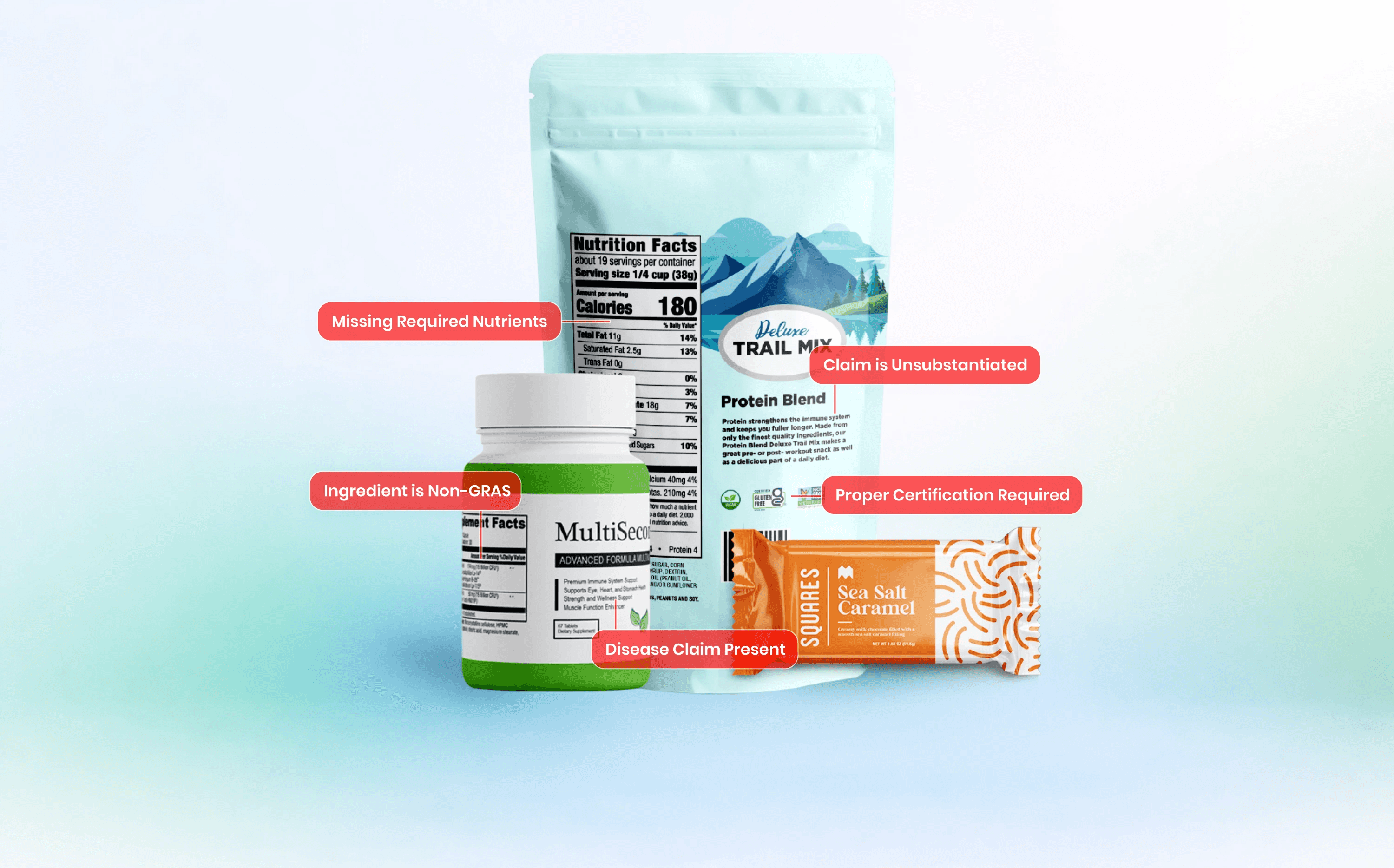
Truli is an AI compliance platform for food, beverage, and supplement brands. Automate FDA/FTC label reviews, claims validation, and post-market monitoring — 10x faster.

Platform
See Truli in action
If regulatory delays are consuming months and thousands in fees, see how Truli delivers fast and continuous compliance coverage at a fraction of the cost.
Book a demo