Truli vs RegulateCPG — Which Compliance Tool Is Right for Your Brand
Truli and RegulateCPG both get described as 'CPG compliance software,' but they address different problems for different buyers. Understanding which problem your brand actually has is the faster path to choosing the right tool — or knowing you need both.

Michael Wu
| Co-founder at Truli

RegulateCPG is a product lifecycle management platform built around formulation, nutrition data, and label generation. Truli is a regulatory compliance analysis platform built around claims review, disease claim detection, and marketing channel coverage. The buyers who get value from each tool are different, the workflows they integrate with are different, and the risks each one reduces are different.
Here's a direct comparison to help food and supplement brands evaluate both.
What RegulateCPG Does
RegulateCPG is designed to manage the workflow from product formulation to finished label across a CPG portfolio. Core capabilities:
Nutrition analysis — calculates nutritional profiles from recipe formulations using an integrated food ingredient database
Label generation — automatically generates FDA-format Nutrition Facts panels and CFIA/EU-format labels from formulation data
Ingredient management — tracks ingredient specifications, suppliers, and allergen declarations across the product portfolio
Recipe and formulation management — manages recipe versions, formulation changes, and their downstream impact on label data
Spec and compliance documentation — generates product specifications and compliance documentation for internal and retailer requirements
Allergen flagging — flags allergen-containing ingredients during formulation based on declared ingredient data
The value proposition is workflow integration: when a formulation changes, the nutrition data updates, and the label data reflects that change automatically. For brands managing large product portfolios with frequent reformulations, this integration reduces manual transcription errors and keeps specification records synchronized with current formulations.
What Truli Does
Truli is designed to evaluate whether label and marketing copy is legally compliant under FDA and FTC requirements. Core capabilities:
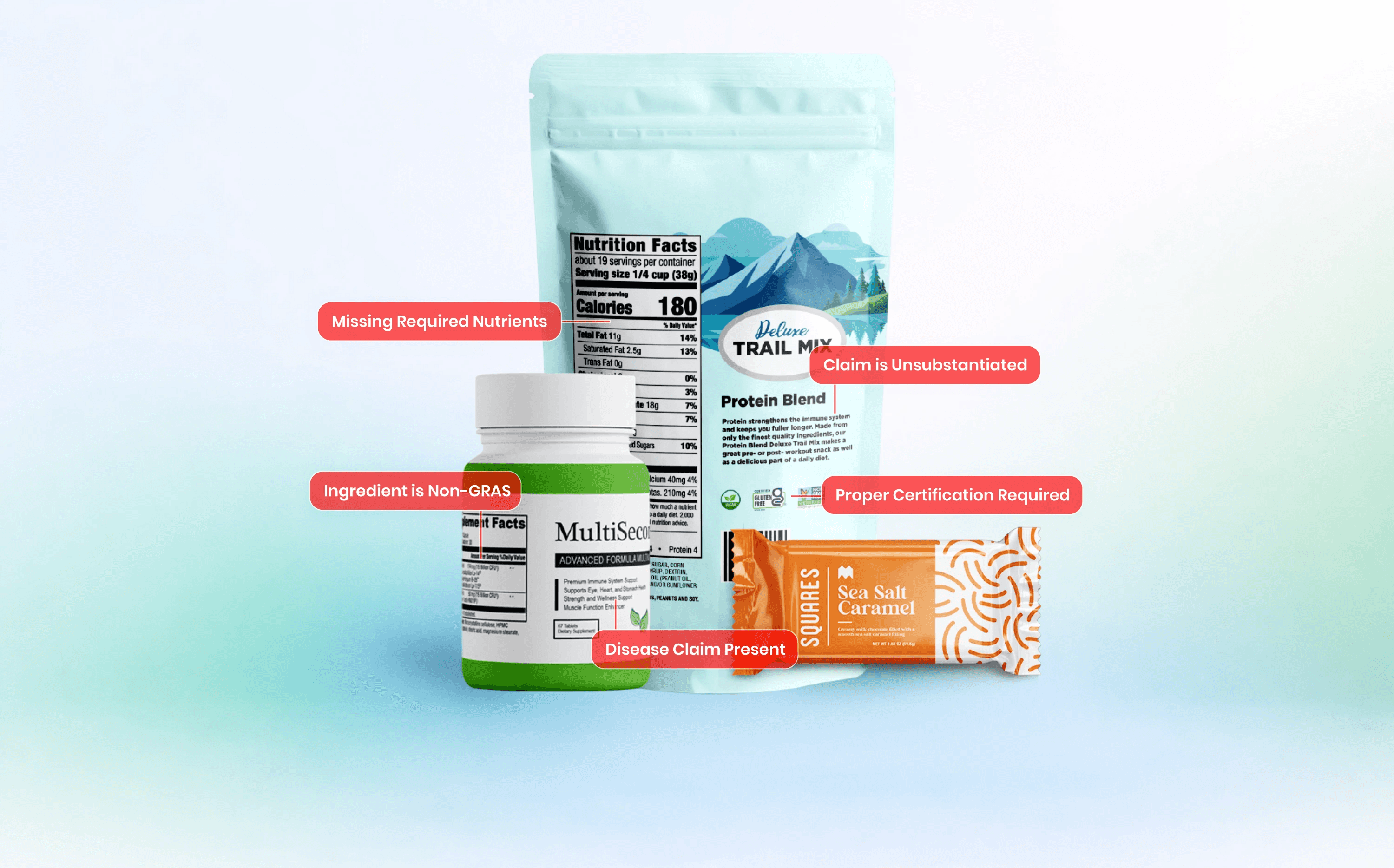
Claims compliance analysis — evaluating every health, function, and benefit claim against the applicable regulatory framework
Disease claim detection — identifying explicit and implied disease claims in supplement and food label copy
Required element verification — checking for the presence, placement, and formatting of mandatory label elements under 21 CFR Part 101
FDA disclaimer verification — confirming the structure/function claim disclaimer is present, prominent, bold, and appears across all labeling channels
Allergen declaration review — scanning ingredient lists against the nine declared allergens, including sesame under the FASTER Act
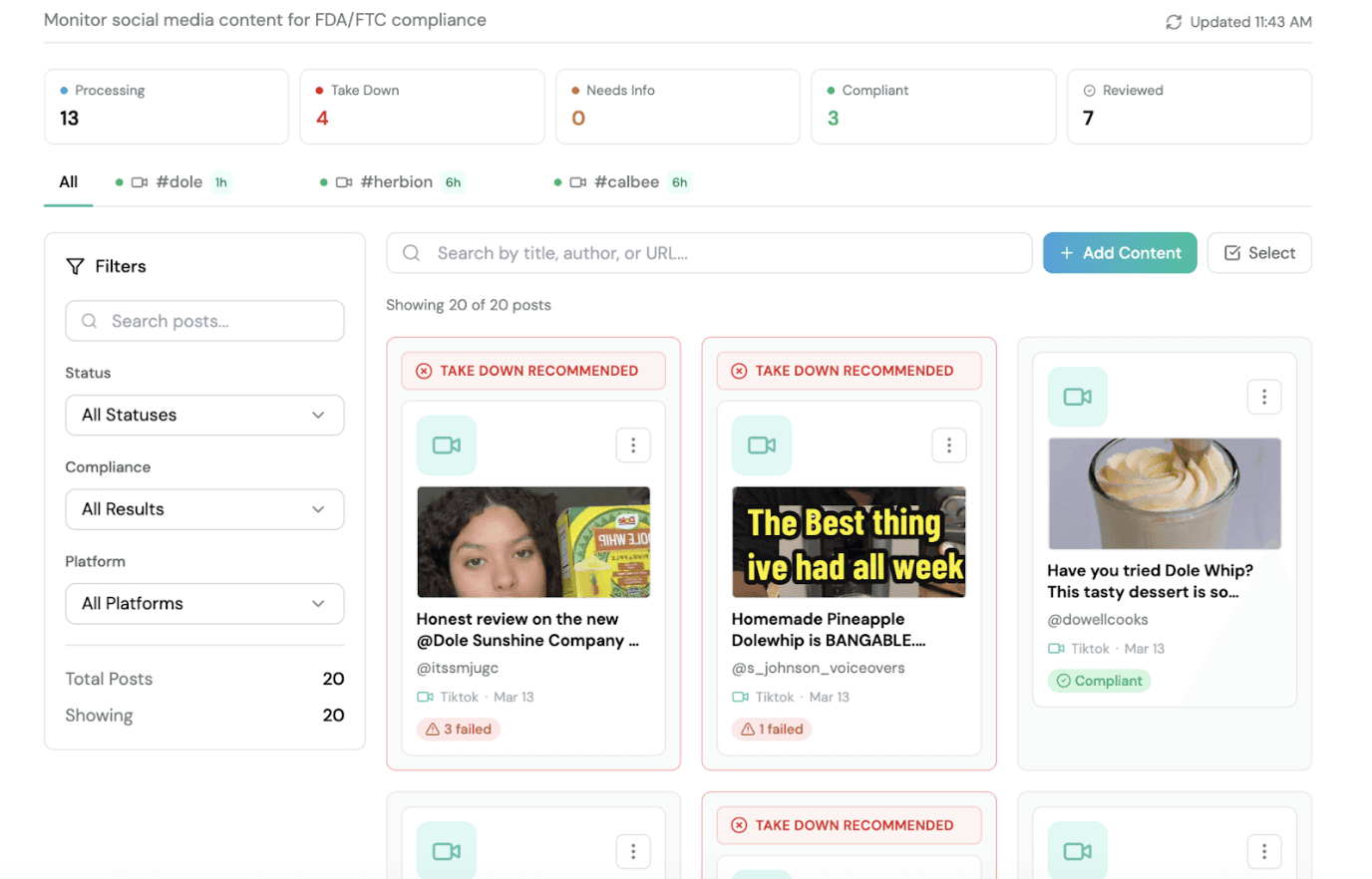
Digital channel coverage — applying regulatory analysis to website copy, Amazon listings, and marketing materials
FTC compliance analysis — evaluating health claims against FTC's substantiation standards and endorsement disclosure requirements
The value proposition is risk reduction: Truli surfaces the regulatory violations — in label copy and across marketing channels — that generate FDA warning letters, FTC enforcement actions, and retailer delistings before they reach an enforcement reviewer.
The Core Distinction
RegulateCPG manages what's on the label and how it got there — tracking the formulation-to-label data pipeline and ensuring the label accurately reflects the product.
Truli evaluates whether what's on the label is legally permissible — analyzing claim language against FDA and FTC regulatory requirements to determine whether it constitutes a violation.
These are different functions, and they're not substitutes for each other.
A brand using RegulateCPG to generate a Supplement Facts panel and manage its formulation data still needs a separate review of whether the claims on the label — the structure/function claims, the benefit language, the product name — comply with FDA requirements. RegulateCPG doesn't evaluate that. A supplement label that reads "supports healthy insulin sensitivity" may be generated accurately by RegulateCPG's label tool. It still needs a claims review to determine whether "insulin sensitivity" implies blood sugar management in diabetic patients — and if so, whether that's a permissible structure/function claim or a prohibited disease claim.
Similarly, a brand using Truli to review claims compliance still needs accurate nutrition data for its Nutrition Facts panel. Truli doesn't generate nutrition profiles from formulation databases. If your brand needs both accurate nutrition calculation and claims compliance review, the tools serve complementary functions.
Head-to-Head Comparison
Capability | Truli | RegulateCPG |
|---|---|---|
Claims compliance analysis | ✓ | ✗ |
Disease claim detection | ✓ | ✗ |
FDA required element verification | ✓ | Partial |
FDA disclaimer verification | ✓ | ✗ |
FTC compliance coverage | ✓ | ✗ |
Website and digital channel review | ✓ | ✗ |
Allergen declaration review | ✓ | ✓ |
Nutrition Facts panel generation | ✗ | ✓ |
Recipe and formulation management | ✗ | ✓ |
Ingredient database | ✗ | ✓ |
PLM and specification workflow | ✗ | ✓ |
Multi-format label generation (FDA/CFIA/EU) | ✗ | ✓ |
Supplements vs. Food and Beverage
RegulateCPG's core design is oriented toward conventional food and beverage products. Its nutrition analysis database and label generation features are optimized for Nutrition Facts panels, and its regulatory framework focuses on food safety compliance and labeling format requirements. Supplement brands evaluating RegulateCPG may find that the Supplement Facts panel generation and DSHEA-specific claim requirements — structure/function claims, FDA disclaimers, NDI notification tracking — are not as well-integrated as the food-focused features.
Truli is built for both food and supplement brands. The claims analysis covers both the structure/function claim framework for supplements and the nutrient content claim and health claim frameworks for conventional food products. For brands with mixed portfolios — a supplement company launching a functional food line, or a food brand adding supplement SKUs — Truli handles the regulatory analysis for both categories in a single workflow.
Who Gets the Most Value from Each Tool
RegulateCPG is the better fit if:
You're a food or beverage brand managing a large portfolio with frequent reformulations
Your primary challenge is keeping label data synchronized with formulation changes across multiple SKUs
You need multi-format label generation for international markets (FDA, CFIA, EU)
Your compliance concern is primarily data accuracy and specification management, not claim language analysis
You don't have active digital marketing channels that need compliance coverage
Truli is the better fit if:
Your primary compliance risk is the claims your brand makes about its products — on labels, websites, Amazon, and social media
You've received or are concerned about FDA warning letters or FTC scrutiny
You're a supplement brand with active structure/function claims that need disclaimer verification and disease claim screening
You need compliance coverage across digital marketing channels, not just the physical label
You're a new brand preparing a first label and need to catch regulatory violations before the product ships
Both tools if:
You're a food or supplement brand with a large portfolio that needs accurate nutrition data management (RegulateCPG) and rigorous claims compliance analysis (Truli) as distinct workflow components
The Compliance Gap Most Brands Miss
Brands evaluating PLM and label generation tools often conclude their compliance needs are met when they've selected a tool that generates accurate labels. Accurate is not the same as compliant.
An accurate label correctly states the nutrient amounts derived from the formulation. A compliant label also has legally permissible claims, correctly formatted required elements, complete allergen declarations, and consistent claim language across every channel where the brand markets the product. Those are different requirements, and only the second set generates FDA warning letters when they're wrong.
If your brand's compliance workflow covers formulation accuracy and label generation but not claim language analysis and digital channel review, the enforcement risk lives in the gap between the two.
See how Truli handles the claims compliance side
RegulateCPG handles the formulation-to-label data workflow well. Truli handles the regulatory claims review that determines whether what's on that label — and across your website, Amazon listing, and marketing content — is legally permissible. Book a demo to see what a full-surface claims compliance review surfaces for your specific products.
A note from Truli: Truli is not a law firm, and this article does not constitute or contain legal advice or create an attorney-client relationship. When determining your obligations and compliance with respect to relevant laws and regulations, you should consult a licensed attorney.
About

Truli is an AI compliance platform for food, beverage, and supplement brands. Automate FDA/FTC label reviews, claims validation, and post-market monitoring — 10x faster.

Platform
See Truli in action
If regulatory delays are consuming months and thousands in fees, see how Truli delivers fast and continuous compliance coverage at a fraction of the cost.
Book a demo