Truli vs Manual Compliance Review — A Practical Comparison
Manual compliance review by a regulatory attorney or consultant is the default for most CPG brands — and for good reason. A qualified regulatory professional brings legal judgment, enforcement pattern knowledge, and the ability to make calls on borderline claims that no software can replicate. But it's also slow, expensive, inconsistent across reviewers, and structurally incapable of covering the full surface area of where CPG brands make claims today.

Catherine Zhou
| Co-founder at Truli

The question isn't whether to use manual review. It's understanding what manual review can and can't do, and where AI-driven compliance review changes the economics and the coverage without replacing the judgment calls that require a human.
What Manual Review Actually Costs
A regulatory attorney or consultant with FDA food and supplement expertise bills at $350–$600 per hour. A label review for a single SKU — covering the physical label, the ingredient list, the claims, and the FDA disclaimer — takes two to four hours at minimum. That's $700–$2,400 per SKU for a basic label review.
Extending that review to website copy, Amazon listings, social media, and active marketing campaigns is not economically feasible at those rates. In practice, most brands that rely on manual review cover the physical label at launch and then don't systematically review the digital channels where FDA and FTC are now doing most of their enforcement monitoring. The label gets reviewed. The website doesn't. The Amazon listing doesn't. The influencer content doesn't.
The result is a compliance program that's thorough where the risk is lowest (physical label copy, which rarely changes) and absent where the risk is highest (digital channels, which change constantly).
For a brand managing five SKUs and active marketing across a website, Amazon, Instagram, and an influencer program, full-surface manual review would require ongoing retainer engagement at a cost most brands at the growth stage can't sustain.
What Manual Review Gets Right
Manual review by a qualified regulatory professional is not replaceable for specific categories of compliance decisions.
Borderline claims require human judgment. Whether "supports healthy inflammatory response" is a permissible structure/function claim or an implied disease claim for arthritis depends on the full label context — other claims present, the product name, the target audience signaling, the ingredient profile, and the enforcement pattern in recent FDA warning letters. A regulatory attorney can weigh those factors and make a defensible call. AI can surface the question with high reliability. It cannot always resolve it with the certainty that legal judgment provides.
Novel ingredient safety assessment is not AI work. Whether a new botanical extract or synthetic ingredient qualifies as GRAS, whether it requires an NDI notification to FDA, and whether the safety data on file is adequate to support the intended use — these are questions that require regulatory science judgment and legal analysis, not pattern matching against a regulatory database.
FDA warning letter response requires legal representation. A warning letter demands a written response within 15 business days documenting specific corrective actions. That response is a legal document that establishes the brand's position with FDA. It requires a qualified regulatory attorney, full stop.
Novel enforcement guidance interpretation. When FDA issues new guidance — the updated "healthy" definition under 21 CFR 101.65, the NMN/NAD+ structure-function claim guidance, a new import alert category — interpreting how it applies to a specific brand's products and claims requires human analysis before it can be integrated into any automated system.
Manual review is the right tool for these decisions. The problem is that brands often use it for the wrong things — reviewing physical label copy that hasn't changed in two years instead of monitoring the digital channels that change every week.
What Manual Review Consistently Misses
The structural limitation of manual review isn't quality — it's coverage and cadence.
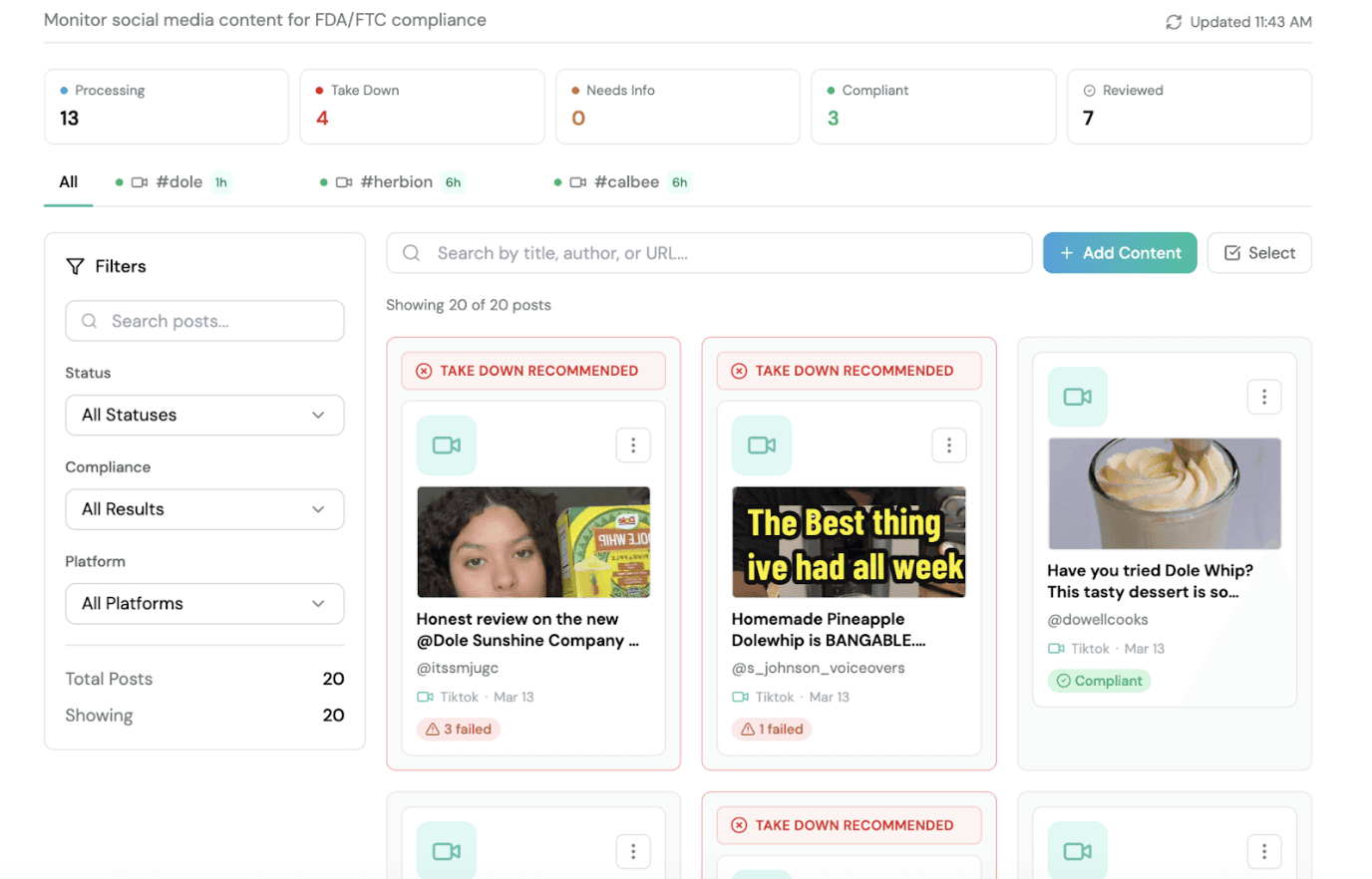
Digital channels are practically unmonitored. FDA warning letters in 2024 and 2025 cited product websites, Amazon storefronts, social media posts, and influencer content as frequently as physical label text. Most brands cannot afford to have a regulatory attorney monitor every piece of marketing content they publish. The result is that the channels where FDA is most actively looking are the ones with the least compliance oversight.
Review is episodic, not continuous. A label reviewed at launch isn't automatically re-reviewed when marketing copy changes, when a new claim is added to the website, or when an influencer posts content using language the brand didn't approve. Manual review happens on a schedule. Compliance risk doesn't.
Consistency across reviewers varies. Two regulatory consultants reviewing the same label will sometimes reach different conclusions on borderline claims. Manual review is only as consistent as the reviewers conducting it, and turnover in regulatory affairs teams means the institutional knowledge about what was reviewed and approved is often poorly documented.
Volume doesn't scale linearly. A brand with 10 SKUs, a website with 50 product pages, an Amazon storefront, and an active influencer program has hundreds of individual claims surfaces to review. The cost of covering all of them manually is not proportional to the value of the brand — it's prohibitive at any stage below enterprise.
What Truli Does Differently
Truli is not a replacement for a regulatory attorney. It's a tool that handles the high-volume, repeatable analysis that makes systematic compliance coverage tractable — and that surfaces the specific items requiring human judgment so that attorney time is spent on decisions, not on reading through marketing copy looking for potential issues.
Speed. A Truli scan of a label image, the associated website copy, and an Amazon listing runs in minutes. The same review conducted manually takes hours. For a brand doing a periodic compliance audit across a 15-SKU portfolio and its full digital footprint, the time difference is measured in days versus hours.
Coverage. Truli applies the same regulatory analysis to the physical label, the website, the Amazon listing, and marketing materials in a single workflow. The analysis is consistent across all channels and all SKUs because it's running the same regulatory framework against all of them — not depending on a reviewer's memory of what the FDA's structure/function claim criteria says.
Continuous monitoring. Truli can be run whenever marketing copy changes — not just at launch and at annual audits. A new landing page, a revised Amazon listing, a product description update can be reviewed against FDA and FTC requirements before it goes live.
Regulatory grounding at review time. Truli retrieves current regulation text when running a review rather than querying a static ruleset. When the Daily Value reference amounts update, when a new health claim is authorized, when FDA issues guidance on a category — the analysis reflects the current rule, not the rule as it existed when the software was last updated.
The Right Model — Human-in-the-Loop
The brands that handle compliance most effectively don't choose between manual review and AI — they use each for what it's best at.
AI compliance review handles:
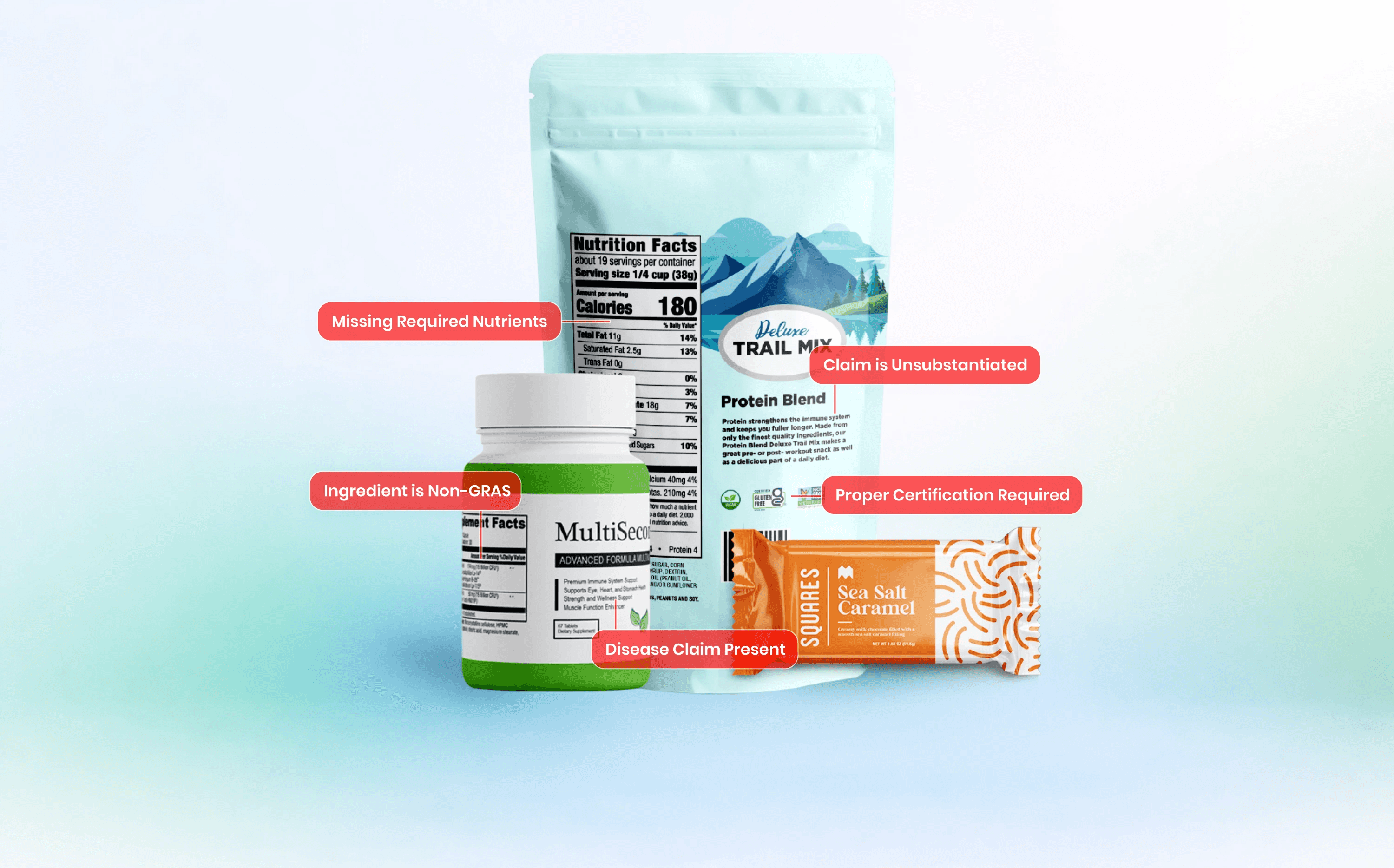
Initial scan of all label copy and digital channels to identify potential issues
Flagging disease claim language, missing disclaimers, incomplete allergen declarations, and format violations
Continuous monitoring of digital channels as marketing content changes
Prioritizing the items that require human judgment so attorney time is focused on decisions, not discovery
Human review handles:
Resolving borderline claims where context and judgment determine the outcome
Novel ingredient and NDI assessment
FDA warning letter response and regulatory correspondence
Interpreting new enforcement guidance before it's built into automated systems
Final sign-off on high-stakes label decisions
This model costs less than full manual review because AI handles the discovery work that currently consumes most attorney time. It's more thorough than manual review alone because AI can monitor channels and volume that no individual reviewer can cover. And it's more defensible than AI alone because borderline decisions get human judgment rather than automated resolution.
Cost Comparison
For a mid-size supplement brand with 10 SKUs, an active website, an Amazon storefront, and an influencer program:
Manual review only:
Initial label review at launch: $700–$2,400 per SKU × 10 = $7,000–$24,000
Annual re-review: similar cost
Digital channel coverage: practically $0 (not done systematically)
Total annual cost: $7,000–$24,000 for physical labels only
Truli + targeted manual review:
Truli scans all 10 labels, full website, Amazon listings, ongoing: fraction of manual cost per SKU
Attorney time focused on borderline claims flagged by Truli, NDI assessments, novel guidance interpretation: 5–10 hours per year vs. 70–240 hours
Total annual cost: substantially lower, with better coverage
The ROI case is clearest when measured against what the alternative costs when compliance fails. An FDA warning letter requires a 15-business-day response, immediate corrective action across all channels, and typically generates follow-up inspection activity. A product recall averages over $10 million in direct costs. Either outcome makes the cost of a compliance program that actually covers the full risk surface look small.
What Truli adds to your existing compliance workflow
If your brand is currently using periodic manual review for physical labels and not systematically covering digital channels, Truli fills the gap — running the claims analysis, required element verification, allergen review, and digital channel scan that manual review doesn't cover at scale. Attorney time stays focused on the decisions that require it. Book a demo to see what a full-surface compliance scan surfaces for your specific product categories.
A note from Truli: Truli is not a law firm, and this article does not constitute or contain legal advice or create an attorney-client relationship. When determining your obligations and compliance with respect to relevant laws and regulations, you should consult a licensed attorney.
About

Truli is an AI compliance platform for food, beverage, and supplement brands. Automate FDA/FTC label reviews, claims validation, and post-market monitoring — 10x faster.

Platform
See Truli in action
If regulatory delays are consuming months and thousands in fees, see how Truli delivers fast and continuous compliance coverage at a fraction of the cost.
Book a demo