Truli vs GlobalVision — CPG Label Compliance Compared
CPG brands comparing Truli and GlobalVision are usually asking the wrong question. The two tools don't compete — they operate at different stages of the label process and solve different problems. Understanding the difference matters, because using only one of them leaves a compliance gap that the other doesn't fill.

Michael Wu
| Co-founder at Truli

The confusion is understandable. Both tools involve reviewing labels. Both use AI. Both claim to catch label errors before they cause problems. But the errors each tool is designed to catch are fundamentally different, the regulatory risk each one addresses is different, and the workflow each one fits into is different.
Here's a direct comparison of what each tool does, where each one belongs in a CPG compliance workflow, and when a brand needs both.
What GlobalVision Does
GlobalVision is a print and packaging quality assurance platform. Its core function is comparing two versions of a document — a reference file and a sample file — and flagging every discrepancy between them.
Specific capabilities in Verify CheckAI and related GlobalVision products:
Text compare — OCR-based character-level comparison of text between artwork versions
Graphics compare — pixel-level comparison of images, logos, and design elements
Barcode and QR verification — validation that barcodes are readable, correctly encoded, and match the reference
Color inspection — comparison of color values between proof and production print
Braille inspection — verification of Braille cell accuracy
Spell check — automated spell checking against a dictionary
These are pre-press and production quality control functions. The use case is: a label was approved at version 4, a designer made a change to version 5, and the brand needs to catch every difference before 100,000 units go to print.
GlobalVision answers one question: does this label match the approved version?
What Truli Does
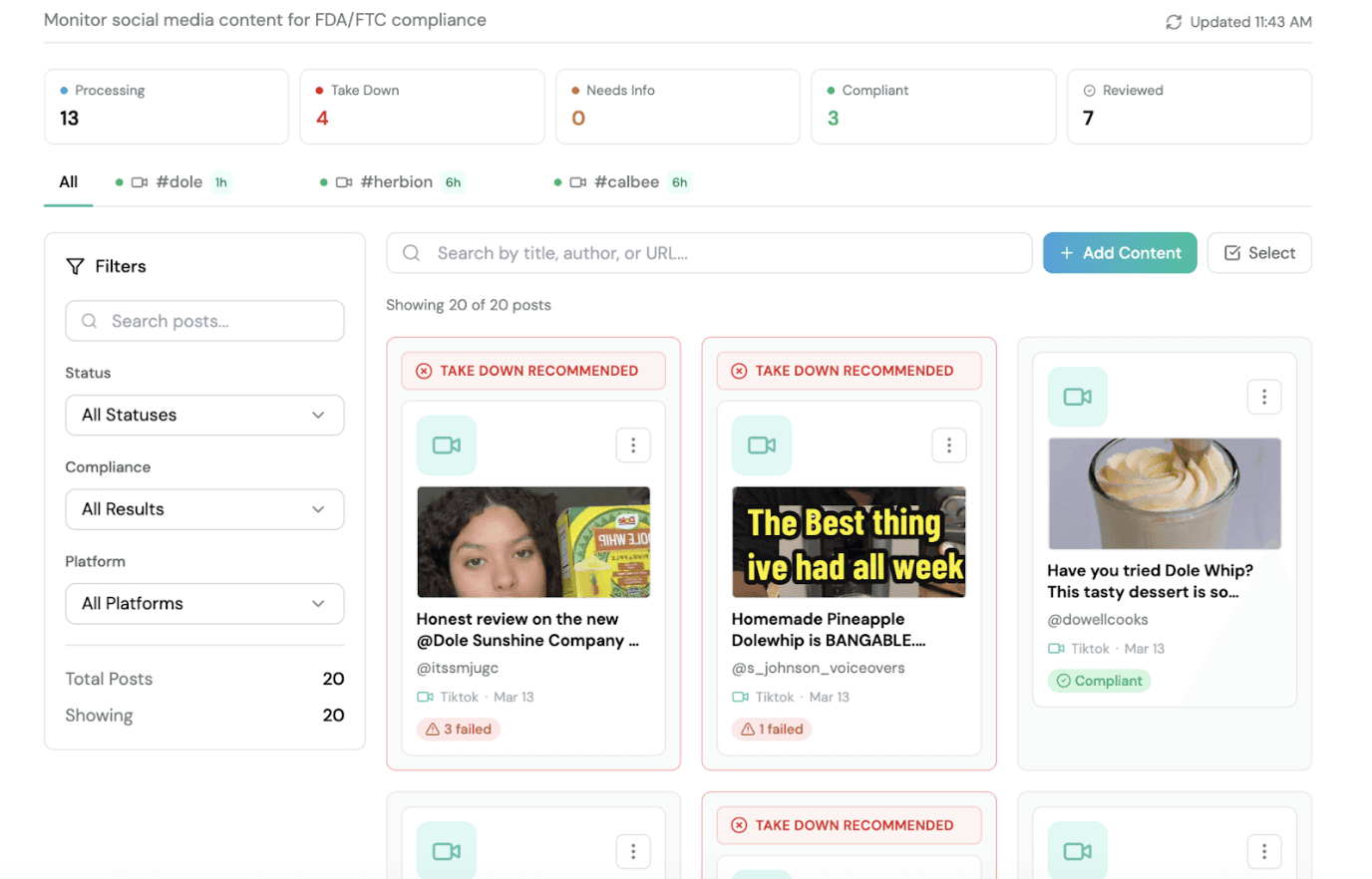
Truli is a regulatory compliance analysis platform. Its core function is evaluating whether label and marketing copy is legally permissible under FDA and FTC requirements — regardless of whether it matches an approved version.
Specific capabilities:
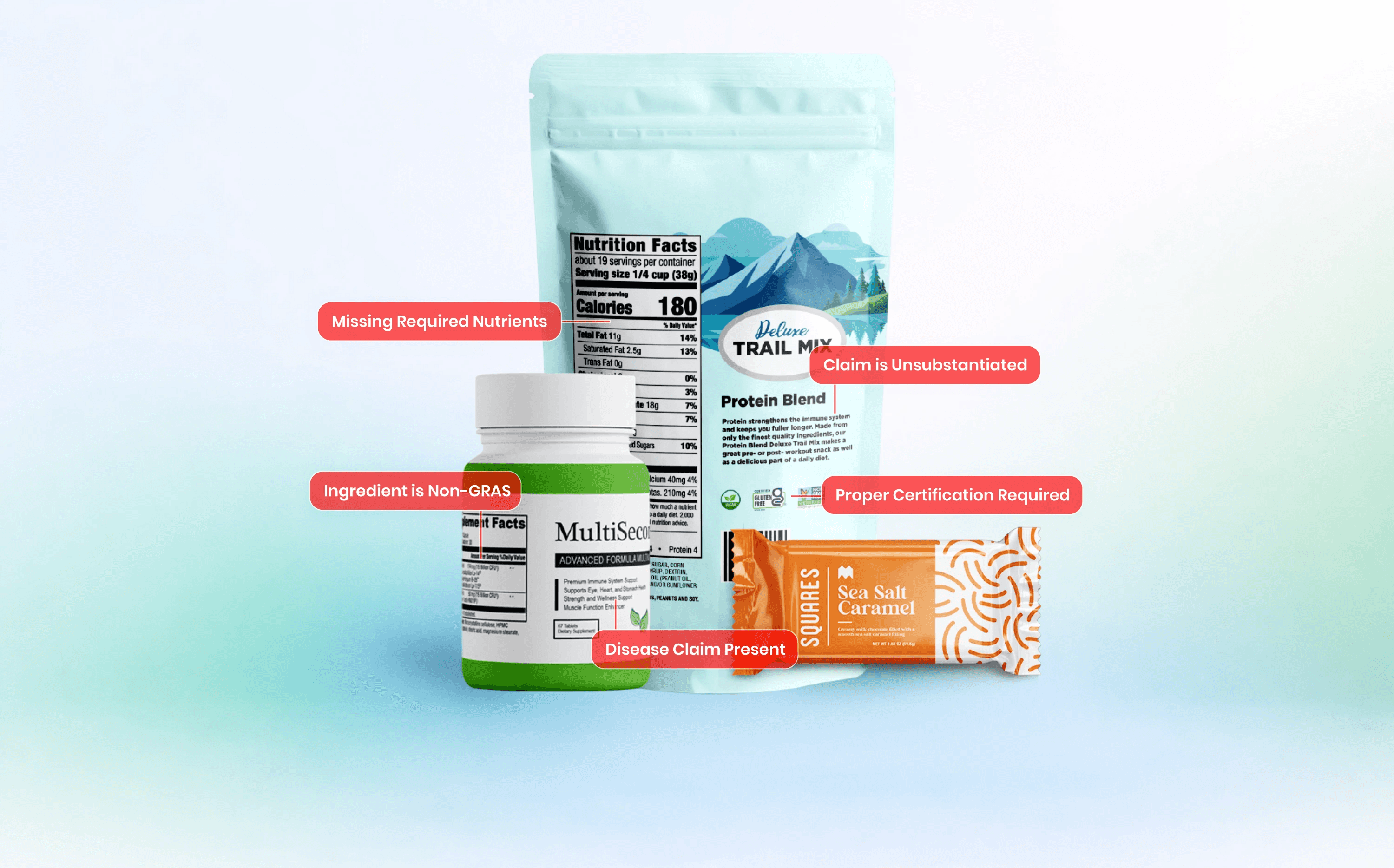
Claims compliance analysis — evaluating every health, function, and benefit claim against the regulatory framework governing it (structure/function claims, nutrient content claims, authorized health claims)
Disease claim detection — identifying explicit and implied disease claims in supplement and food label copy that would constitute misbranding under 21 CFR Part 101
Required element verification — checking for the presence, placement, and format of mandatory label elements under 21 CFR Part 101
FDA disclaimer verification — confirming the required structure/function claim disclaimer is present, bold, correctly placed, and present across all labeling
Allergen detection — scanning ingredient lists against the nine declared allergens, including sesame under the FASTER Act
Digital channel coverage — applying the same regulatory analysis to website copy, Amazon listings, and marketing materials
Truli answers a different question: does this label comply with FDA and FTC requirements?
The Critical Difference — Regulatory Compliance vs. File Accuracy
Consider a supplement label that reads: "Clinically proven to reduce joint pain and inflammation."
GlobalVision would pass this label perfectly — if the text matches the approved artwork file exactly, there's nothing to flag. From a print quality perspective, the label is correct.
Truli would flag this immediately. "Reduces joint pain" is a disease claim — pain reduction implies treatment of a disease or condition. "Inflammation" is frequently a disease claim marker. "Clinically proven" implies drug-level substantiation. The label, as approved, is misbranded under 21 U.S.C. 331. A warning letter would cite this language regardless of how accurately it was printed.
This is the gap that GlobalVision cannot address: it has no visibility into whether the approved version is itself compliant. The compliance error was made when the label was written and approved — not when it was printed. GlobalVision operates downstream of that decision.
Where Each Tool Fits in the Workflow
For a CPG brand's label development process, compliance review and print verification are sequential steps, not interchangeable ones:
Step 1 — Regulatory compliance review (Truli): Before artwork is finalized, every claim is evaluated against FDA and FTC requirements. Disease claim language is flagged and remediated. Required elements are verified. Allergen declarations are confirmed. Digital channel copy is reviewed simultaneously. This step happens before the label goes to a designer.
Step 2 — Artwork development and approval: The label is designed based on the compliant copy. Claims and required elements appear as reviewed.
Step 3 — Print file verification (GlobalVision): The production file is compared against the approved artwork to catch transcription errors, print defects, barcode issues, and color shifts before the print run.
A brand that uses only GlobalVision is doing step 3 without step 1. The production file is accurate — but what it accurately reproduces may be a non-compliant label.
A brand that uses only Truli has compliant label copy but no systematic check that the production file matches what was reviewed and approved. That's a different gap — less likely to generate an FDA warning letter, but potentially costly in reprints and production errors.
Head-to-Head Comparison
Capability | Truli | GlobalVision |
|---|---|---|
Claims compliance analysis | ✓ | ✗ |
Disease claim detection | ✓ | ✗ |
FDA required element verification | ✓ | ✗ |
Allergen declaration review | ✓ | ✗ |
FTC compliance coverage | ✓ | ✗ |
Website and digital channel review | ✓ | ✗ |
Artwork file text comparison | ✗ | ✓ |
Graphics pixel comparison | ✗ | ✓ |
Barcode and QR verification | ✗ | ✓ |
Color inspection | ✗ | ✓ |
Braille verification | ✗ | ✓ |
Pre-press print QA | ✗ | ✓ |
Who Needs Both
Brands with high SKU volume or complex packaging workflows benefit from both tools serving their distinct functions. A brand managing 30 SKUs across multiple package formats and regional variants has real pre-press risk — a wrong barcode on a production run of 50,000 units is an expensive mistake. GlobalVision catches that. The same brand has real regulatory risk from claims language across its labels, website, and Amazon storefront. Truli catches that.
For smaller brands with simpler packaging workflows, the tradeoff is different. A single-SKU brand with straightforward packaging and an in-house designer may find that careful manual review of the print file is sufficient for pre-press QA, while Truli's regulatory claims review addresses the higher-risk compliance exposure.
The decision isn't which tool to use — it's recognizing that they address different risks at different points in the process.
What GlobalVision Users Are Missing
CPG brands that currently use GlobalVision as their primary label "compliance" tool have likely reviewed their production files carefully. What they haven't reviewed is whether the claims on those files are legally permissible.
The FDA warning letters from 2024 and 2025 don't cite print defects. They cite disease claims on supplement labels, missing FDA disclaimers, unauthorized health claims on food products, and claims that appear on brand websites or Amazon listings that exceed what the label supports. None of those violations are visible to a print comparison tool.
If your brand uses GlobalVision and hasn't separately conducted a claims compliance review against FDA's regulatory framework — for the physical label and for your digital marketing channels — that review is the compliance gap that's most likely to generate enforcement action.
Start with the compliance review
Truli's label compliance scanning addresses the regulatory risk that print verification tools can't see — claims analysis, disease claim detection, required element verification, and digital channel coverage. If you're currently relying on GlobalVision for "compliance" and haven't separately reviewed your label claims against FDA requirements, book a demo to see what the regulatory review surfaces.
A note from Truli: Truli is not a law firm, and this article does not constitute or contain legal advice or create an attorney-client relationship. When determining your obligations and compliance with respect to relevant laws and regulations, you should consult a licensed attorney.
About

Truli is an AI compliance platform for food, beverage, and supplement brands. Automate FDA/FTC label reviews, claims validation, and post-market monitoring — 10x faster.

Platform
See Truli in action
If regulatory delays are consuming months and thousands in fees, see how Truli delivers fast and continuous compliance coverage at a fraction of the cost.
Book a demo