Truli vs FoodChain ID — Regulation Database vs AI Review
FoodChain ID and Truli both get filed under 'label compliance,' but they automate different steps of the job. FoodChain ID tells your regulatory team what the rules are — across 220+ countries. Truli reads your actual label and marketing and tells you where they break FDA and FTC rules.

Michael Wu
| Co-founder at Truli

Every compliance workflow has two steps: knowing the rules, and applying the rules to your product. FoodChain ID built its business on the first step — its gComply regulatory library is one of the most comprehensive collections of food regulations in the world. Truli automates the second step for FDA and FTC compliance: AI agents read your label, packaging, and marketing content and flag specific violations with the regulation cited.
Which one your team needs depends on where your bottleneck is — and for global manufacturers versus US-focused brands, the answer is usually different.
What FoodChain ID Does
FoodChain ID is a food safety, quality, and regulatory company serving over 30,000 customers globally, spanning testing, certification (it's a major Non-GMO Project verifier), and regulatory intelligence. On the compliance software side, the core products are:
gComply / gComply Plus — a regulatory library covering food regulations across more than 220 countries and 27+ economic communities: additives, contaminants, standards of identity, labeling requirements, food contact, supplements
Regulatory assessment tools — automated screening of ingredient lists and bills of materials against multiple target markets in a single search
Expert services — regulatory consultants who answer market-entry and formulation questions
The value is breadth and authority. If you're shipping one formulation into the US, Canada, the EU, and Japan, FoodChain ID answers "is this additive permitted in each market, and what must the label declare" from maintained, current regulatory content — a research task that would otherwise take a regulatory team days per market.
What Truli Does
Truli is an AI-native compliance platform focused on US FDA and FTC enforcement risk. Instead of giving your team a library to research, it reviews the artifacts themselves:
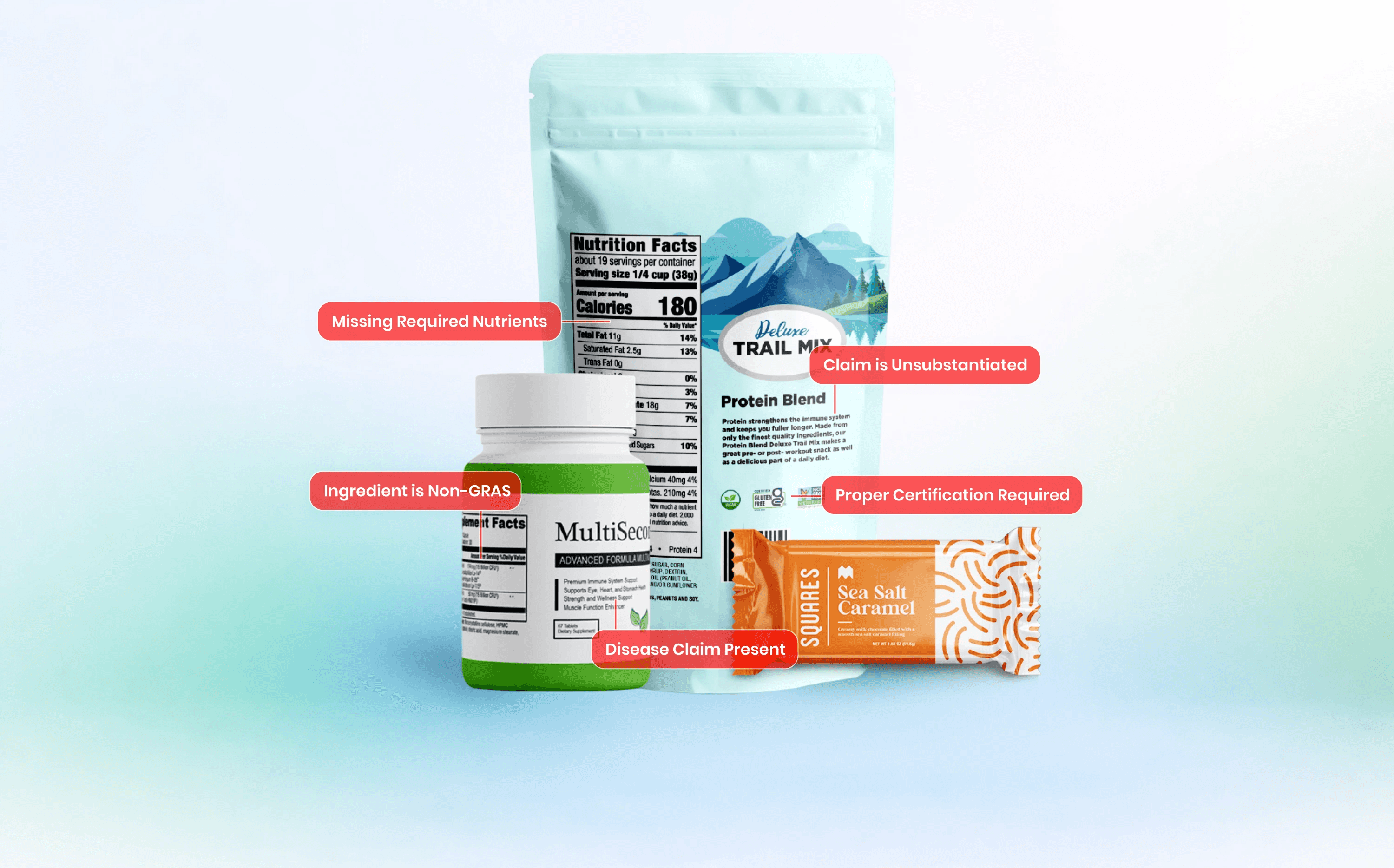
Label audits — a scanned label is checked for required elements under 21 CFR Part 101, panel format and rounding, allergen declarations, and prohibited or unsubstantiated claims
Claims analysis — every claim evaluated against the structure/function, health claim, and nutrient content claim frameworks, with implied disease claims flagged and compliant rewrites suggested
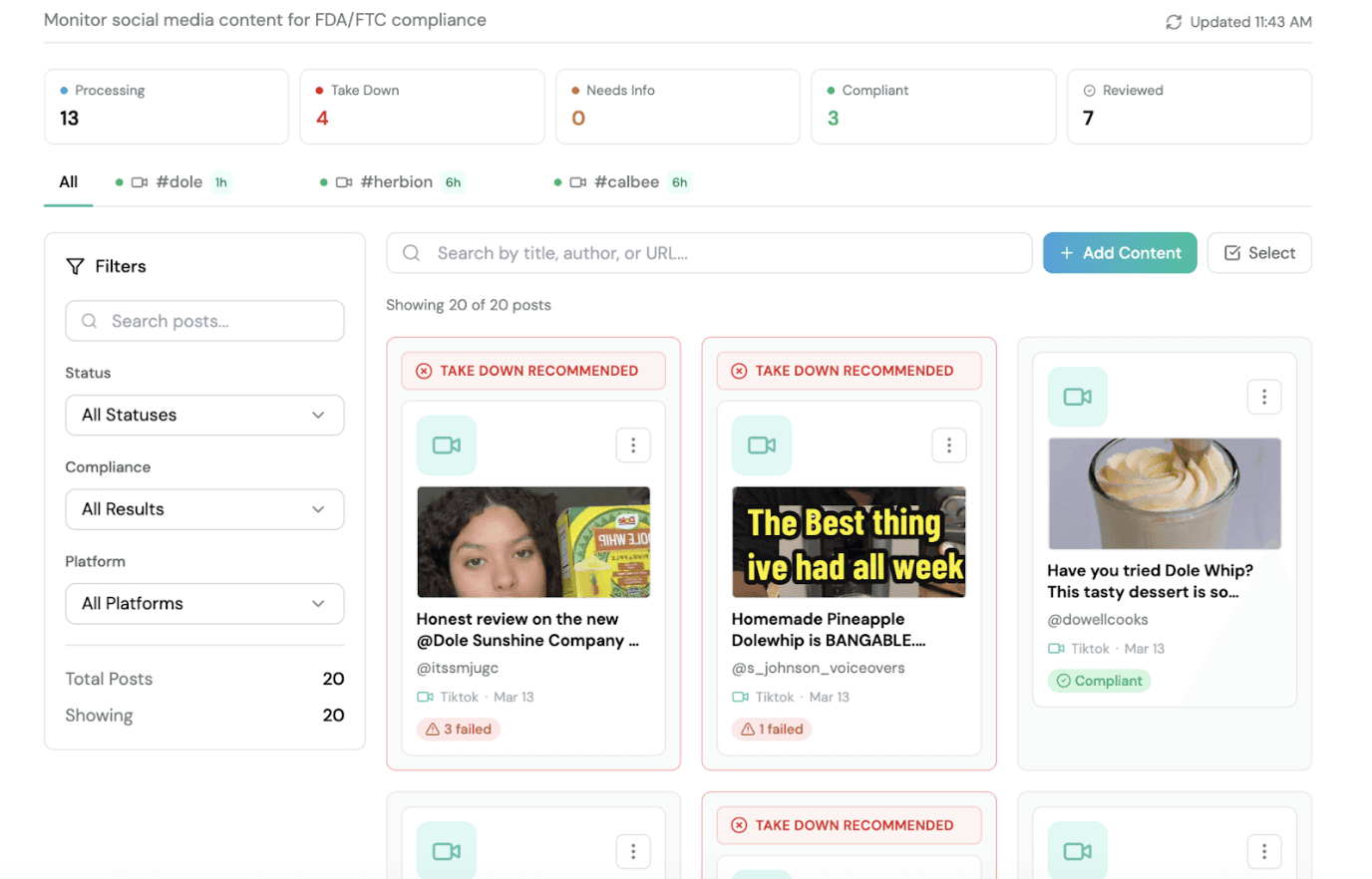
Marketing surface coverage — websites, Amazon listings, ads, and TikTok/Instagram content run through the same regulatory analysis, continuously
Regulatory grounding — agents retrieve current regulation text at review time, so findings cite the actual rule, not a summary
The output isn't research material — it's a prioritized findings list for a specific label or campaign: what's wrong, which regulation it violates, and what to say instead.
The Core Distinction
FoodChain ID answers "what does the regulation say?" — globally, authoritatively, for your regulatory team to apply.
Truli answers "does my label and marketing comply?" — automatically, for FDA and FTC, with findings your whole team can act on.
That difference shapes who uses each product. gComply assumes a trained regulatory professional is doing the applying: it hands them rule text and market comparisons, and their judgment does the rest. Truli automates the applying: the founder, brand manager, or marketer uploads a label or connects a channel, and the analysis runs without a regulatory specialist in the loop — which is the whole point for SMB brands that don't have one.
It also shapes coverage. FoodChain ID is far broader geographically. Truli is far deeper on the US enforcement surface — including the marketing and social channels where FDA warning letters and FTC actions actually originate, which no regulation library reviews.
Head-to-Head Comparison
Capability | Truli | FoodChain ID |
|---|---|---|
Global regulation library (220+ countries) | ✗ | ✓ |
Multi-market ingredient/BOM screening | ✗ | ✓ |
Automated label review (image in, findings out) | ✓ | ✗ |
Claims compliance and disease claim detection | ✓ | ✗ |
FTC substantiation and endorsement coverage | ✓ | ✗ |
Website, Amazon, and ad review | ✓ | ✗ |
Social/influencer monitoring | ✓ | ✗ |
Usable without in-house regulatory staff | ✓ | ✗ |
Certification and testing services | ✗ | ✓ |
Which One Fits Your Team
FoodChain ID is the better fit if you're a manufacturer exporting into many markets, you have a regulatory team doing multi-country research, and your hardest problem is keeping up with 100,000+ regulations that change constantly across jurisdictions.
Truli is the better fit if your revenue is concentrated in the US, your enforcement exposure is FDA and FTC, and your bottleneck isn't finding rule text — it's that nobody has time to review every label revision, listing update, and creator post against the rules. That's a volume problem, and it's what AI review automates.
Both show up together in larger organizations: the regulatory team uses a global library for market-entry research while Truli continuously audits the US label and marketing surface that the library can't see.
See the difference on your own label
Reading regulations and catching violations are different jobs. Upload a label to Truli and get back the findings — regulation cited, severity ranked, fix suggested — in minutes. Book a demo to try it on your products.
A note from Truli: Truli is not a law firm, and this article does not constitute or contain legal advice or create an attorney-client relationship. When determining your obligations and compliance with respect to relevant laws and regulations, you should consult a licensed attorney.
About

Truli is an AI compliance platform for food, beverage, and supplement brands. Automate FDA/FTC label reviews, claims validation, and post-market monitoring — 10x faster.

Platform
See Truli in action
If regulatory delays are consuming months and thousands in fees, see how Truli delivers fast and continuous compliance coverage at a fraction of the cost.
Book a demo