TraceGains Alternatives for CPG Compliance Teams in 2026
TraceGains is the dominant platform for supplier and ingredient data management in food and CPG. But teams searching for TraceGains alternatives are often discovering a mismatch: supplier document compliance and finished-label compliance are different problems, and buying one doesn't solve the other.

Michael Wu
| Co-founder at Truli

TraceGains built its position on a specific problem: collecting, organizing, and monitoring supplier and ingredient documentation across a CPG supply chain. Specification sheets, certificates of analysis, allergen statements, audit documents — TraceGains automates the collection and review of the paperwork that quality and procurement teams used to chase over email.
That's genuinely valuable, and for supplier compliance it remains the benchmark. But "compliance" covers a lot of territory. When regulatory teams evaluate TraceGains alternatives, it's usually for one of two reasons: the platform is heavier and more expensive than their supplier-data problem justifies, or the compliance risk they actually need to manage — the finished label, the claims, the marketing — isn't what TraceGains does.
Here's how the landscape breaks down.
What TraceGains Actually Covers
TraceGains is a networked product development and supplier compliance platform. Its core functions:
Supplier document management — automated collection and review of supplier documentation, with expiration tracking and gap flagging
Ingredient and specification data — centralized, searchable ingredient specs mapped to suppliers, with a networked marketplace (TraceGains Gather) connecting buyers and ingredient sellers
Formula and specification workflows — digital formulas built on ingredient data, with versioning and collaboration for R&D teams
Regulatory monitoring — horizon-scanning for global regulatory changes affecting ingredients and supply chains
The common thread: TraceGains manages inputs — the ingredients, suppliers, and documents that go into a product. It is not a tool for auditing the output: the finished label and the claims a brand makes about the product.
The Gap — Input Compliance vs. Output Compliance
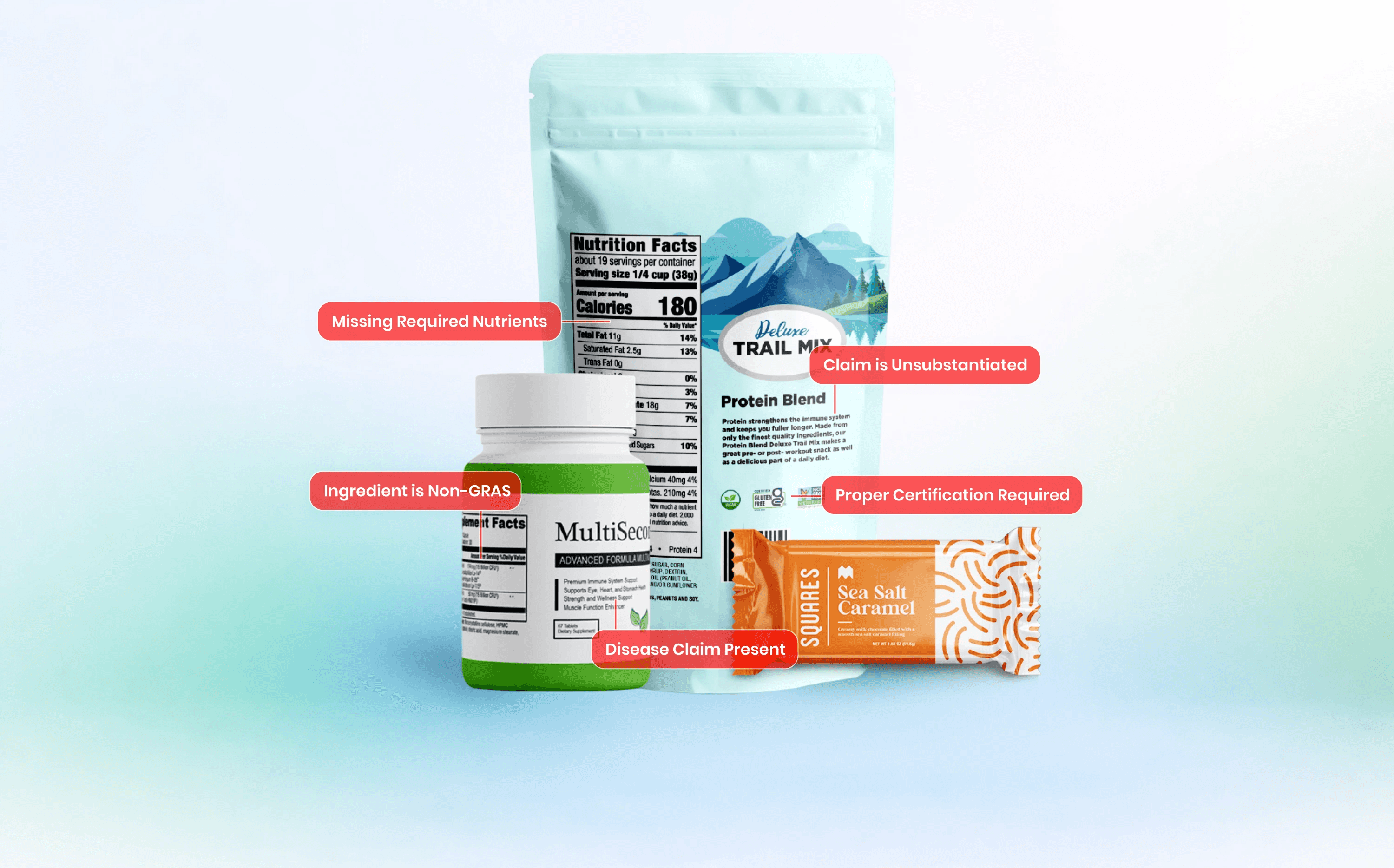
An FDA warning letter rarely cites a missing supplier document. It cites what's on the label and the website: a structure/function claim that crosses into disease territory, a missing allergen declaration, an absent 21 CFR 101.93 disclaimer, a "clinically proven" claim with no substantiation behind it.
A brand can have flawless supplier documentation in TraceGains and still ship a label that draws enforcement. The ingredient specs can be perfect while the marketing team publishes an Amazon listing claiming the product "fights inflammation" — a claim no supplier document addresses. Input compliance and output compliance are managed by different teams, reviewed at different stages, and enforced by different mechanisms.
If output compliance is the gap, these are the platforms to evaluate.
1. Truli — Best for Label and Marketing Claims Compliance
Truli is an AI-native platform that audits finished labels, packaging, and marketing content against FDA and FTC requirements. Specialized AI agents review each label in parallel — required elements under 21 CFR Part 101, claims against the structure/function, health claim, and nutrient content claim frameworks, allergen declarations against the nine declared allergens, and panel format and rounding rules. Every finding cites the specific regulation and includes a suggested fix.
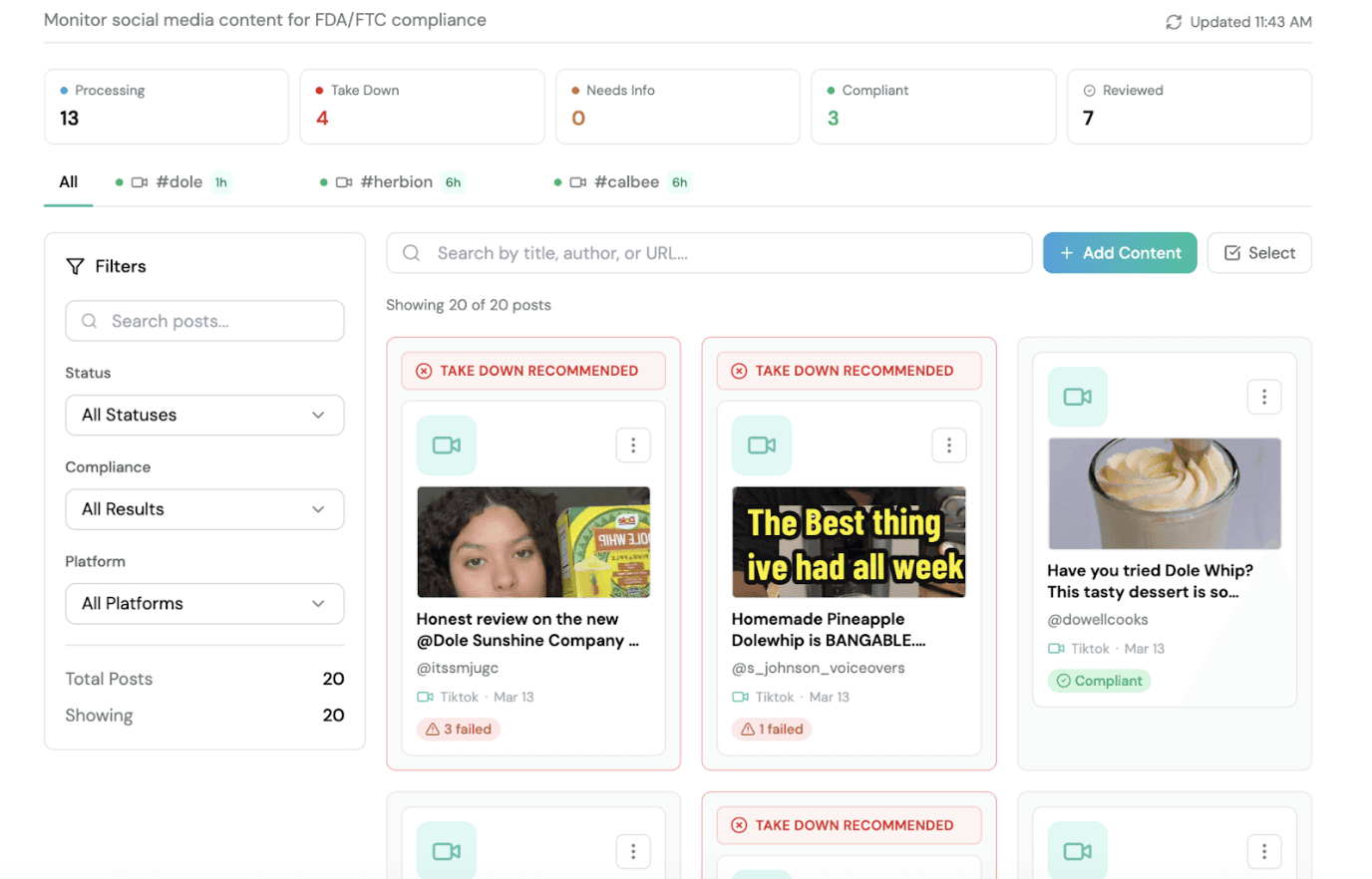
The coverage extends past packaging: Truli runs the same regulatory analysis on website copy, Amazon listings, ad campaigns, and TikTok and Instagram content from brand and creator accounts. For teams whose enforcement exposure lives in what marketing publishes — which is where FDA and FTC are actively looking — that channel coverage is the differentiator.
Best for: Food and supplement brands that need continuous compliance review of labels and marketing output, complementing (not replacing) supplier data management.
2. Trustwell — Best for Nutrition Analysis Plus Supply Chain
Trustwell — formed by the 2022 merger of ESHA Research and FoodLogiQ — is the closest like-for-like TraceGains alternative because it spans both sides: Genesis handles formulation-based nutrition analysis and FDA-format label generation, while the FoodLogiQ side covers supplier compliance, traceability, and recall management.
For a food manufacturer whose priorities are accurate Nutrition Facts data and supply chain visibility in one vendor, Trustwell is the natural head-to-head evaluation against TraceGains. Like TraceGains, it does not evaluate claim language for regulatory permissibility.
Best for: Food manufacturers who want nutrition analysis, label generation, and supplier traceability from a single vendor.
3. FoodChain ID — Best for Global Regulatory Intelligence
FoodChain ID's gComply library covers labeling and ingredient regulations across more than 220 countries, and its compliance tools can assess bills of materials against multiple markets at once. Where TraceGains monitors regulatory change as part of its supplier platform, FoodChain ID makes regulatory intelligence the product.
Best for: Global manufacturers whose core need is authoritative country-by-country regulatory research and ingredient compliance assessment.
4. Trace One Devex — Best Full PLM Consolidation
For enterprises that want formulation, specifications, supplier data, and compliance documentation in one product lifecycle management system, Trace One's Devex platform (acquired with Selerant in 2022) competes for the same budget as TraceGains — as a deeper, heavier PLM implementation spanning food, beverage, and cosmetics.
Best for: Enterprise process manufacturers making a system-of-record PLM decision rather than buying a point solution.
Comparison Summary
Tool | Supplier/ingredient data | Formulation management | Label generation | Claims compliance review | Marketing channel coverage |
|---|---|---|---|---|---|
TraceGains | ✓ | ✓ | ✗ | ✗ | ✗ |
Truli | ✗ | ✗ | ✗ | ✓ | ✓ |
Trustwell | ✓ | ✓ | ✓ | ✗ | ✗ |
FoodChain ID | Partial | ✗ | ✗ | Research only | ✗ |
Trace One Devex | ✓ | ✓ | ✓ | Partial (workflow) | ✗ |
How to Decide
Start with which compliance failure would actually hurt you. If a supplier document lapse or an ingredient spec mismatch is the nightmare scenario, you're in TraceGains/Trustwell/Trace One territory — pick by portfolio size and how much PLM you want. If the nightmare is an FDA warning letter over a claim, a recall over an undeclared allergen, or a retailer delisting over marketing copy, no supplier-data platform prevents that. That's a label and claims review problem.
Many mid-size and enterprise teams end up pairing tools: a supplier-data platform managing inputs, and Truli auditing outputs — every label, listing, and post — before an enforcement reviewer sees them.
Audit the output side of your compliance stack
If your supplier documentation is under control but nobody is systematically reviewing labels, listings, and creator content against FDA and FTC rules, that's the exposed flank. Book a demo to see what Truli flags across your products and channels.
A note from Truli: Truli is not a law firm, and this article does not constitute or contain legal advice or create an attorney-client relationship. When determining your obligations and compliance with respect to relevant laws and regulations, you should consult a licensed attorney.
About

Truli is an AI compliance platform for food, beverage, and supplement brands. Automate FDA/FTC label reviews, claims validation, and post-market monitoring — 10x faster.

Platform
See Truli in action
If regulatory delays are consuming months and thousands in fees, see how Truli delivers fast and continuous compliance coverage at a fraction of the cost.
Book a demo