Sustainable CPG Packaging Claims — FTC Compliance Guide
Sustainability claims have become standard in CPG marketing — 'compostable packaging,' 'made with recycled materials,' 'carbon neutral.' They've also become one of the most actively litigated areas of consumer product law. The FTC's Green Guides set specific substantiation requirements for environmental claims, and most brands using sustainability language haven't read them.

Catherine Zhou
| Co-founder at Truli

The practical problem isn't that brands intend to mislead consumers about their packaging. It's that the marketing instinct to communicate environmental benefit outpaces the regulatory framework governing what can be claimed and how. "Eco-friendly" printed on a package isn't a regulated claim — it's a general environmental benefit assertion that the FTC considers presumptively deceptive without qualification. That gap between marketing intuition and regulatory reality is where class actions are filed.
What the FTC Green Guides Actually Say
The FTC's environmental marketing guidelines under 16 CFR Part 260 — the Green Guides — establish substantiation requirements for environmental claims in advertising, labeling, and all other marketing. They apply to every channel: the package itself, the brand's website, Amazon listing, social media, influencer content.
The Green Guides don't create legal obligations directly — they're guidance, not regulations. But the FTC uses them as the standard for evaluating whether a claim is deceptive under Section 5 of the FTC Act. A claim that violates the Green Guides is presumptively deceptive, and the FTC has pursued enforcement actions and civil investigative demands against brands on this basis.
The core principle running through the Green Guides is specificity: general environmental benefit claims are deceptive unless the specific benefit is identified and substantiated. "Eco-friendly" without qualification, "green," "sustainable," "planet-friendly," "environmentally responsible" — all of these, standing alone, imply a broad environmental benefit the brand cannot substantiate. The Green Guides require that such claims be qualified to identify the specific environmental attribute being communicated.
Specific Claim Categories and Their Requirements
Compostable
A product or package may be called "compostable" only if all materials can be composted in a safe and timely manner in a home compost pile or municipal/industrial facility. If the claim is true only for industrial composting facilities (which accept materials that home composting cannot break down), the label must clearly state that — "compostable in industrial facilities" — and note that industrial composting is not available everywhere.
The distinction matters practically. Most certified compostable packaging materials — plant-based PLA plastics, compostable films, certified paper packaging — require industrial composting temperatures to break down within the required timeframe. A package labeled simply "compostable" that only breaks down in industrial facilities violates the Green Guides because it implies home compostability that doesn't exist.
Recyclable
Recyclable claims require that the product or package can be collected, separated, and recovered from the waste stream in significant quantities. The Green Guides use a practical availability threshold: if recycling facilities accepting the material are available to "a substantial majority" of consumers where the product is sold, an unqualified recyclable claim is permissible. If facilities are available only to some consumers, the claim must be qualified — "recyclable where facilities exist."
This threshold creates real compliance exposure for brands using materials that are technically recyclable but not accepted by the majority of municipal recycling programs. Flexible plastic packaging is the most common example. Technically recyclable through specialty collection programs, it's not accepted in most curbside programs. An unqualified "recyclable" claim on flexible plastic packaging is inconsistent with Green Guides guidance.
Biodegradable
Unqualified biodegradable claims require that the entire product or package will completely break down and return to nature within a reasonably short time after disposal in the way consumers typically dispose of it. The Green Guides consider "reasonably short" to mean within one year for solid waste disposed in landfills. Most packaging materials, including many that are technically biodegradable under controlled conditions, do not meet this standard in landfill conditions.
The practical implication: qualified biodegradable claims (specifying conditions and timeframe) are generally safer than unqualified ones. "Biodegradable in home compost within 180 days" with certification backing is defensible. "Biodegradable" on a product that goes to landfill is not.
Recycled Content
Recycled content claims are among the more straightforward Green Guides categories — but still require specificity. "Made with recycled materials" without a percentage may be read to imply the entire product is recycled. The Green Guides require that the specific percentage be disclosed, and that the claim distinguish between pre-consumer recycled content (manufacturing waste diverted back into production) and post-consumer recycled content (material recovered after consumer use). Post-consumer recycled content carries more environmental weight in consumer perception, so conflating the two is deceptive.
General Environmental Benefit Claims
"Eco-friendly," "green," "sustainable," "environmentally responsible" — the Green Guides treat these as inherently deceptive when used without qualification, because no single product or package is environmentally beneficial in all respects. A package may use recycled content but require energy-intensive production. A brand may offset carbon emissions but generate packaging waste. An unqualified general benefit claim implies comprehensive environmental performance that virtually no product delivers.
Qualified alternatives — "made with 30% post-consumer recycled plastic" rather than "eco-friendly packaging" — communicate the actual benefit without the deceptive overreach.
The Greenwashing Litigation Landscape
FTC enforcement is one exposure pathway. Class action litigation is another, and in recent years it has been the faster-moving one.
Plaintiffs' attorneys have filed class actions against brands in packaged food, personal care, and household products for "compostable" claims on packaging that requires industrial composting, "ocean-friendly" claims without certification, "100% recyclable" claims on products with non-recyclable components, and "carbon neutral" claims based on offset programs with disputed methodology.
The litigation theory is straightforward: consumers pay a premium for products they believe are environmentally responsible, the claim is either false or misleading, and that constitutes consumer fraud. The damages model in a class action multiplies the premium across all purchasers in the class period.
Carbon neutral and net-zero claims have attracted particular scrutiny. These claims depend on carbon offset accounting, and offset quality varies significantly. A brand claiming carbon neutrality based on low-quality offsets — Verified Carbon Standard credits that aren't actually additional, or credits from projects with high reversal risk — faces both FTC scrutiny under the Green Guides and class action exposure from plaintiffs who argue the offset claim is misleading.
International Dimensions — EU Green Claims Directive
Brands with distribution into EU markets face an additional regulatory layer: the EU Green Claims Directive, which imposes verification and disclosure requirements that go significantly beyond the FTC Green Guides.
Under the Directive, brands must substantiate explicit environmental claims with a Life Cycle Assessment (LCA) methodology approved by an accredited third-party verifier before making the claim. Claims based solely on carbon offset accounting are prohibited under the Directive. "Carbon neutral" and "net-zero" claims without LCA verification and offset exclusion are non-compliant.
The Directive also prohibits future-oriented sustainability claims ("we aim to be carbon neutral by 2030") that aren't backed by a verified plan with specific interim targets. Marketing copy that is common practice in the US — forward-looking environmental commitments — faces prohibition in EU markets without this verification.
For brands managing global packaging with unified claims, EU compliance now sets the effective floor for what environmental language requires before it can appear on packaging.
Building a Defensible Sustainability Claim Program
A defensible environmental claim program for CPG brands in 2026 requires three components: substantiation before the claim goes on the package, specificity that accurately describes the actual environmental attribute, and channel consistency that applies the same standards to every marketing surface.
Substantiation means the claim is backed by testing, certification, or life cycle analysis before it appears on the label. For compostable claims, TUV Austria, BPI, or Cedar Grove certification. For recyclable claims, How2Recycle verification. For recycled content claims, supplier documentation of post-consumer vs. pre-consumer content percentages. For carbon claims, credible LCA and offset methodology disclosed.
Specificity means replacing general environmental benefit language with the actual claim: "made with 40% post-consumer recycled plastic" instead of "eco-friendly," "compostable in industrial facilities, not in home compost" instead of "compostable."
Channel consistency means the same substantiation standard applies to the package, the website, the Amazon listing, and influencer content. A package with a qualified "recyclable where facilities exist" claim that's promoted on Instagram as "100% recyclable" creates the same deception as if the unqualified claim were on the package itself.
Truli scans sustainability claims against FTC standards
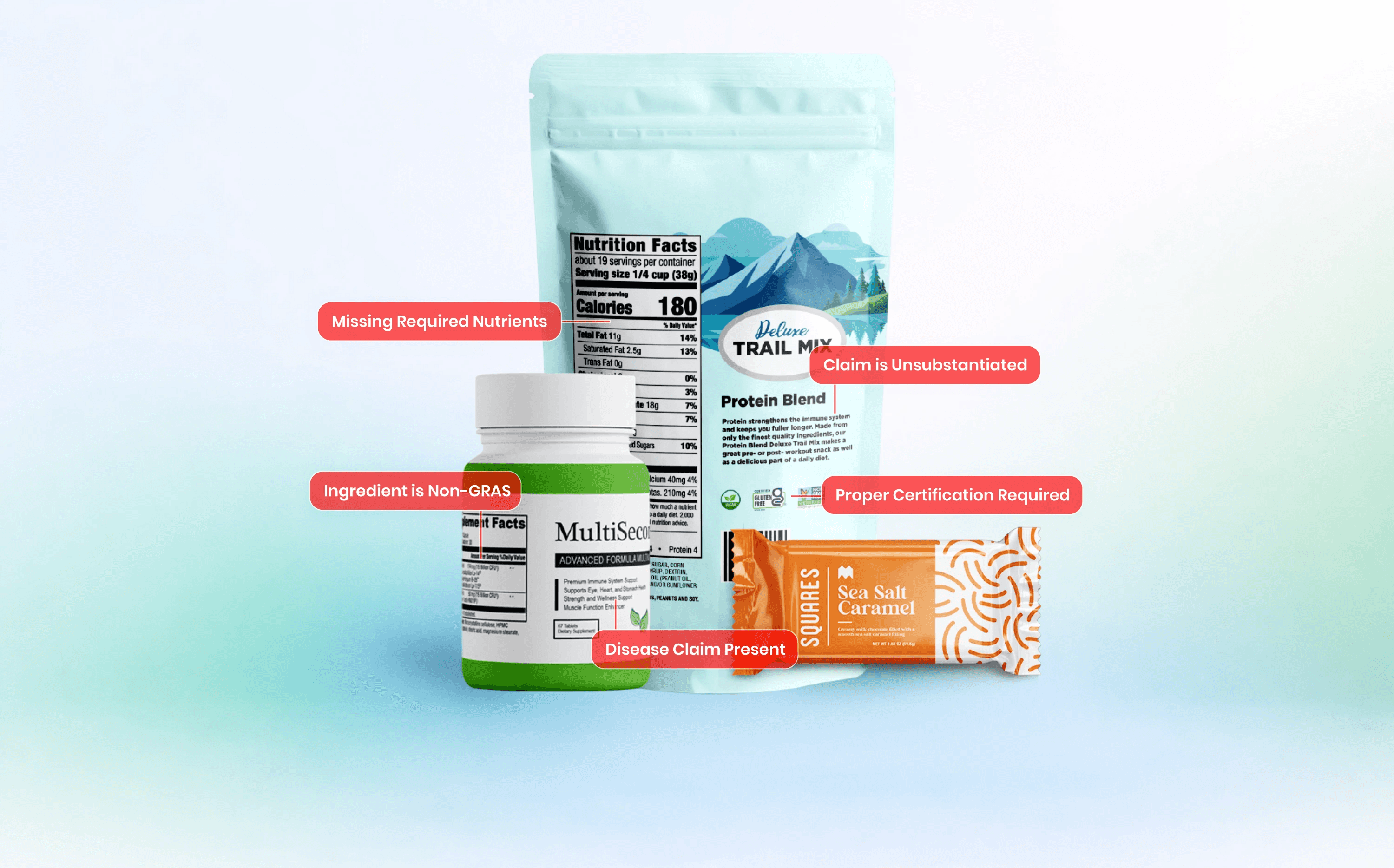
Truli's compliance scanning evaluates environmental and sustainability claims against the FTC Green Guides framework — flagging unqualified general benefit claims, compostable/recyclable language that lacks required qualifiers, and greenwashing language that may constitute a deceptive claim under FTC standards. The same scan applies to physical label copy, website, and marketing channels. If your packaging uses sustainability claims, Truli surfaces the issues before a class action attorney does.
A note from Truli: Truli is not a law firm, and this article does not constitute or contain legal advice or create an attorney-client relationship. When determining your obligations and compliance with respect to relevant laws and regulations, you should consult a licensed attorney.
About

Truli is an AI compliance platform for food, beverage, and supplement brands. Automate FDA/FTC label reviews, claims validation, and post-market monitoring — 10x faster.

Platform
See Truli in action
If regulatory delays are consuming months and thousands in fees, see how Truli delivers fast and continuous compliance coverage at a fraction of the cost.
Book a demo