Structure/Function Claims on Supplement Labels - What You Can and Cannot Say
Structure/function claims are how virtually every supplement brand talks about their products. But the rules governing what you can say, how you have to say it, and what happens if you cross the line are detailed enough that most brands are operating with at least one violation they don't know about.

Catherine Zhou
| Co-founder at Truli

Under 21 CFR 101.93(f), dietary supplement labels may bear statements that "describe the role of a nutrient or dietary ingredient intended to affect the structure or function in humans or that characterize the documented mechanism by which a nutrient or dietary ingredient acts to maintain such structure or function."
That's the legal basis for almost every claim on almost every supplement label. "Supports bone density." "Promotes healthy digestion." "Helps maintain cardiovascular function." These are all structure/function claims — and they're permitted, provided you follow the rules.
What Makes a Claim a Structure/Function Claim
A structure/function claim describes what a nutrient or ingredient does in or for the body — not what it does to a disease. It speaks to normal physiological function, not to the treatment or prevention of a specific health condition.
The key distinction is context and implication. "Supports healthy blood sugar levels" is a structure/function claim. "Helps control diabetes" is a disease claim. "Promotes cardiovascular health" is a structure/function claim. "Reduces the risk of heart attack" is not. The line isn't always obvious from the words alone — under 21 CFR 101.93(g), the FDA considers the context of the labeling as a whole, not just the specific phrase.
What the FDA looks at
The agency evaluates:
The name of the product
The specific words used in the claim
How the claim is presented visually and contextually
Any citations, publications, or references on the label
The combination of all claims taken together
A product named "ArteryClear" with a structure/function claim about cardiovascular support is, in context, making an implied disease claim — even if no individual statement mentions heart disease. Under 21 CFR 101.93(g)(iv)(A), the product name alone can tip a claim into disease territory.
The Three Requirements You Must Meet
Under 21 CFR 101.93(a), making a structure/function claim on a supplement label triggers three mandatory requirements:
1. FDA notification within 30 days
You must notify the FDA's Office of Dietary Supplement Programs no later than 30 days after you first market a supplement bearing a structure/function statement. The notification must include the text of the claim, the name of the ingredient, and a certification that you have substantiation that the claim is truthful and not misleading.
2. The mandatory disclaimer
Under 21 CFR 101.93(c), every structure/function claim must be accompanied by the disclaimer: "This statement has not been evaluated by the Food and Drug Administration. This product is not intended to diagnose, treat, cure, or prevent any disease."
3. Disclaimer placement and formatting
Under 21 CFR 101.93(d) and (e), the disclaimer must appear adjacent to the claim, in boldface type, in a font size no smaller than one-sixteenth of an inch. If the disclaimer isn't adjacent, it must be linked to the claim with a symbol (like an asterisk) and appear in a box. It must appear on every panel or page where a structure/function claim appears.
Why brands get the disclaimer wrong
The most common violations aren't missing disclaimers — they're improperly placed ones. Putting the disclaimer only on the back panel when claims appear on the front panel, using type smaller than 1/16 inch, or including it once when claims appear on multiple pages all constitute misbranding under 21 CFR 101.93(d) and (e). These are easy to miss in the design process and frequently flagged in FDA warning letters.
Substantiation: Your Obligation Before You Make the Claim
Making a structure/function claim comes with an implicit obligation that most brands underestimate: you must have competent and reliable scientific evidence to support the claim before you market the product. This isn't just an FTC requirement — it's built into the 21 CFR 101.93(a)(3) notification certification, which requires the notifying firm to attest that it "has substantiation that the statement is truthful and not misleading."
That means the time to evaluate your evidence is before the label goes to print, not after you get a warning letter.
What substantiation looks like in practice
For most structure/function claims, the FDA expects:
Human clinical studies on the specific ingredient at the dose you're using
Studies conducted in a population relevant to your target consumer
Evidence that reflects the totality of the research, not cherry-picked positive studies
Animal studies and in vitro research can support a claim, but they're generally not sufficient on their own. A single industry-funded trial isn't enough if the broader literature is mixed or absent.
Truli's product scan cross-references your claims against your formulation data to flag claims that may not be substantiated by the ingredients and doses in your product — before you file the notification or print the label.
Common Structure/Function Claims by Category
Permitted (typical structure/function):
"Supports immune function"
"Promotes healthy sleep"
"Helps maintain energy levels"
"Supports muscle recovery"
"Promotes healthy gut flora"
High-risk (implied disease territory):
"Fights infection" — implies treatment of infectious disease
"Reduces inflammation" — inflammation is associated with specific disease states
"Lowers cholesterol" — disease-adjacent, suggests treatment
"Improves memory in people with cognitive decline" — references a disease condition
"Relieves joint pain" — pain relief implies treatment of arthritis or similar
The high-risk examples may still be defensible as structure/function claims in some contexts, but they require careful review of the full label and supporting evidence before use.
Know where your claims stand before your label prints
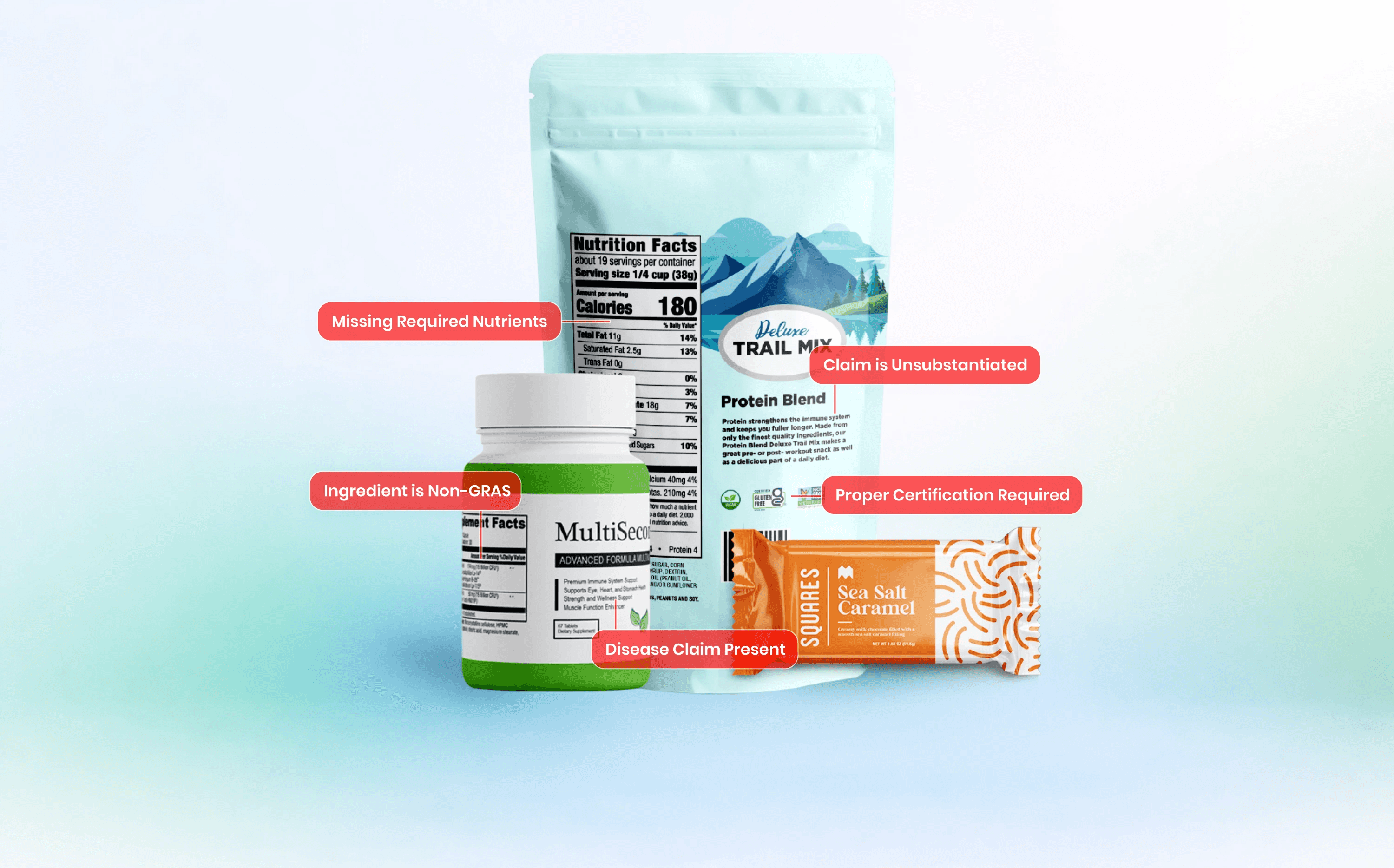
Most structure/function claim violations aren't the result of brands intentionally pushing the line. They happen because someone wrote copy that sounded good, nobody reviewed it against the actual regulation, and the label went to print. Truli scans your label claims against 21 CFR 101.93, matches them to your product formulation, and surfaces issues before they become enforcement actions.
A note from Truli: Truli is not a law firm, and this article does not constitute or contain legal advice or create an attorney-client relationship. When determining your obligations and compliance with respect to relevant laws and regulations, you should consult a licensed attorney.
About

Truli is an AI compliance platform for food, beverage, and supplement brands. Automate FDA/FTC label reviews, claims validation, and post-market monitoring — 10x faster.

Platform
See Truli in action
If regulatory delays are consuming months and thousands in fees, see how Truli delivers fast and continuous compliance coverage at a fraction of the cost.
Book a demo