Peptides in Sports Nutrition — Claims Rules and Athlete Risk
Sports nutrition is racing to put 'peptide' on every label, because athletes are searching for it. But the word covers legal food-derived ingredients and WADA-banned drug compounds, and brands selling to tested athletes carry risk most categories never see. Here's the map.

Michael Wu
| Co-founder at Truli

Sports nutrition has always chased the vocabulary of performance, and right now that vocabulary is "peptides." The problem is that the word spans two completely different lists. One list is boring and legal: collagen peptides, carnosine, whey hydrolysates. The other list is what athletes actually search for: ipamorelin, CJC-1295, BPC-157 — growth hormone secretagogues and recovery compounds that are unapproved drugs and banned in sport at all times.
A sports brand that borrows the second list's energy to sell the first list's ingredients inherits both FTC substantiation risk and a uniquely unforgiving customer: the drug-tested athlete, who faces strict liability for whatever is in your bottle.
The Legal Roster — Food-Derived Peptides With Real Claims
Peptides from food proteins are lawful dietary ingredients, and they anchor legitimate sports claims. Collagen peptides support joint-health positioning backed by a meaningful clinical literature. Carnosine — the dipeptide beta-alanyl-L-histidine — and its precursor beta-alanine sit behind muscle-buffering claims that are among the better-substantiated in the category. Whey and casein hydrolysates support faster-absorption positioning, since hydrolyzed proteins are partially pre-digested.
All of these live under standard supplement rules. Structure/function claims — "supports joint health," "supports muscle recovery" — need the FDA disclaimer under 21 CFR 101.93, notification to FDA within 30 days, and substantiation on file. None of that is exotic. The exotic risk comes from the other list.
The Banned List — Secretagogues Are Drugs, Not Supplements
Ipamorelin, CJC-1295, and BPC-157 cannot be sold as supplements, and all three are WADA-prohibited at all times. On the 2026 WADA Prohibited List, growth hormone secretagogues like ipamorelin and GHRH analogues like CJC-1295 fall under category S2 (peptide hormones, growth factors, and mimetics). BPC-157 is prohibited under category S0 — non-approved substances — the catch-all for pharmacology that has never been approved for human therapeutic use anywhere.
Peptide | Regulatory status | Sport status (WADA 2026) |
|---|---|---|
Collagen peptides | Lawful dietary ingredient | Permitted |
Carnosine (beta-alanyl-histidine) | Lawful dietary ingredient | Permitted |
Whey/casein hydrolysates | Lawful dietary ingredient | Permitted |
Ipamorelin | Unapproved drug | Prohibited at all times (S2) |
CJC-1295 | Unapproved drug | Prohibited at all times (S2) |
BPC-157 | Unapproved drug | Prohibited at all times (S0) |
An athlete testing positive for these faces sanctions of up to four years, with no therapeutic use exemption pathway for any of them. A brand selling them faces FDA — these compounds fail the dietary ingredient definition, and the "research use only" framing collapsed under FDA's 2025–2026 warning letter campaigns against online peptide sellers. In sports channels, even naming these compounds in comparative marketing ("like ipamorelin, but natural") drags your brand into their enforcement gravity.
Muscle Claims Need an FTC-Grade Substantiation File
Every muscle-building claim needs competent and reliable scientific evidence before you make it — that's the FTC standard, and it's enforced. "Builds lean muscle," "increases strength," and "boosts recovery by 40%" are objective performance claims. FTC expects human clinical evidence on your ingredient at your dose, and its health products guidance has pushed expectations toward randomized controlled trials for claims like these.
The substantiation file should exist before the claim runs, not after the inquiry letter arrives. That means the study population resembles your customer, the dose matches your serving, and the endpoint matches the promise. A collagen study at 15 grams daily does not substantiate a claim on your 2.5-gram scoop, and a study on trained athletes doesn't automatically transfer to a general-population promise. Quantified claims — "40% faster recovery" — need evidence for the number itself, which is why most brands should delete the numbers.
The "anabolic" word problem
Skip "anabolic" entirely. The word does double damage: it invites FDA to read a drug intended use into your marketing, and it signals steroid-adjacency in a category still living down the designer-steroid era of prohormone enforcement. "Supports muscle protein synthesis" with a citation beats "anabolic matrix" with a lightning bolt logo, in both legal exposure and athlete trust.
Third-Party Certification Is the Athlete-Channel Gate
If you want tested athletes as customers, NSF Certified for Sport or Informed Sport certification is effectively mandatory. NSF Certified for Sport screens every batch for roughly 280 banned substances and is the only certification recognized by USADA, MLB, the NHL, and the CFL; team dietitians and college compliance departments treat it as a hard purchasing filter. Informed Sport plays the same role with batch-level banned-substance testing.
This isn't just marketing. Anti-doping operates on strict liability: the athlete is responsible for anything in their body regardless of intent. USADA's own guidance tells athletes that a contaminated certified product may reduce a sanction but rarely eliminates it. Which means athletes and their advisors don't extend benefit of the doubt — an uncertified "peptide" product from a brand with edgy marketing is an automatic no.
Budget for certification as a launch cost, not a growth-stage upgrade. Batch testing takes lead time, constrains formulation changes, and effectively audits your co-manufacturer — all things easier to build in from day one than to retrofit after a team dietitian asks for your certificate.
Contamination Liability Runs Upstream to You
A contaminated batch doesn't just end an athlete's season — it becomes your lawsuit and your FDA problem. Supplement GMPs under 21 CFR Part 111 require finished-batch specifications for identity, purity, strength, and composition, with limits on contaminants. Sports products carry elevated risk because banned-substance contamination — from shared manufacturing lines or spiked raw materials — has repeatedly produced positive tests traced back to labeled products.
Athletes who lose eligibility to a contaminated product have sued brands and won settlements, and the publicity is fatal in the athlete channel. Certification, supplier qualification, and batch retention samples are the insurance. If your co-manufacturer also runs gray-market "hardcore" products, that's a supply-chain risk assessment, not a coincidence.
Keep your sports claims inside the lines
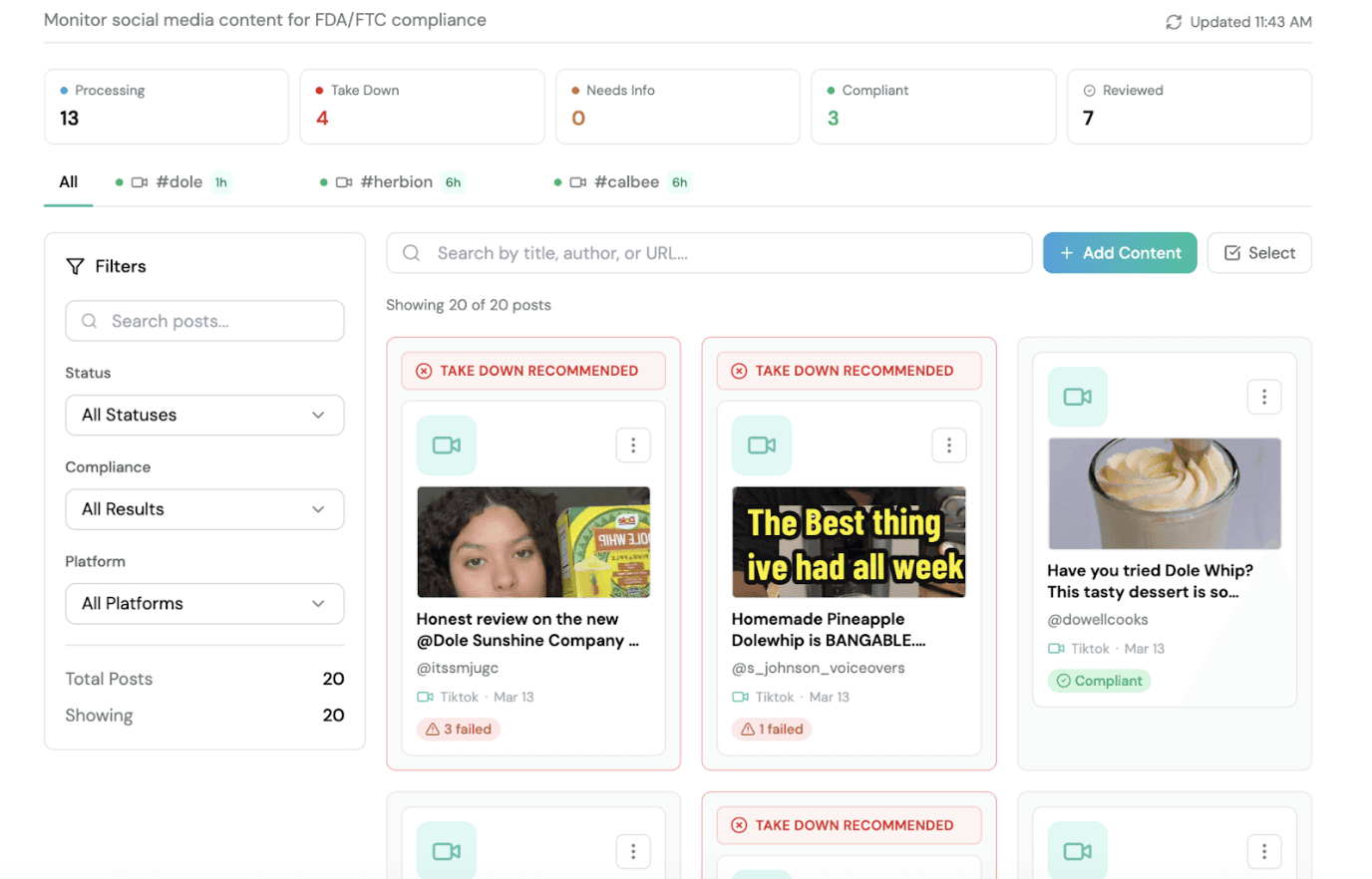
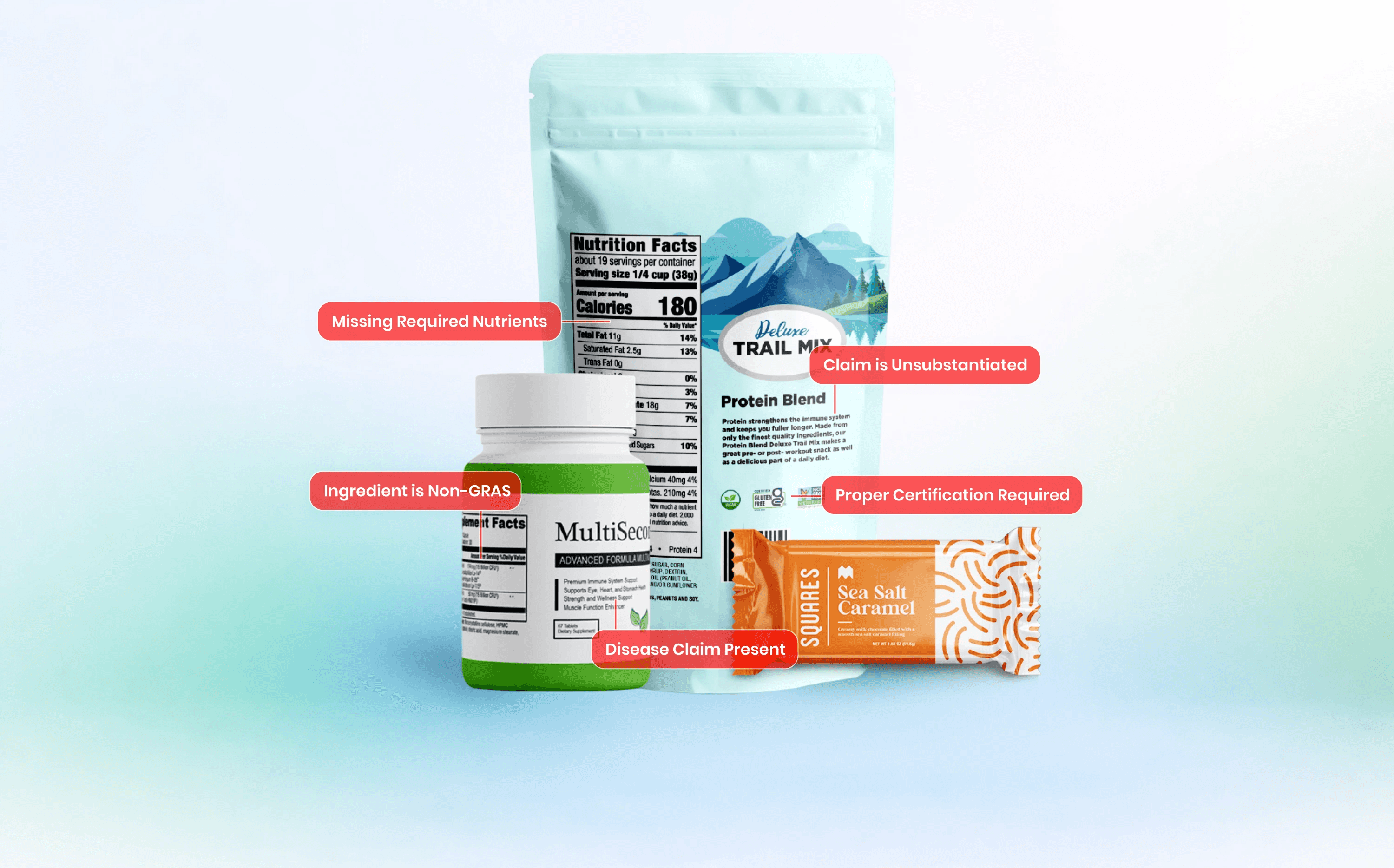
Truli's AI agents scan your labels, product pages, and influencer content against FDA and FTC rules — flagging drug-adjacent language, unsubstantiated performance claims, and missing disclaimers with the regulation cited for every finding. Book a demo to see it run on your sports line.
A note from Truli: Truli is not a law firm, and this article does not constitute or contain legal advice or create an attorney-client relationship. When determining your obligations and compliance with respect to relevant laws and regulations, you should consult a licensed attorney.
About

Truli is an AI compliance platform for food, beverage, and supplement brands. Automate FDA/FTC label reviews, claims validation, and post-market monitoring — 10x faster.

Platform
See Truli in action
If regulatory delays are consuming months and thousands in fees, see how Truli delivers fast and continuous compliance coverage at a fraction of the cost.
Book a demo