Pet CBD Products — FDA Warning Letters and Compliance
Pet CBD looks like the friendliest corner of the cannabinoid market, and it is one of FDA's most consistent warning-letter targets. Say your chews calm anxiety or control seizures and you have marketed an unapproved animal drug. Add that CBD isn't an approved animal food ingredient and that no supplement category exists for animals, and the compliance lane gets very narrow.

Catherine Zhou
| Co-founder at Truli

Pet CBD sits in a harsher regulatory position than human CBD, not a softer one. The Dietary Supplement Health and Education Act — the law that created the supplement category and its structure/function claim framework — does not apply to animals. Under the FD&C Act, a pet product is either an animal food or an animal drug. There is no third lane. A CBD chew marketed to "relieve your dog's anxiety" is an unapproved new animal drug, full stop, and FDA's Center for Veterinary Medicine has said so in letter after letter.
Meanwhile the category keeps growing, powered by exactly the claims FDA prohibits. That combination — high consumer demand, sympathetic marketing, zero approved pathway — is why pet CBD remains one of the most reliable warning-letter categories in the cannabinoid space.
The Warning Letters Keep Coming
The enforcement record is current, not historical. In April 2025, FDA's Center for Veterinary Medicine sent warning letters to Bailey's Wellness, Holista, and House of Alchemy for selling unapproved cannabis-derived products for animals. The cited marketing promised to reduce stress, relieve pain, control seizures, and reduce inflammation in dogs, cats, horses — and, notably, food-producing animals like cattle and alpacas, where FDA raised the added concern of unstudied residues in milk, meat, and eggs.
Three months earlier, in January 2025, FDA warned six sellers of unapproved seizure-control products for dogs and cats. The pattern across both rounds is consistent: the agency reads product pages, Amazon listings, and social posts — not just labels — and quotes them back as evidence of drug intent.
Why "drug intent" is the whole ballgame
Under the FD&C Act, intended use defines a drug. A product becomes a drug when its marketing shows it's intended to treat or prevent disease or affect the body's structure or function in a drug-like way. FDA has approved no cannabis-derived drug for animals, so any therapeutic claim on a pet CBD product creates an unapproved-drug violation regardless of what the label panel says.
CBD Isn't an Approved Animal Food Ingredient Either
Dropping the health claims doesn't make a pet CBD product a lawful animal food. FDA's position is that adding CBD or THC to any food — including animal food and feed — violates the FD&C Act, because both compounds were first investigated as human drugs. And on the feed-ingredient side, AAFCO (the Association of American Feed Control Officials) lists no ingredient definition for CBD or hemp extracts, and no GRAS conclusion supports them in animal food. AAFCO's ingredient work on hemp has so far advanced only narrow seed-derived materials, not cannabinoid extracts.
So a pet CBD brand can't claim the drug lane (no approval), can't claim the food lane (unapproved ingredient), and can't claim the supplement lane (doesn't exist for animals). The category operates on enforcement discretion, and discretion runs out fastest for products making therapeutic claims.
What Pet Brands Can and Cannot Say
The claims line for pet products is stricter than for human supplements, because there is no structure/function safe harbor equivalent to 21 CFR 101.93 for animals. The working framework enforcement actually reflects:
Lower-risk framing | Enforcement-magnet claims |
|---|---|
"Veterinarian-formulated chews for dogs" | "Relieves anxiety" / "for separation anxiety" |
"Supports normal, calm behavior" | "Controls seizures" / "alternative to seizure meds" |
"For occasional stiffness from normal daily activity" | "Treats arthritis pain" / "anti-inflammatory" |
Quality claims: mg per chew, batch-tested, COA access | "Helps with cancer symptoms" |
"Consult your veterinarian before use" | Any claim aimed at food-producing animals |
Be clear about what the left column is: risk reduction, not permission. Because CBD has no approved status in animal products at all, even soft wellness framing carries residual ingredient-level exposure. But every named disease — anxiety, epilepsy, arthritis, cancer — moves a product from FDA's discretion pile to its warning-letter pile. The National Animal Supplement Council's self-regulatory framework points the same direction: no disease claims, adverse-event reporting, and quality standards.
Watch every channel, not just the bag
The April 2025 letters cited website and social media content, not label panels. Testimonials repeating seizure stories, influencer posts about anxious rescues, and Amazon bullet points all count as labeling or advertising. FTC substantiation rules apply in parallel: a "calms your dog" claim needs competent and reliable scientific evidence in the target species, which for most pet CBD claims doesn't exist.
The Compliance Playbook for Pet CBD Brands
The category's rules may eventually change — FDA has acknowledged the need for new cannabinoid pathways, and animal products are part of that conversation — but brands have to operate on today's law:
Purge disease claims everywhere. Label, site, marketplace listings, social, affiliates, and review widgets you curate. Anxiety and seizures are the two words most likely to appear in your warning letter.
Stay out of food-producing animals. Cattle, poultry, goats, alpacas — residue concerns make these products a priority target even with clean claims.
Run supplement-grade quality anyway. Accurate mg-per-unit dosing, batch COAs from accredited labs, and contaminant testing. Mislabeled potency in pet products is well documented and pairs badly with a drug-claim citation.
Keep the human/pet lines separate. Marketing that implies your human tincture works for pets (or vice versa) imports each product's violations into the other's file.
Document a claims-review gate. Every new SKU, listing, and post should pass a check against the drug-claim line before it ships.
Catch the claim before FDA's screenshot does
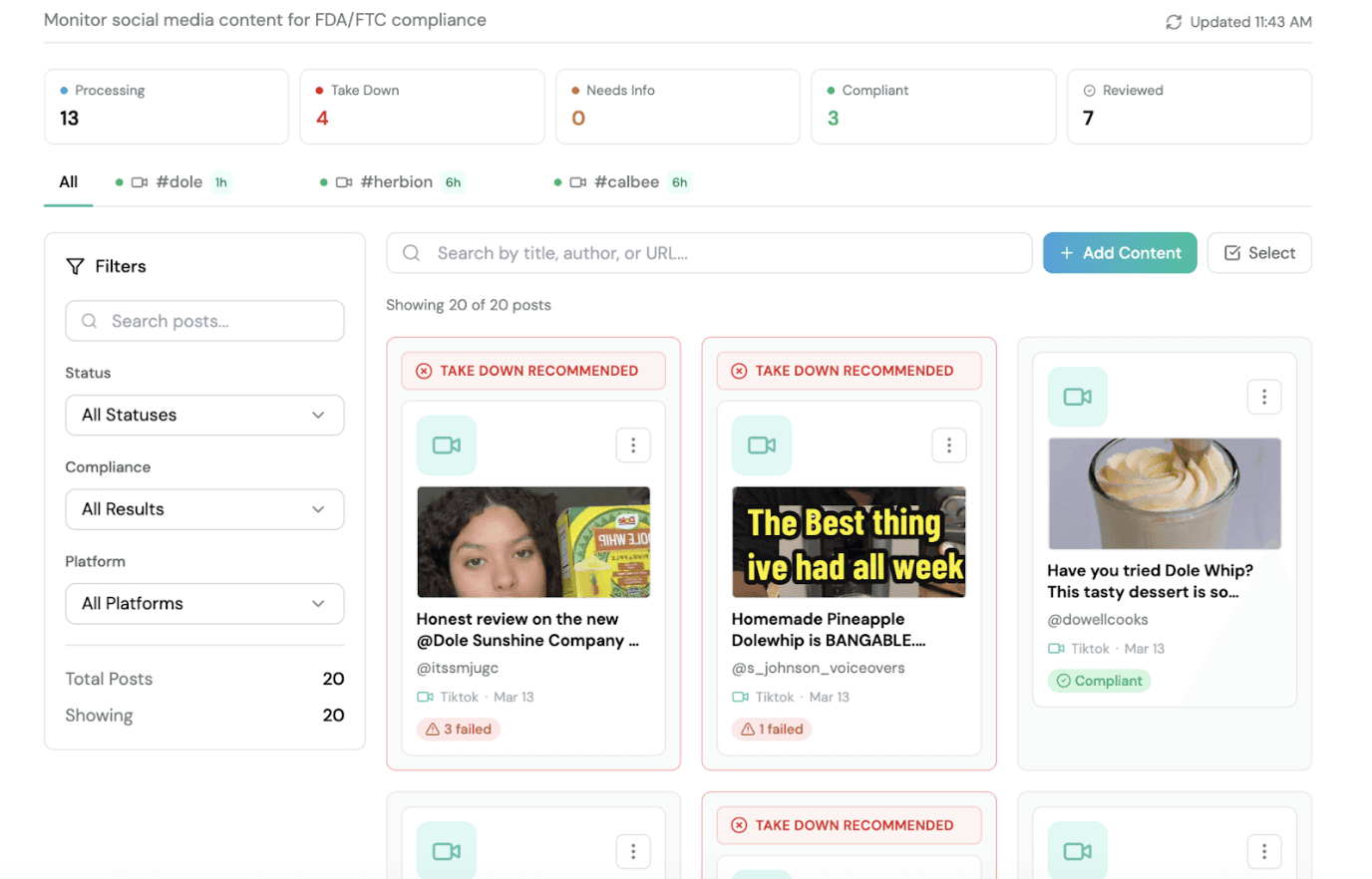
Truli's AI agents scan pet product labels, packaging, websites, and social content against FDA and FTC regulations — flagging the anxiety, pain, and seizure language that drives animal-product enforcement, with the specific rule cited for every finding. Book a demo to audit your pet line end to end.
A note from Truli: Truli is not a law firm, and this article does not constitute or contain legal advice or create an attorney-client relationship. When determining your obligations and compliance with respect to relevant laws and regulations, you should consult a licensed attorney.
About

Truli is an AI compliance platform for food, beverage, and supplement brands. Automate FDA/FTC label reviews, claims validation, and post-market monitoring — 10x faster.

Platform
See Truli in action
If regulatory delays are consuming months and thousands in fees, see how Truli delivers fast and continuous compliance coverage at a fraction of the cost.
Book a demo