Oral vs Injectable Peptides — Different Rules, Same Word
The peptide market sells capsules, sublinguals, nasal sprays, and injectable vials under one word. FDA doesn't see one category — it sees a bright statutory line at the mouth. How a peptide gets into the body decides which agency rules apply, and most 'peptide brands' drift across that line without noticing.

Catherine Zhou
| Co-founder at Truli

Two products can contain the identical peptide and sit in opposite regulatory universes. A collagen peptide capsule is a dietary supplement governed by labeling rules. The same idea in a vial with bacteriostatic water is an unapproved new drug that can trigger a warning letter, seizure, or injunction. Nothing about the molecule changed — only the route of administration did.
This is the least understood line in the peptide economy, and the most mechanically enforced. Route of administration isn't a marketing detail. It's the statutory definition doing its work.
The Statutory Line — Supplements Must Be Ingested
A dietary supplement must be intended for ingestion; anything delivered by injection is automatically outside the category. The Federal Food, Drug, and Cosmetic Act's definition — 21 U.S.C. 321(ff)(2)(A)(i) — requires that a dietary supplement be a product "intended for ingestion" in the forms the statute specifies. Courts and FDA have applied this consistently: if the product's route bypasses the digestive tract, it cannot be a dietary supplement no matter what the label says.
An injectable peptide therefore has exactly two lawful identities: an FDA-approved drug, or a compounded drug prepared by a licensed pharmacy for an individual prescription. A vial sold on a website with an "add to cart" button is neither. It's an unapproved new drug, and the marketing around it — dosing calculators, reconstitution guides, syringes in the upsell — is the evidence.
Route | Regulatory category | Can it be a supplement? |
|---|---|---|
Capsule, powder, gummy (swallowed) | Dietary supplement (if ingredient qualifies) | Yes |
Sublingual (dissolved, then swallowed) | Gray zone — FDA tolerance is narrow | Sometimes |
Nasal spray | Drug (FDA: cannot be ingested) | No |
Topical serum or cream | Cosmetic or drug | No |
Injection | Drug — approved or compounded only | Never |
The Gray Zones — Sublingual, Nasal, Topical
Nasal and injectable routes can never be supplements; sublingual survives only because the product is ultimately swallowed. FDA has stated plainly that nasal sprays cannot be compliant dietary supplements, because nothing delivered to the nasal mucosa is ingested. The peptide nasal spray market — a fast-growing corner of the gray market — is an unapproved drug market wearing wellness packaging.
Sublingual and buccal products occupy a narrower position than sellers assume. The tolerated theory is that a sublingual tablet mostly ends up swallowed, keeping it inside "intended for ingestion." But a brand that markets sublingual delivery as the point — "bypasses digestion," "absorbs directly into the bloodstream" — is arguing against its own supplement status in its own copy. Topicals sit outside the supplement question entirely: a peptide cream is a cosmetic if it makes appearance claims and a drug if it makes structure/function claims, and no topical is a supplement. Brands sometimes try to carry supplement-style claims and disclaimers onto sprays and topicals, and it accomplishes nothing — the disclaimer belongs to a category those products can never join.
Why Peptide Brands Drift From Capsules to Vials
Brands cross the line chasing potency, because the honest oral-peptide story undercuts the marketing. Most pharmacologically active peptides degrade in the digestive tract — that's why real peptide drugs are so often injected. A brand that starts with lawful capsules eventually meets the customer objection: "doesn't stomach acid destroy this?" The compliant answers are unglamorous. The lucrative answer is a vial, a sublingual "bioavailability breakthrough," or a nasal spray.
That drift is visible across the category: the same brand name spanning a supplement line and a "research" vial line, Discord communities steering capsule buyers toward injectables, influencers reconstituting product on camera. FDA's 2026 enforcement wave hit exactly this pattern — seven warning letters to online peptide sellers published in a single April day, rejecting "research use only" disclaimers where dosing guidance and injection supplies established human intended use. Route of administration is where wellness brands quietly become drug companies, and FDA reads the whole funnel, not just the label.
Bioavailability Claims Are the Early Warning Sign
Bioavailability marketing is where oral brands start writing drug claims without noticing. "Clinically shown absorption" claims need substantiation for your formulation under the FTC's competent-and-reliable-evidence standard — borrowed studies on different molecules or doses don't carry the weight. Comparative framing is worse: "injection-level absorption without needles" invites regulators to read your product as a substitute for an injected drug, which is a drug intended use.
There's a legitimate version of this story. Hydrolyzed proteins genuinely absorb differently, and honest structure/function claims with the 21 CFR 101.93 disclaimer can describe it. The test we'd apply to any peptide product page: if the copy is explaining how the product defeats digestion, ask whether you're still describing something intended for ingestion — because that's the entire legal basis of your category.
The Operator's Takeaway
The route question deserves a permanent place in product development review, with a simple standing test for every new SKU and every new claim:
Is it swallowed? If not, it is not a supplement, and no copy fixes that.
Does the ingredient qualify? Route is necessary but not sufficient — the peptide still has to be a lawful dietary ingredient.
Does the absorption story stay honest? Substantiated, non-comparative, and never framed as defeating digestion or replacing injections.
Does the brand stay on one side? A supplement line and a "research" vial line under one brand contaminates the compliant half.
The moment a roadmap slide says "spray" or "vial," the regulatory model changes from labeling compliance to drug approval — and there is no marketing language that papers over that. The brands that last in this category are the ones that decided, early and in writing, which side of the mouth they operate on.
Check every SKU against the line
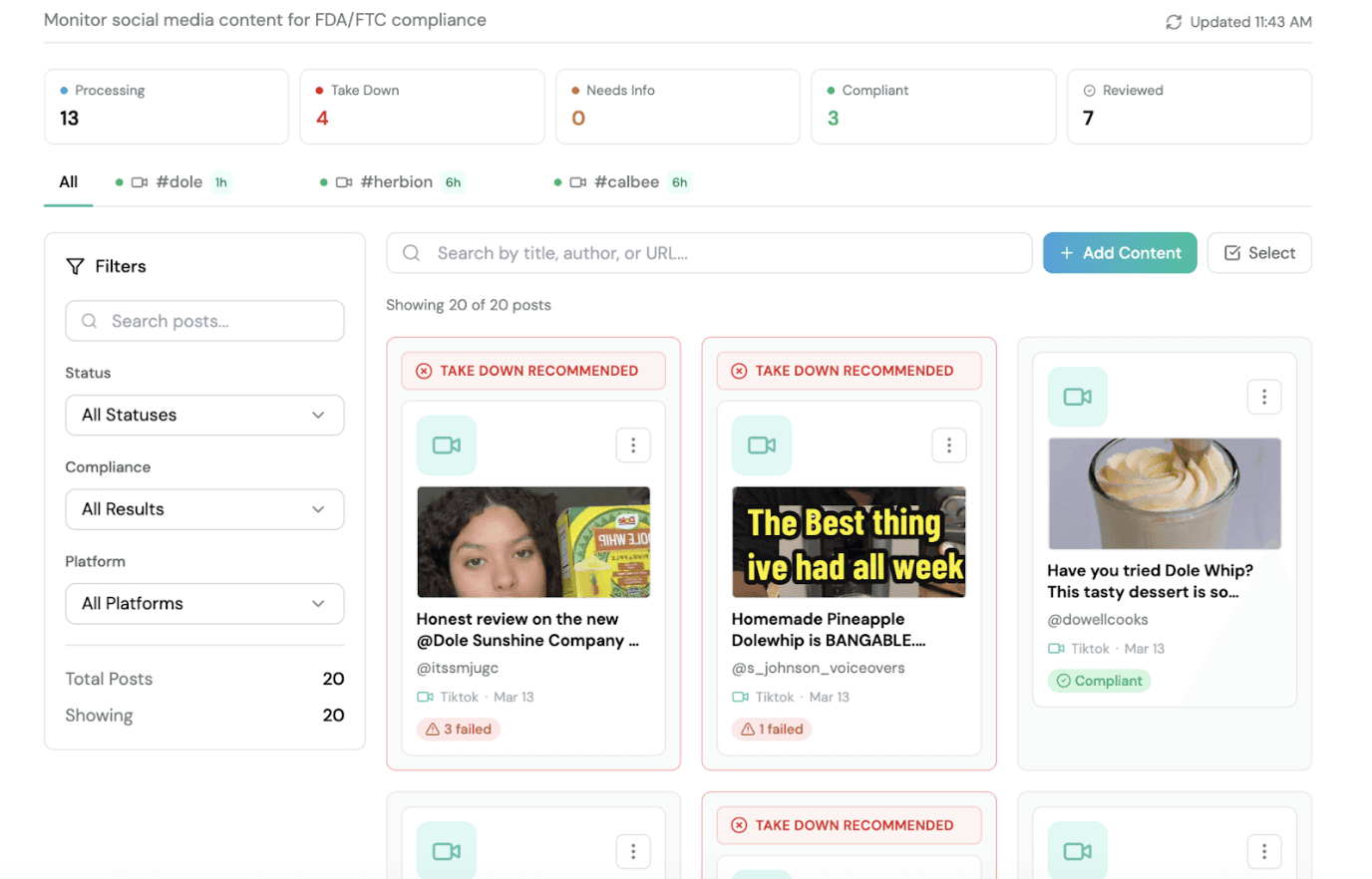
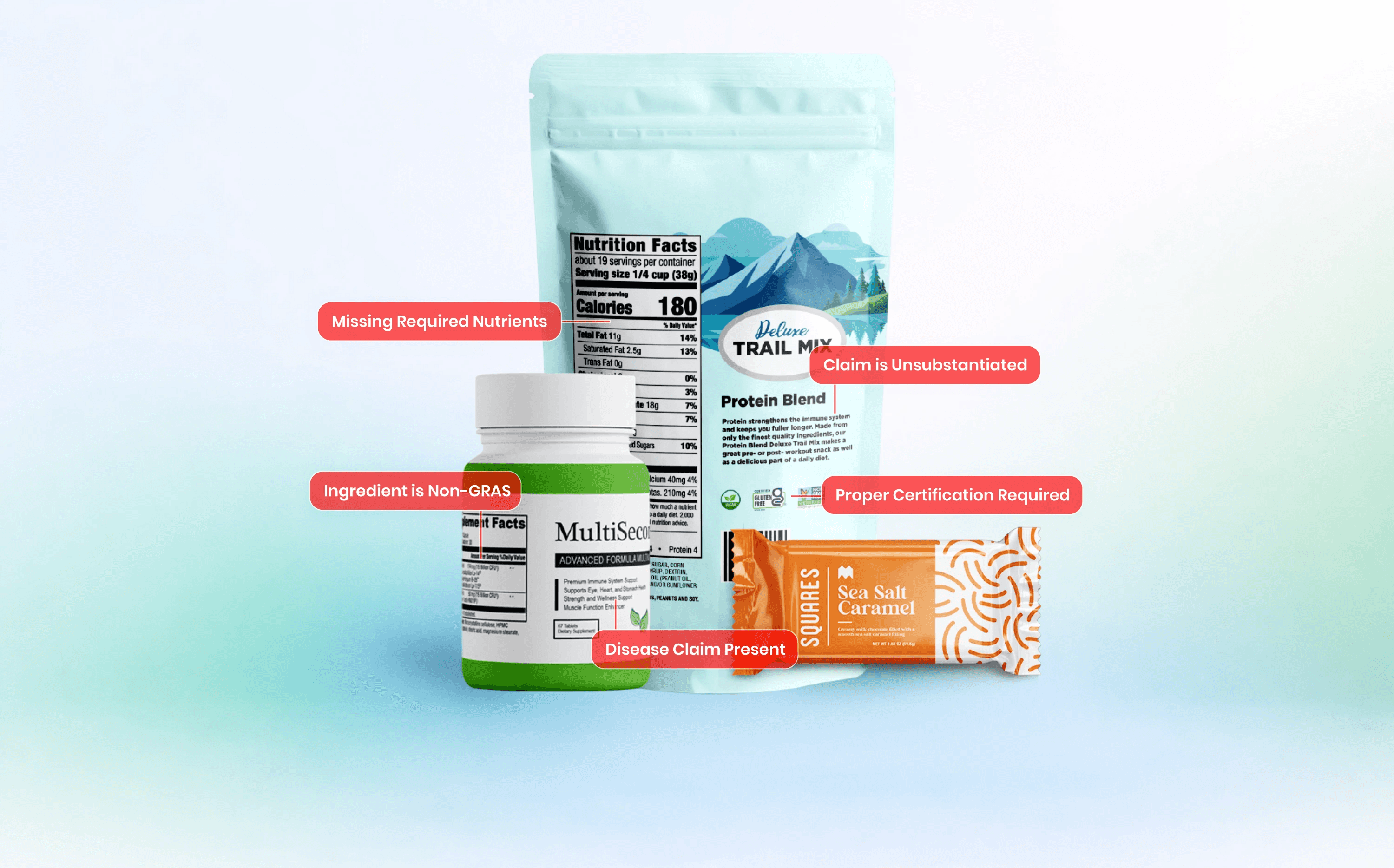
Truli's AI agents scan labels, websites, and influencer content against FDA and FTC rules — flagging drug claims, route-of-administration red flags, and missing disclaimers with the rule cited for every finding. Book a demo to see your full catalog mapped.
A note from Truli: Truli is not a law firm, and this article does not constitute or contain legal advice or create an attorney-client relationship. When determining your obligations and compliance with respect to relevant laws and regulations, you should consult a licensed attorney.
About

Truli is an AI compliance platform for food, beverage, and supplement brands. Automate FDA/FTC label reviews, claims validation, and post-market monitoring — 10x faster.

Platform
See Truli in action
If regulatory delays are consuming months and thousands in fees, see how Truli delivers fast and continuous compliance coverage at a fraction of the cost.
Book a demo