Nutrition Analysis vs Label Compliance Software — The Difference
The CPG labeling software market looks crowded — Trustwell Genesis, LabelCalc, Food Label Maker, TraceGains, Trace One, FoodChain ID, Truli. But it's actually three distinct categories doing three different jobs, and brands routinely buy from the wrong one. Here's the taxonomy that makes the choice obvious.

Catherine Zhou
| Co-founder at Truli

Ask ten founders what "label compliance software" means and you'll get three different answers: a tool that makes the Nutrition Facts panel, a system that manages product and supplier data, or a reviewer that catches regulatory violations. All three exist. They're different products, they mitigate different risks, and only one of them addresses the failures that show up in FDA warning letters.
Here's how the market actually divides — and which category covers which risk.
Category 1 — Nutrition Analysis and Label Generation
What it does: Calculates a nutrient profile from your recipe and generates a correctly formatted Nutrition Facts panel, ingredient statement, and allergen listing.
Tools in this category include Trustwell Genesis (formerly ESHA — the enterprise standard, with a professionally maintained ingredient database), LabelCalc (FoodCalc's affordable online option for smaller manufacturers), and Food Label Maker (a budget web app for startups). They differ in database depth, formats supported, and price — but they share one job: producing the panel.
The risk it covers: Inaccurate nutrition data and malformed panels. Under 21 CFR 101.9, nutrient declarations must fall within defined accuracy tolerances and follow strict format and rounding rules — database-driven calculation is how most non-lab-tested products get there.
What it can't do: Evaluate anything it didn't generate. The front-of-pack claims, the required elements, the website — all outside scope. A generated panel can be perfect while the label around it is a warning letter waiting to happen.
Category 2 — PLM and Supplier Data Platforms
What it does: Manages the data pipeline behind the product — ingredient specifications, supplier documents, formulations, versioning, and regulatory documentation across a portfolio.
Tools here include TraceGains (networked supplier and ingredient data), Trace One Devex (enterprise PLM for process manufacturers, formerly Selerant), and Trustwell's FoodLogiQ side (supplier compliance and traceability). FoodChain ID sits adjacent with a different emphasis: a global regulatory library covering 220+ countries that regulatory teams use for market-entry research.
The risk it covers: Data integrity and supply chain failures — a supplier substituting an ingredient without documentation, a reformulation that never propagated to the spec, missing certificates when an auditor or retailer asks.
What it can't do: Audit the finished label or the marketing. PLM systems track what should be true about the product; they don't read what the consumer actually sees and judge its legality.
Category 3 — Label Compliance Review
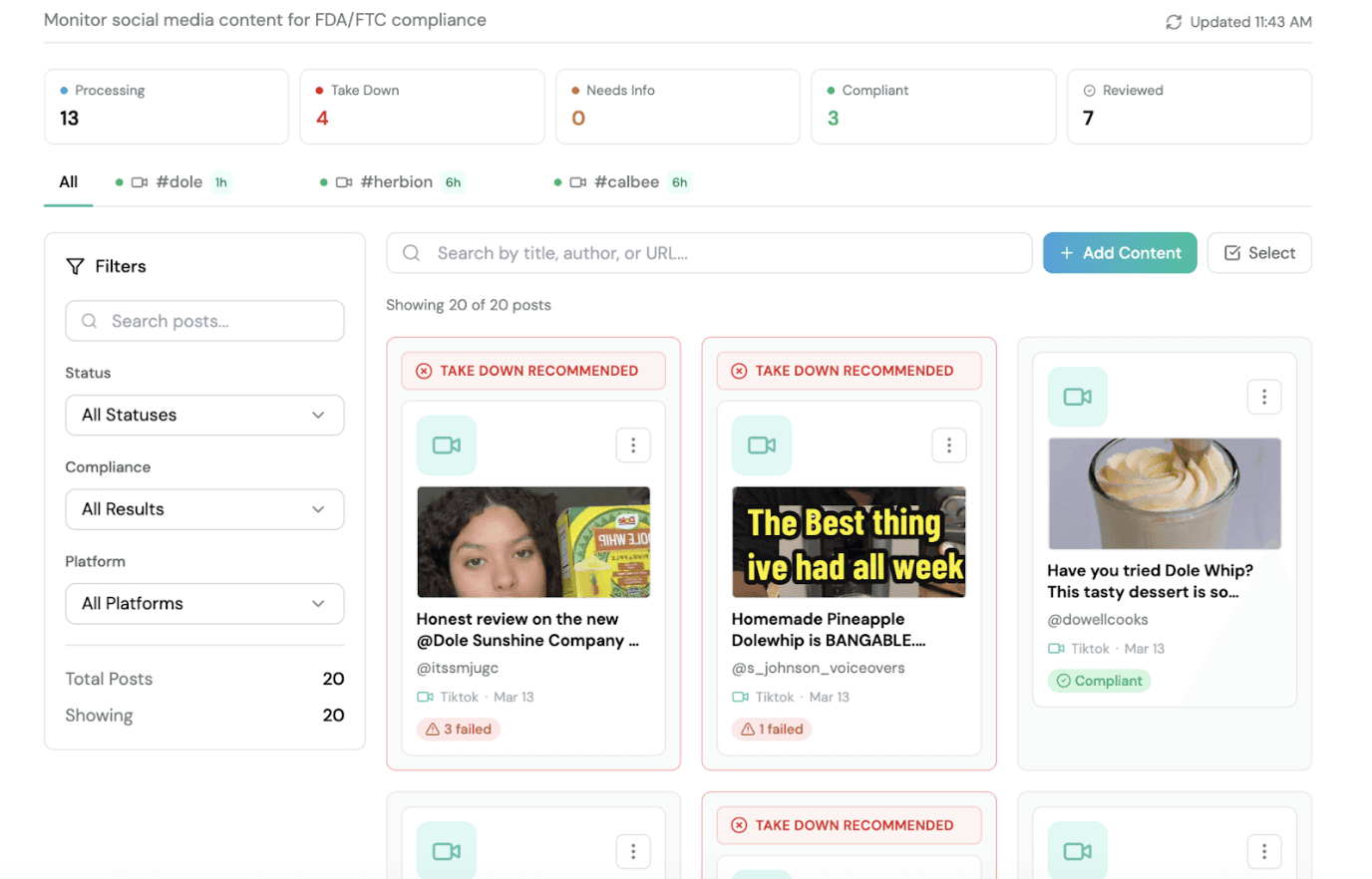
What it does: Reads the finished output — label artwork, packaging, website copy, Amazon listings, ads, social content — and evaluates it against FDA and FTC regulations, flagging violations with citations and fixes.
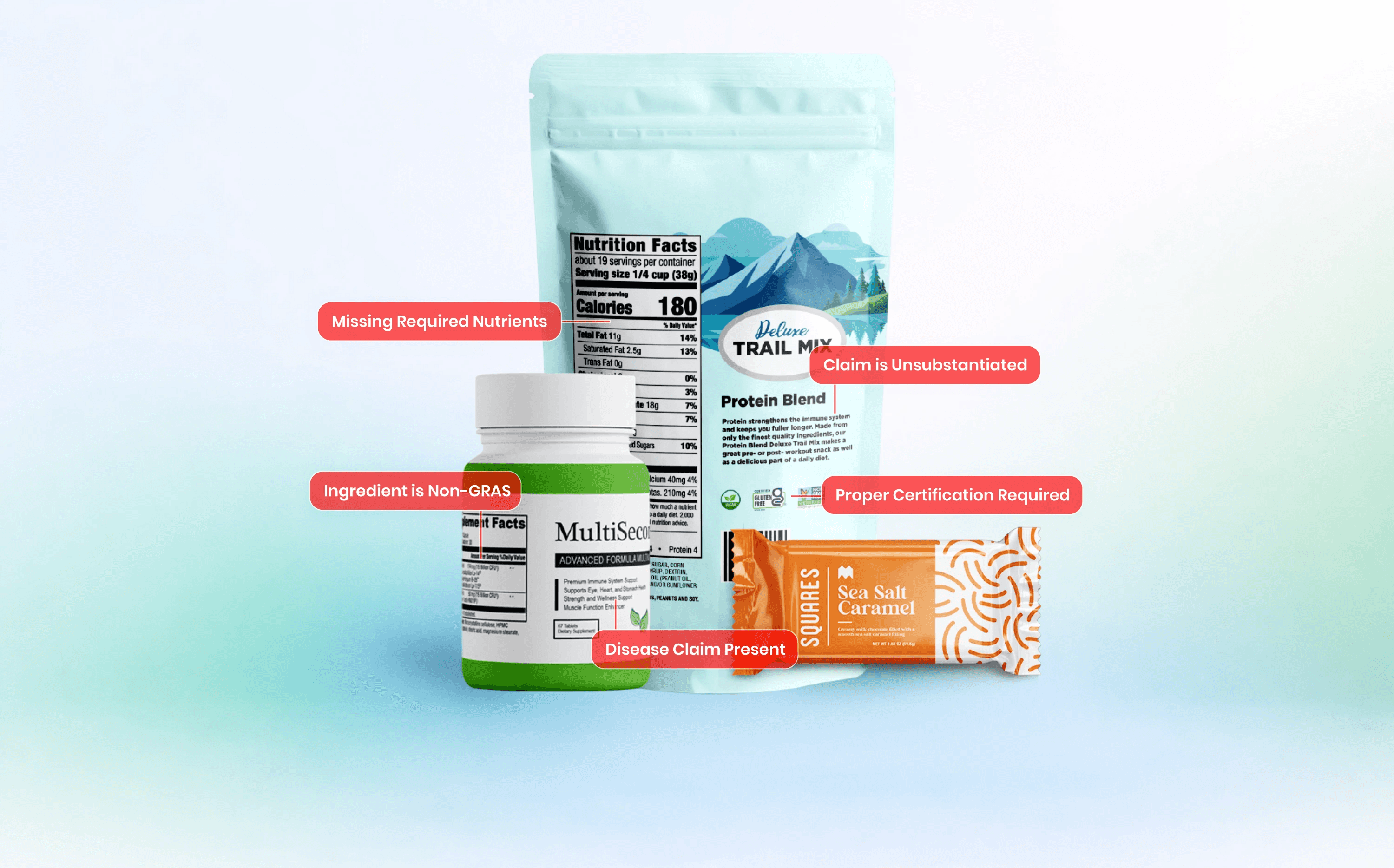
This is Truli's category. AI agents review each label for required elements under 21 CFR Part 101, panel format and rounding, allergen declaration completeness including sesame under the FASTER Act, and — most consequentially — claims: nutrient content claims against their defined thresholds, health claims against the authorized list, structure/function claims against the disease claim line, and the 21 CFR 101.93 disclaimer where it's required. The same analysis runs continuously across digital and social channels. Legacy alternatives in this category are human: FDA lawyers and label consultants, who review the same material at hourly rates, per revision.
The risk it covers: Enforcement and litigation. Warning letters, FTC actions, class action suits, retailer delistings, and allergen-driven recalls almost always originate in this layer — a claim that crossed a line, a required element missing, an allergen undeclared, marketing that outran the label.
What it can't do: Generate your nutrition data or manage your supplier documents. It audits outputs; the other categories build and track inputs.
The Full Map
Tool | Category | Primary job |
|---|---|---|
Trustwell Genesis (ESHA) | Nutrition analysis | Nutrient calculation, panel generation |
LabelCalc | Nutrition analysis | Budget panel generation for SMBs |
Food Label Maker | Nutrition analysis | Entry-level panel generation |
TraceGains | PLM / supplier data | Supplier and ingredient data management |
Trace One Devex | PLM / supplier data | Enterprise product lifecycle management |
FoodChain ID (gComply) | Regulatory intelligence | Global regulation research library |
Truli | Label compliance review | AI audit of labels, claims, and marketing |
FDA lawyers / consultants | Label compliance review | Manual regulatory review |
Why Brands Buy the Wrong Category
The confusion is baked into the marketing: every vendor above uses the word "compliance." A nutrition tool is "FDA-compliant labeling software." A PLM is a "compliance platform." Both statements are true within their category — and both leave a founder believing the claims on their label have been checked when nothing in their stack reads claims at all.
The test is simple. Take the last FDA warning letter in your category — or the last class action against a competitor — and ask which of your tools would have caught the violation before it shipped. If the violation was a claim, a missing required element, or an undeclared allergen, the answer is only ever a compliance review, human or AI.
What a Complete Stack Looks Like
A small brand needs two things: a nutrition analysis tool (or lab) to build the panel, and a compliance review before printing and publishing. A mid-size or enterprise brand adds the data layer: PLM or supplier management keeping inputs accurate, nutrition analysis feeding labels, and continuous compliance review auditing every label, listing, and post that goes out. One category per job — the failure mode is assuming one purchase covers all three.
Cover the layer that gets enforced
Whatever generates your panels and manages your specs, the claims on your label and marketing are the layer regulators actually read. Book a demo to see what Truli's AI review flags across your products, listings, and social channels.
A note from Truli: Truli is not a law firm, and this article does not constitute or contain legal advice or create an attorney-client relationship. When determining your obligations and compliance with respect to relevant laws and regulations, you should consult a licensed attorney.
About

Truli is an AI compliance platform for food, beverage, and supplement brands. Automate FDA/FTC label reviews, claims validation, and post-market monitoring — 10x faster.

Platform
See Truli in action
If regulatory delays are consuming months and thousands in fees, see how Truli delivers fast and continuous compliance coverage at a fraction of the cost.
Book a demo