Nature's Ozempic — The GLP-1 Claims Drawing FDA Warning Letters
The GLP-1 drug boom created a marketing gold rush, and regulators have noticed. FDA warning letters referencing GLP-1 products have surged over the past 18 months, and the enforcement net is now reaching supplement and food brands marketing metabolism, appetite, and weight claims. If your product is riding the Ozempic wave, here's what the enforcement data says about your risk.

Catherine Zhou
| Co-founder at Truli

Semaglutide and tirzepatide changed the weight management market overnight, and the supplement industry responded the way it always does — with a flood of products positioned as the natural, cheaper, no-prescription alternative. "Nature's Ozempic." "GLP-1 support." "Boosts your body's own GLP-1." The claims are everywhere, and regulators are now working through them systematically.
We monitor FDA warning letters through Truli's Regulatory Radar, and the GLP-1 category is one of the clearest enforcement trends we've tracked. This post breaks down what the letters actually target, why most "nature's Ozempic" claims are legally indefensible, and how the enforcement pattern should change what your brand puts on its website and social channels.
The GLP-1 Gold Rush Created a New Enforcement Target
The pattern in the data is not subtle. Since 2020, Truli's Regulatory Radar has logged more than 4,200 FDA warning letters to food, supplement, drug, and related companies — with 314 issued in just the last six months. Two months stand out sharply against a typical volume of roughly 55 letters per month.
In September 2025, FDA issued 126 warning letters — the single highest month in our dataset — driven substantially by a coordinated action against online sellers of compounded GLP-1 products. Then June 2026 spiked again to 82 letters, including a batch of more than 20 sent on a single day to telehealth companies marketing compounded semaglutide and tirzepatide.
What the warning letter data shows
Across the past 18 months, more than 120 warning letters in our dataset reference GLP-1 drugs by name — semaglutide, tirzepatide, or liraglutide. The subjects are consistent: "False & Misleading Claims," "Unapproved New Drug," "Misbranded." The volume tells you where FDA's attention is, and the language tells you why: these products make claims their legal category doesn't allow.
Most of these letters went to telehealth and compounding operations selling the actual drug compounds. But the enforcement logic behind them applies directly to supplement and food brands — because the violation isn't about the molecule. It's about the claim.
Why "Nature's Ozempic" Is a Disease Claim, Not a Structure/Function Claim
Dietary supplements are allowed to make structure/function claims — statements that a nutrient or ingredient affects the normal structure or function of the body. Under 21 CFR 101.93(f), a supplement label may describe the role of an ingredient in maintaining a body structure or function, provided the statement is not a disease claim.
The moment a claim crosses into disease territory, the product is regulated as an unapproved new drug. The regulation is explicit: if a supplement label or labeling bears a disease claim as defined in 21 CFR 101.93(g), "the product will be subject to regulation as a drug unless the claim is an authorized health claim for which the product qualifies."
That is exactly what "nature's Ozempic" does. Ozempic is a prescription drug approved to treat type 2 diabetes and obesity. Positioning a supplement as a natural version of it explicitly invokes the drug's disease-treatment purpose. It doesn't matter that the phrase never says "diabetes" or "obesity" — the reference to a named disease drug carries the disease context with it.
The line DSHEA draws
Compare two claims for the same berberine supplement:
"Supports healthy glucose metabolism already within the normal range" — a structure/function claim
"Nature's Ozempic for blood sugar and weight loss" — a disease claim that converts the product into an unapproved drug
Berberine has become the flagship ingredient of this trend, widely marketed as "nature's Ozempic" despite no evidence that it produces anything comparable to a GLP-1 receptor agonist. The ingredient itself isn't the problem. The claim wrapped around it is. Weight-loss and appetite-suppression claims appear in dozens of the letters we track, and they are among the highest-scrutiny categories in all of supplement enforcement.
Enforcement Now Reads Your Website, Not Just Your Label
The most important shift for brands to understand: FDA does not limit its review to the physical label. It reviews the totality of your marketing to determine your product's intended use.
Of the roughly 700 warning letters our radar logged in the past year, more than 300 quote the company's own website as the source of the violating claims. Warning letters routinely cite product detail pages, blog posts, landing pages, social media captions, and even customer testimonials the brand chose to publish. A compliant Supplement Facts panel is no defense if your homepage says the product works like Ozempic.
This is where GLP-1 brands get caught. The label may carry careful structure/function language and the required DSHEA disclaimer. But the marketing team writes the website, the ads, and the influencer briefs — and that copy reaches for the Ozempic comparison because it converts. FDA treats every one of those surfaces as labeling or advertising for the product.
The FTC Is Running a Parallel Track
FDA is not the only regulator in this space. The FTC governs off-package advertising for supplements and holds health and weight-loss claims to a "competent and reliable scientific evidence" standard — interpreted, for efficacy claims, to require well-designed human clinical trials. For weight-loss claims specifically, the FTC's long-standing benchmark is two independent, randomized, controlled human studies. Almost no "GLP-1 support" supplement meets that bar.
Enforcement here isn't hypothetical. In September 2025, BBB National Programs' National Advertising Division took up GLP-1 advertising by Ryze Superfoods, and the company agreed to stop marketing its products as appetite-suppressing. Consumer class actions have followed the regulators — including a proposed class action against Veracity Wellness over its "Metabolism Ignite" product, alleging it was deceptively marketed as delivering appetite suppression and weight loss comparable to prescription GLP-1s.
The through-line: a GLP-1-adjacent claim exposes a brand on three fronts at once — an FDA disease-claim citation, an FTC substantiation problem, and private plaintiff litigation. One phrase can trigger all three.
What This Means for Your Brand
If you sell anything in the metabolism, weight, appetite, or blood-sugar space, treat GLP-1 comparisons as a bright-line risk. Practical steps:
Remove every reference to Ozempic, Wegovy, Zepbound, semaglutide, tirzepatide, and "GLP-1 drug" from your marketing — including implied comparisons like "nature's Ozempic" or "the natural alternative to weight-loss shots"
Audit your website, not just your label — product pages, blogs, and FAQs are all labeling in FDA's view
Review affiliate and influencer content, which is your advertising the moment you pay for or amplify it
Keep structure/function claims within the normal-range framing and confirm you hold the human evidence to back them
Verify the DSHEA disclaimer appears verbatim everywhere structure/function claims appear, per 21 CFR 101.93 — not just on the back of the bottle
Get Ahead of the GLP-1 Crackdown
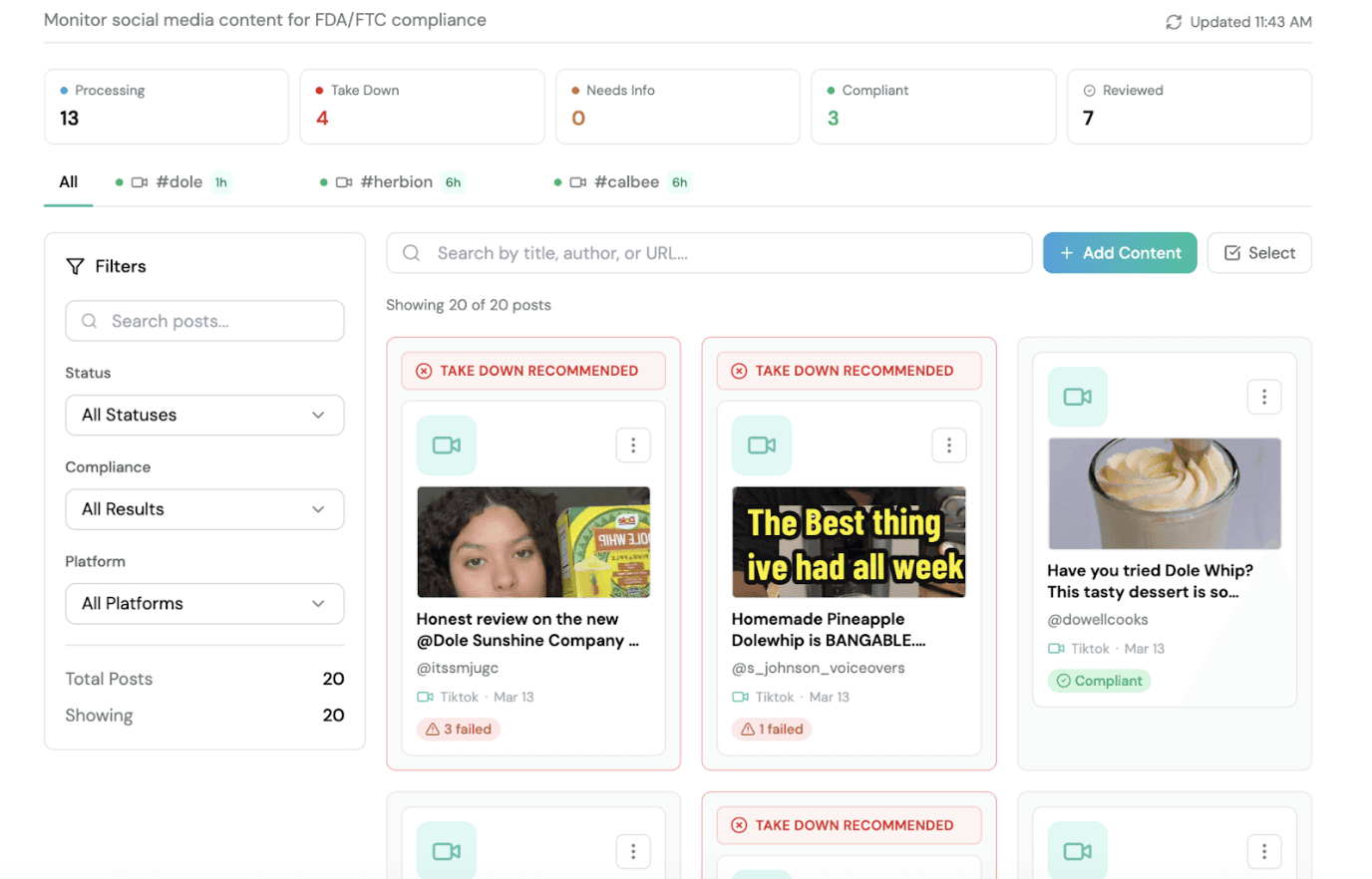
The GLP-1 enforcement wave is still building, and the letters FDA posts each week are a live map of what's drawing scrutiny in your category. Truli's Regulatory Radar monitors FDA warning letters and enforcement actions relevant to your products and surfaces the trends before they reach your shelf. Truli's AI compliance platform audits your labels, website copy, ads, and social content against current FDA and FTC rules — catching a "nature's Ozempic" claim wherever it lives, before enforcement does. Book a demo to see how Truli keeps your GLP-1-era marketing on the right side of the line.
About

Truli is an AI compliance platform for food, beverage, and supplement brands. Automate FDA/FTC label reviews, claims validation, and post-market monitoring — 10x faster.

Platform
See Truli in action
If regulatory delays are consuming months and thousands in fees, see how Truli delivers fast and continuous compliance coverage at a fraction of the cost.
Book a demo