Full Spectrum vs Broad Spectrum — CBD Label Claim Rules
Every CBD label leads with one of three words: full spectrum, broad spectrum, or isolate. No regulator defines any of them. That vacuum does not make the terms safe to use loosely — it makes them pure advertising claims, judged on whether your certificate of analysis can back the ordinary meaning a consumer takes away. The class-action bar has already shown what happens when it can't.

Michael Wu
| Co-founder at Truli
Walk any CBD shelf and the spectrum language does the selling: full spectrum for the purists, broad spectrum for the drug-tested, isolate for the cautious. Here is what surprises most operators: no federal or state regulation defines any of these terms. They are marketing vocabulary, not regulatory categories. That means they are governed by the general false-advertising and misbranding rules that govern every label statement, and the evidence standard is whatever a reasonable consumer understands the word to promise. Get the COA wrong and the label is deceptive, with plaintiffs' lawyers far quicker to act than FDA.
No Agency Defines These Terms
FDA has never defined full spectrum, broad spectrum, or isolate for labeling purposes, and no state hemp program fills the gap with binding definitions. The terms are still regulated, just indirectly. A false or misleading statement misbrands a food under FDCA 403(a), and deceptive advertising violates FTC Act Section 5. Because the terms carry well-established industry meanings, using one your product does not match is the classic setup for both.
The industry conventions, and what they imply on a certificate of analysis, look like this. Treat the table as market expectation, not law:
Label term | Industry convention | What the COA must show |
|---|---|---|
Full spectrum | Whole-plant extract, cannabinoids plus terpenes, THC present | Cannabinoid profile with minor cannabinoids present; THC within legal limits |
Broad spectrum | Multiple cannabinoids, THC removed | Minor cannabinoids present; THC non-detect at a stated detection limit |
Isolate | Purified single cannabinoid | 99 percent or higher CBD purity, nothing else detected |
What Your COA Must Actually Show
The answer-first version: match the batch COA to the ordinary meaning of the front-panel word, and refresh it every batch.
Full spectrum
Full spectrum promises the whole plant. A COA showing CBD plus non-detect everything else contradicts the claim, and consumers have sued over exactly that gap. The THC content must also stay within legal limits: 0.3 percent delta-9 by dry weight today, and after November 12, 2026, finished hemp products face the new federal cap of 0.4 mg total THC per container under H.R. 5371. For a full spectrum tincture, that per-container cap is an existential formulation problem, not a footnote, and it makes "contains legal THC" statements on 2026 labels a moving target.
Broad spectrum
Broad spectrum promises THC removal with the rest of the profile intact. The COA needs two things: detectable minor cannabinoids (CBG, CBN, CBC) and THC below the lab's limit of quantification, with that limit stated. A broad spectrum product whose COA shows trace THC above the LOQ is mislabeled by its own paperwork.
Isolate
Isolate promises purity. Convention is 99 percent or greater CBD with no other cannabinoids detected. Isolate is the easiest claim to substantiate and the safest basis for THC-related marketing, which is exactly why the riskier claim discussed next usually appears on non-isolate products.
"THC-Free" Is the Highest-Risk Claim in the Category
"THC-free" reads as an absolute: zero. Analytical chemistry does not do zero. A lab reporting "non-detect" means below the limit of quantification, often around 0.01 to 0.05 percent depending on method, and trace THC below that threshold can still accumulate with heavy use and appear on an employment drug screen.
That gap has already produced litigation. An Illinois truck driver sued Just Brands, maker of JustCBD, in a class action after allegedly failing an employer drug test having used gummies labeled "No THC," and a separate class action alleged Curaleaf CBD drops contained THC despite contrary labeling. The plaintiff theory writes itself: the label made an absolute claim the COA never supported, and consumer-fraud statutes like Illinois's supply the cause of action. Damages theories reach past the purchase price to lost employment, which is what makes these cases attractive to plaintiffs' firms.
Safer language states the evidence rather than the absolute: "THC non-detect" or "no detectable THC per batch COA," with the COA accessible from the label and the detection limit stated on it. If your buyer persona includes drug-tested professionals, the honest framing is also the one that keeps them as customers, because a nurse or driver who fails a screen becomes a plaintiff and a one-star review at the same time.
Entourage Effect Claims Are Health Claims in Disguise
"Full spectrum works better because of the entourage effect" feels like ingredient education. Legally, it is an efficacy claim: a representation that your product produces stronger physiological results than alternatives. Under FTC substantiation standards that requires competent and reliable scientific evidence for your product's comparative effect, which the current entourage literature, largely preclinical and mechanism-level, does not supply. Pair the entourage claim with an outcome, "better sleep support than isolate," and you have layered an unsubstantiated superiority claim onto a structure/function claim regime CBD products already sit uneasily in, as covered in our post on CBD supplement claims and the drug exclusion clause. Describe composition on the label. Let the COA, not pharmacology theory, do the persuading.
The Compliance Pattern That Works
State what the product is, prove it batch by batch, and never claim an absolute you cannot measure. Spectrum term matched to COA. Detection limits disclosed when THC status is the selling point. No comparative efficacy without evidence. Reviewed against the 16 CFR Part 255 endorsement rules when reviews and influencers repeat your spectrum claims for you.
One operational habit closes most of the gap: route every new batch COA through the same review as the label itself. Spectrum drift is real, because extraction inputs vary crop to crop, and a broad spectrum product is only broad spectrum until the batch where the lab finds quantifiable THC. The claim lives or dies at the batch level, so the review has to happen there too.
Verify every spectrum claim against the paperwork behind it
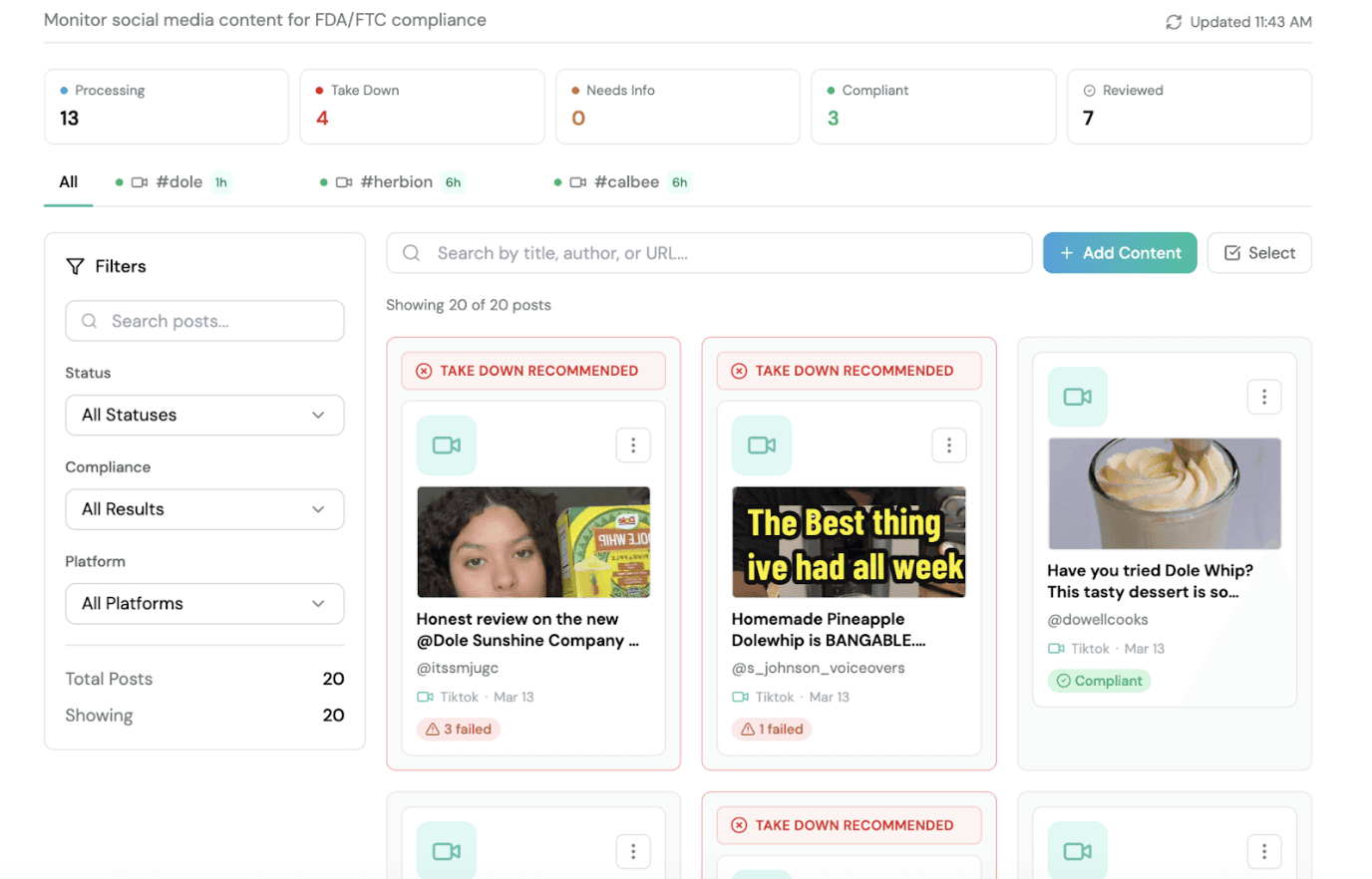
Truli's AI agents scan labels, packaging, websites, and social content against FDA and FTC regulations, flagging absolute claims like THC-free, spectrum terms your disclosed testing cannot support, and efficacy language that needs substantiation, with the specific rule cited for every finding. Book a demo.
A note from Truli: Truli is not a law firm, and this article does not constitute or contain legal advice or create an attorney-client relationship. When determining your obligations and compliance with respect to relevant laws and regulations, you should consult a licensed attorney.
About

Truli is an AI compliance platform for food, beverage, and supplement brands. Automate FDA/FTC label reviews, claims validation, and post-market monitoring — 10x faster.

Platform
See Truli in action
If regulatory delays are consuming months and thousands in fees, see how Truli delivers fast and continuous compliance coverage at a fraction of the cost.
Book a demo