FSVP Failures — The Import Violation Brands Don't See Coming
If you import a food or supplement ingredient into the United States, you are almost certainly the importer of record under FSVP — even if you're a small brand buying from one overseas supplier. FDA keeps citing companies that had no FSVP program at all. Here's what the rule requires and how to avoid the warning letter.

Michael Wu
| Co-founder at Truli

If you import a food or supplement ingredient into the United States, FSVP almost certainly applies to you. The rule does not care how small you are or how many suppliers you use. FDA keeps issuing warning letters to brands that had no Foreign Supplier Verification Program at all. Most of them did not know the requirement existed until an investigator showed up.
Truli's Regulatory Radar tracks FSVP failures as an ongoing manufacturing and import risk. The signal is steady: warning letters to importers with inadequate or missing programs. This is not an exotic violation reserved for large multinationals. It hits emerging supplement and food brands sourcing a single ingredient from overseas.
The reason it catches people off guard is structural. FSVP responsibility attaches at the moment of US entry, not at the moment you notice you have an import operation. A brand can trigger the rule with its first overseas purchase order and stay non-compliant for years without ever seeing a red flag from its supplier or broker. The gap only becomes visible when FDA asks for records you never built.
What FSVP actually requires
FSVP lives in 21 CFR Part 1, Subpart L, part of the Food Safety Modernization Act. It shifts responsibility for imported food safety onto the US importer. You must verify that your foreign supplier produces food using processes that meet US safety standards.
The rule is built from a defined set of core elements. Each one is a documented obligation, not a checkbox:
Determine the FSVP importer for each imported food
Perform a hazard analysis of the imported food
Evaluate the foreign supplier's performance and the risk posed by the food
Conduct supplier verification activities, such as onsite audits, sampling and testing, or records review
Take corrective actions when problems surface
Maintain FSVP records that prove you did all of the above
The verification activity has to match the hazard. A food with a serious hazard controlled by the supplier generally requires an annual onsite audit. Lower-risk foods may allow sampling or records review instead. The point is that you choose the activity based on the analysis, and you write down why.
Records tie the whole program together. Every element — the importer determination, the hazard analysis, the supplier evaluation, the verification activity, and any corrective action — has to be documented and retrievable. FDA reviews FSVP compliance largely on paper. If the record does not exist or you cannot produce it during an inspection, the agency treats the requirement as unmet regardless of what you actually did.
Who is the "FSVP importer"
This is the point most brands get wrong. The FSVP importer is not your customs broker and not your freight forwarder. It is the US-based entity that owns the food, or has agreed to buy it, at the time of US entry.
If you are a US brand purchasing an ingredient from an overseas manufacturer, you are the FSVP importer. That responsibility does not transfer to the supplier because they packed the container. It does not transfer to the broker because they filed the entry. It sits with you.
There is one wrinkle worth knowing. The FSVP importer must be a US-based entity. If there is no US owner or consignee at the time of entry, the US agent identified for the shipment becomes the FSVP importer by default. That means a US agent can inherit the full program obligation without realizing it.
The most common warning letter: no program at all
The most frequent FSVP citation is also the most basic. The importer had no FSVP whatsoever for a given foreign supplier or ingredient. Not a weak program. Not a missing audit. Nothing.
When an investigator asks for your FSVP records and you have none to produce, that is the violation. FDA does not need to find a contaminated shipment first. The absence of the program is itself the finding, and it lands in a public warning letter.
These letters follow a pattern. The brand imported an ingredient for months or years. They assumed the supplier's paperwork or the broker's entry covered them. They never determined they were the FSVP importer, so they never built a program. The fix is not complicated, but it has to exist before the knock on the door.
How FSVP connects to allergen and pathogen risk on imports
FSVP is not a paperwork exercise in isolation. Imported ingredients drive several other risks that Regulatory Radar tracks, and a strong FSVP program is what catches them upstream.
Undeclared allergens are a leading example. Foreign-labeled products often carry allergen declarations that do not match US requirements under US law. An ingredient may contain a major allergen that never makes it onto your finished label. Your hazard analysis and supplier verification are where you catch that gap before it becomes a recall.
Microbial contamination in imported produce is the other major thread. Pathogen risk in produce sourced overseas is exactly the kind of hazard FSVP verification is designed to control. Sampling, testing, and onsite audits exist because the hazard is real and the supply chain is long. Skip the verification and you are trusting a supplier you have never evaluated.
What this means for your brand
FSVP compliance is manageable once you accept that it applies to you. Treat these as the working checklist for every imported ingredient:
Identify your FSVP importer role for each food and supplier, and confirm no one else holds it
Run a documented hazard analysis for each imported food, not one generic template
Verify each foreign supplier with an activity matched to the hazard — onsite audit, sampling, or records review
Keep FSVP records that a US investigator can request and review on demand
Re-evaluate suppliers on a schedule, and whenever new hazard information appears
The brands that get cited are rarely negligent. They simply never mapped their import footprint to the rule. If you source anything from outside the United States, do that mapping now, before an entry review forces it.
Find your FSVP gaps before FDA does
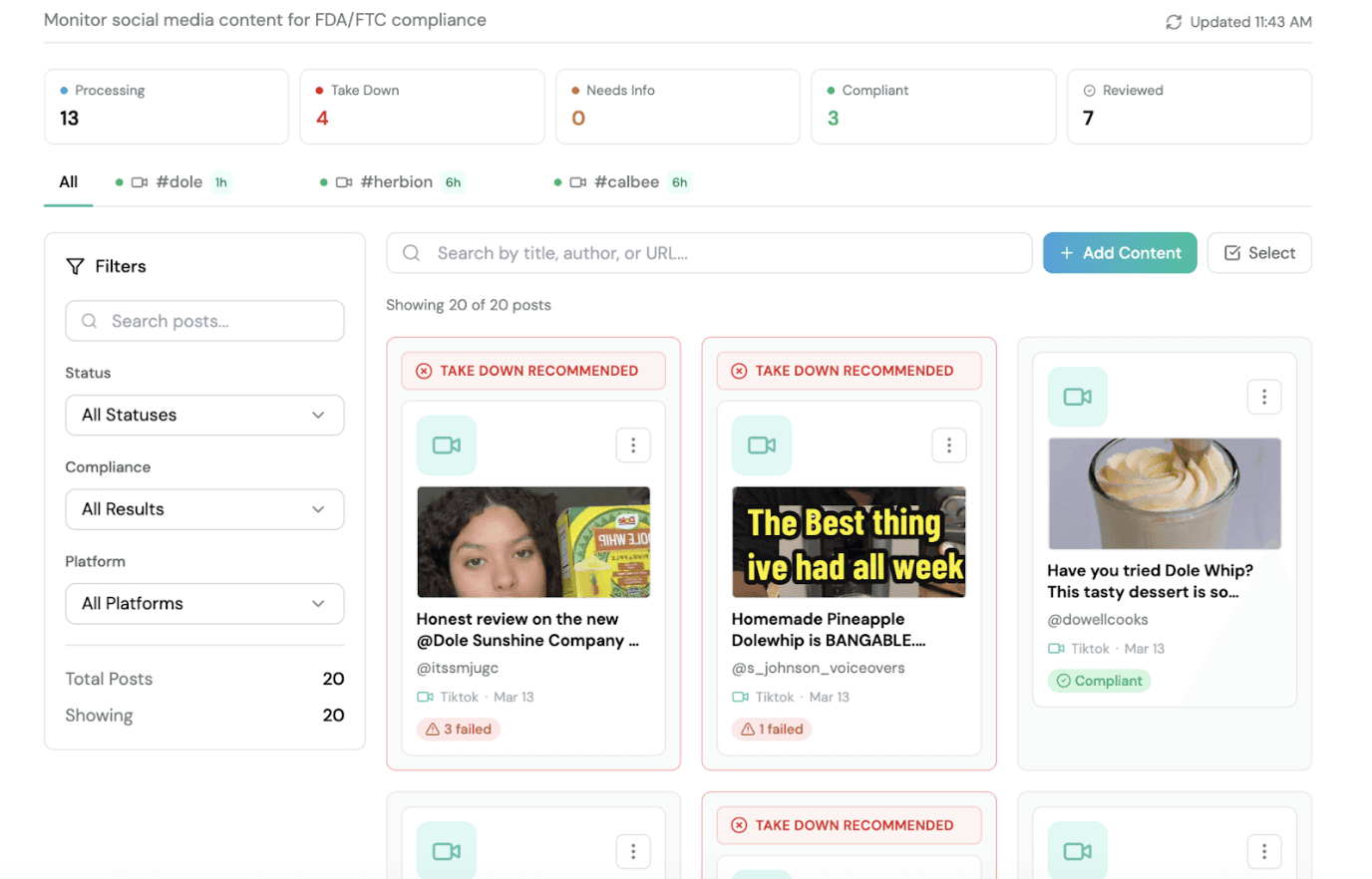
Truli is an AI-native compliance platform built for food and supplement CPG brands. Our AI agents audit your labels, packaging, and marketing against FDA and FTC rules, while Regulatory Radar monitors warning letters, recalls, and litigation trends across your product categories — including FSVP failures on imported ingredients. Ingredient and allergen cross-checks against your product catalog surface the undeclared-allergen and pathogen risks that FSVP verification is meant to catch. See where your import program has gaps before enforcement does. Book a demo.
About

Truli is an AI compliance platform for food, beverage, and supplement brands. Automate FDA/FTC label reviews, claims validation, and post-market monitoring — 10x faster.

Platform
See Truli in action
If regulatory delays are consuming months and thousands in fees, see how Truli delivers fast and continuous compliance coverage at a fraction of the cost.
Book a demo