FDA Food Label Compliance Review — What Brands Actually Get Wrong
An FDA food label compliance review is not a single thing. It's two distinct workstreams with different risk profiles, different regulatory frameworks, and different enforcement consequences. Brands that understand only one of them tend to find out about the other through a warning letter.

Michael Wu
| Co-founder at Truli

The two dimensions are format compliance and claims compliance. Format compliance is about whether the required elements are present and correctly configured — the Nutrition Facts panel, the ingredient list, the net quantity statement, the manufacturer's address. Claims compliance is about whether the health, function, and marketing language on the label and its associated labeling is legally permissible.
These are not the same review, and they shouldn't be conducted by the same process. Format compliance is largely a checklist operation. Claims compliance requires regulatory interpretation.
Format Compliance — What the Regulations Actually Require
FDA's food labeling regulations under 21 CFR Part 101 establish the mandatory elements that must appear on virtually every food product sold in the United States. The principal display panel (PDP), defined at 21 CFR 101.1 as "the part of a label that is most likely to be displayed, presented, shown, or examined under customary conditions of display for retail sale," must carry the statement of identity and net quantity of contents.
The information panel — the panel immediately to the right of the PDP under 21 CFR 101.2 — carries the Nutrition Facts panel, ingredient list, allergen declarations, and manufacturer information. The regulations specify not just what must appear but how: type size minimums, prominence requirements, the specific order in which ingredients must be listed, and the format of the Nutrition Facts table.
Common format violations brands actually encounter:
Net quantity statement placement. 21 CFR 101.7 requires the net quantity statement to appear in the bottom 30% of the PDP with minimum type size requirements based on the PDP area. Brands frequently place this statement correctly on one package format and misplace it when reformatting for a different package size.
Serving size accuracy. The serving size must reflect the amount of the food customarily consumed per eating occasion, as defined in FDA's reference amounts customarily consumed (RACC) tables under 21 CFR 101.12. Brands in beverage and snack categories frequently understate serving sizes to produce more favorable per-serving nutrition numbers — a practice FDA reviews during inspections.
Ingredient list formatting. Ingredients must be declared in descending order of predominance by weight under 21 CFR 101.4. Brands with complex formulations that incorporate ingredient blends or proprietary flavor systems sometimes misorder ingredients when the blend components are incorporated individually into the calculation. Additionally, water added as a processing aid that remains in the finished product must be included in the ingredient list even if the brand doesn't think of it as an ingredient.
Daily Value reference amounts. The 2020-2025 Dietary Guidelines updated Daily Value reference amounts for several nutrients, and FDA updated the Nutrition Facts panel requirements accordingly. Brands that haven't reviewed their Nutrition Facts panels since the compliance dates for the updated rules may be using outdated reference amounts.
Claims Compliance — The High-Risk Zone
Format errors generate compliance findings during inspections and can require label reformatting. Claims errors generate warning letters, import alerts, and in serious cases, product injunctions. The regulatory consequences are categorically more severe because claims errors constitute misbranding — representing the product as something it isn't.
For dietary supplements, the critical framework is the structure/function claim system under 21 CFR 101.93. Supplements may make structure/function claims that "describe the role of a nutrient or dietary ingredient intended to affect the structure or function in humans" — but only if those claims don't imply that the product treats, cures, mitigates, or prevents a disease.
FDA's ten-factor test for disease claims under 21 CFR 101.93(g) evaluates claim language based on:
The disease or health-related condition mentioned
The use of scientific or medical terminology that implies a drug effect
The description of the product's effect on characteristic signs or symptoms of a disease
Citation of a publication or reference that implies the product has a drug effect
The product name itself, if it implies a disease treatment function
This is why claim language that never uses the word "disease" can still constitute a disease claim. "Helps people with type 2 diabetes manage their blood sugar" doesn't need to say the word "disease" — it explicitly names the disease population. "Reduces the appearance of symptoms associated with psoriasis" describes a disease's characteristic signs.
For conventional food products, the claims framework is different but similarly structured. Nutrient content claims — "high fiber," "low sodium," "fat free," "good source of calcium" — have defined thresholds under 21 CFR 101.54 and related sections. Health claims — statements about the relationship between a nutrient and a disease or health-related condition — require FDA authorization under 21 CFR 101.14 or qualification for a qualified health claim with appropriate disclaimers.
Brands in the functional food category frequently blur between these claim types. A granola bar "high in fiber" with a claim that "diets high in fiber may reduce the risk of some types of cancer" — which is an authorized health claim for soluble fiber — must meet both the nutrient content claim threshold for "high fiber" and all the qualifying criteria for the authorized health claim. If the product doesn't meet the fiber threshold, the health claim isn't permitted regardless of whether the claim language is otherwise accurate.
What FDA Enforcement Actually Targets
A review of FDA warning letters from 2023 through 2025 reveals the most consistent enforcement targets:
Immune support claims that shade into disease claim territory. "Strengthens immune defense against viruses" is a disease claim — it implies prevention of viral infection. "Supports healthy immune function" is a structure/function claim. The line is thinner than most marketing teams recognize.
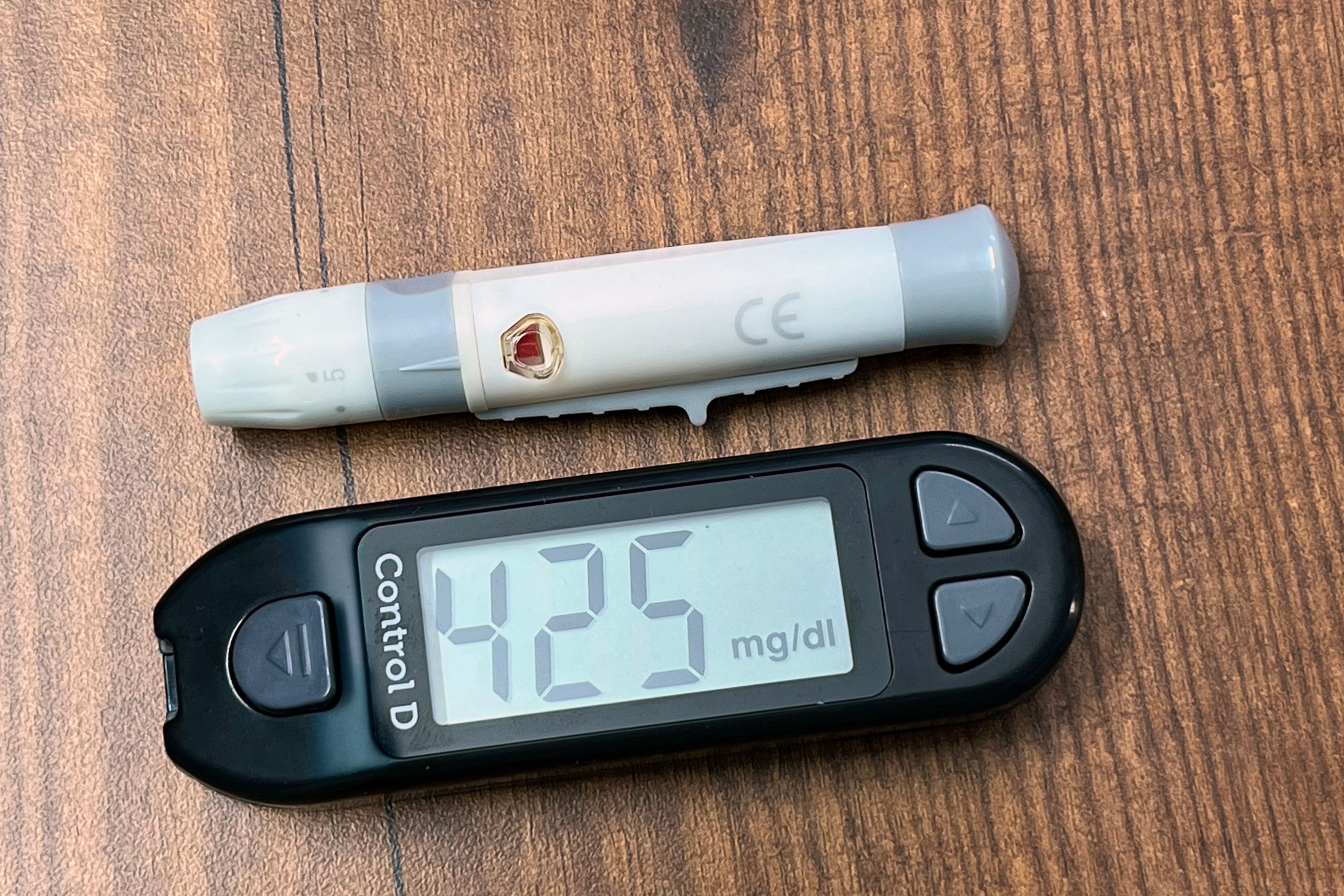
Blood sugar and cardiovascular claims. "Helps lower blood sugar" is a disease claim for diabetes. "Supports healthy blood pressure" requires careful framing to avoid implying treatment of hypertension. Both categories are consistently flagged in warning letters.
Missing disclaimers. The FDA disclaimer required under 21 CFR 101.93(b) — "This statement has not been evaluated by the Food and Drug Administration. This product is not intended to diagnose, treat, cure, or prevent any disease." — must appear on the label, prominently, whenever a structure/function claim appears. Omissions and improper configurations are among the most frequently cited violations.
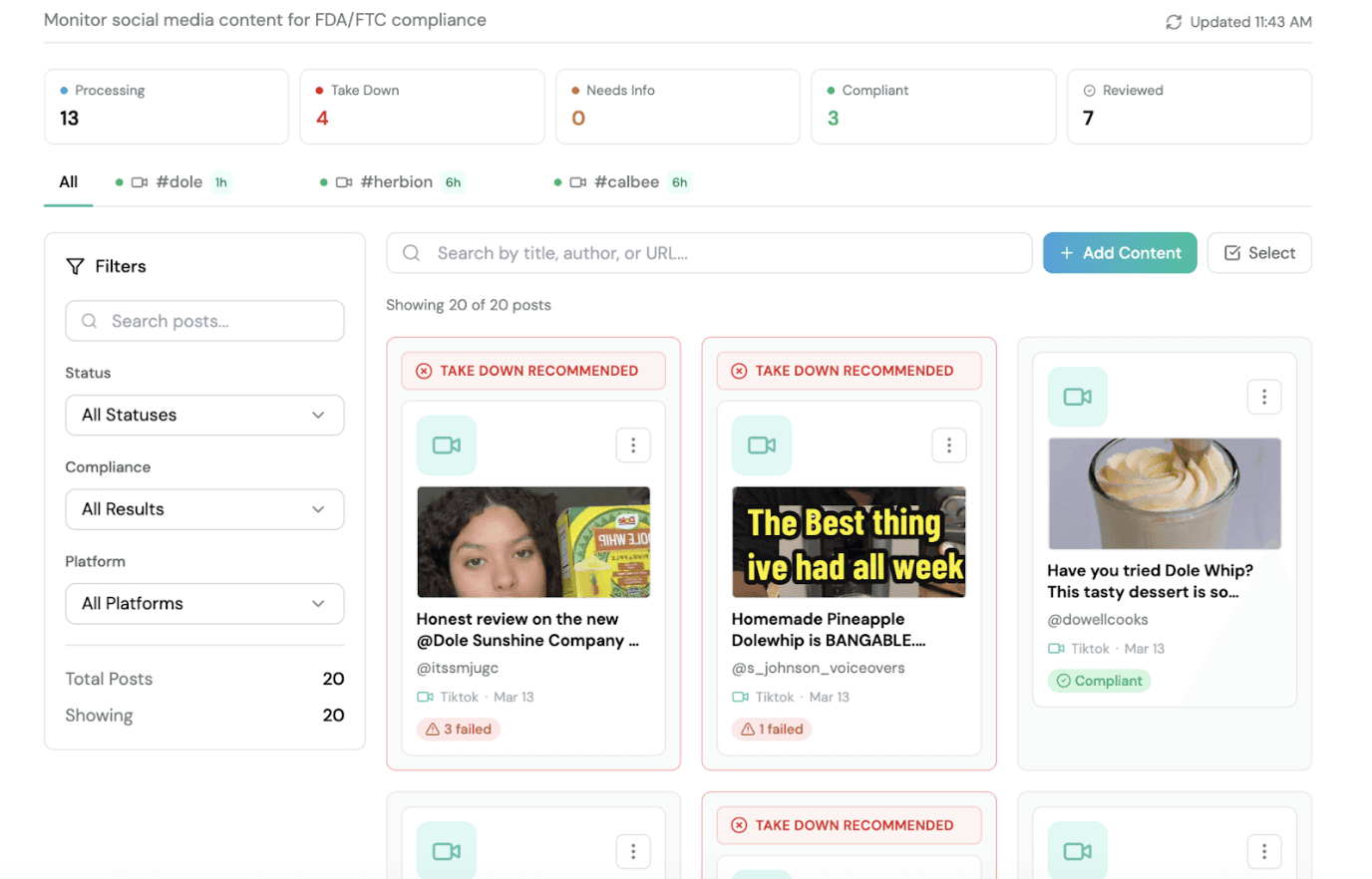
Website and digital channel claims. FDA increasingly quotes product website copy, Amazon product descriptions, and social media posts in warning letters. A physical label that passes careful review can still generate enforcement action if the website says something the label doesn't permit.
A Review Process That Actually Works
An effective FDA food label compliance review in 2026 requires separating the format review from the claims review, covering both the physical label and all digital channels, and updating the review whenever the product formulation, marketing copy, or applicable regulations change.
The format review is a structured checklist — every mandatory element, every type size requirement, every placement rule — applied to the actual label artwork file before production. The claims review requires evaluating every health, function, and marketing statement on the label and across all labeling against the regulatory framework that governs it.
The claims review is the harder workstream and the one most brands underinvest in. It requires knowing not just what claims the label makes, but what regulatory category each claim falls into, what requirements that category imposes, and whether the claim as written meets those requirements. That analysis needs to happen before the label goes to production — and it needs to happen again whenever the marketing copy changes, even if the physical label doesn't.
Truli runs both reviews in a single workflow
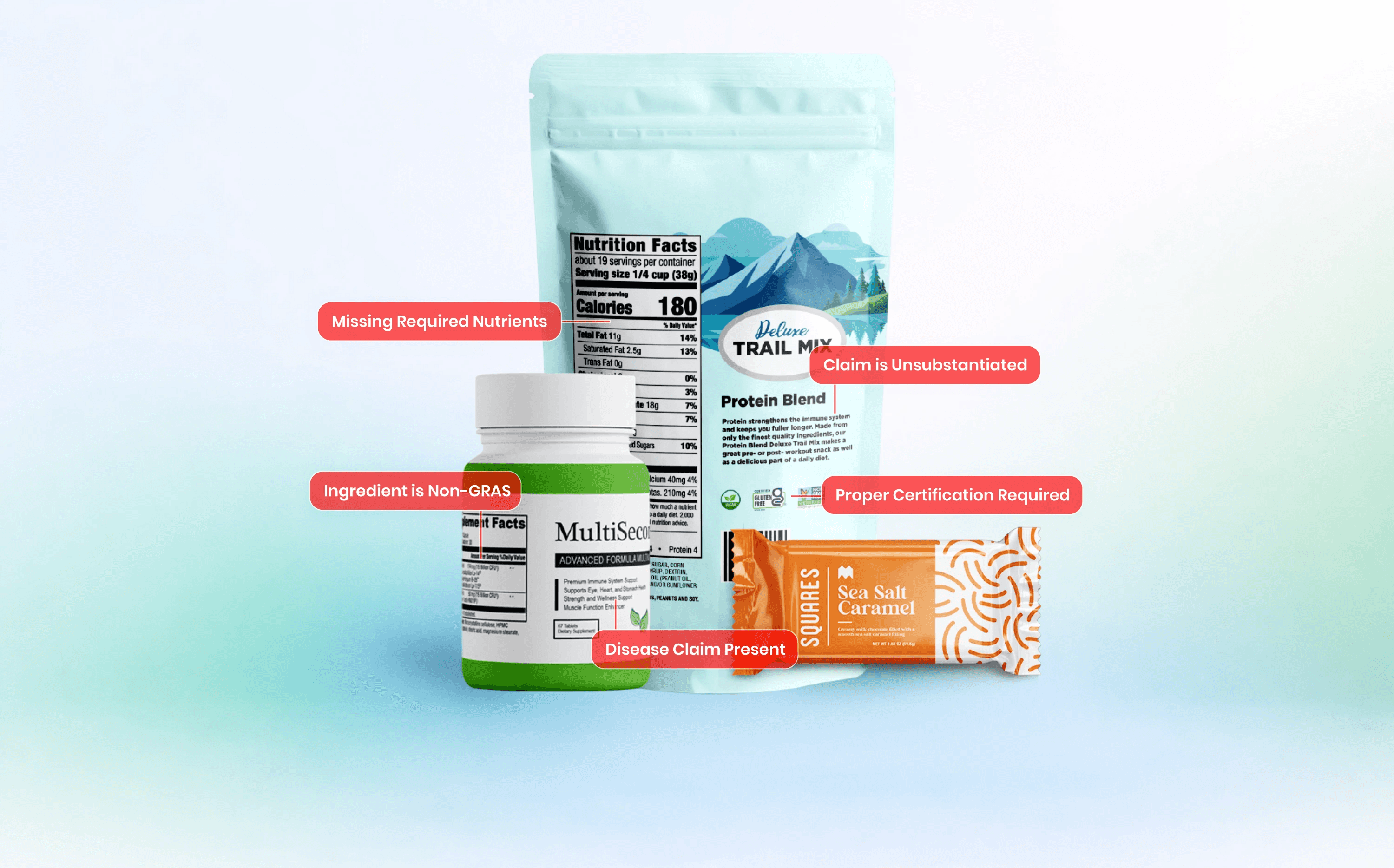
Truli's label compliance platform scans label images for required elements, evaluates every claim against the FDA regulatory framework, flags disease claim language and missing disclaimers, and extends the same analysis to website and marketing copy. Reviews are grounded in current regulation text retrieved at scan time — not a static ruleset. If you're preparing a new product launch or conducting a periodic compliance audit, Truli surfaces what needs to change before it reaches an enforcement reviewer.
A note from Truli: Truli is not a law firm, and this article does not constitute or contain legal advice or create an attorney-client relationship. When determining your obligations and compliance with respect to relevant laws and regulations, you should consult a licensed attorney.
About

Truli is an AI compliance platform for food, beverage, and supplement brands. Automate FDA/FTC label reviews, claims validation, and post-market monitoring — 10x faster.

Platform
See Truli in action
If regulatory delays are consuming months and thousands in fees, see how Truli delivers fast and continuous compliance coverage at a fraction of the cost.
Book a demo