The 5 Biggest CPG Label Compliance Mistakes Food Brands Make
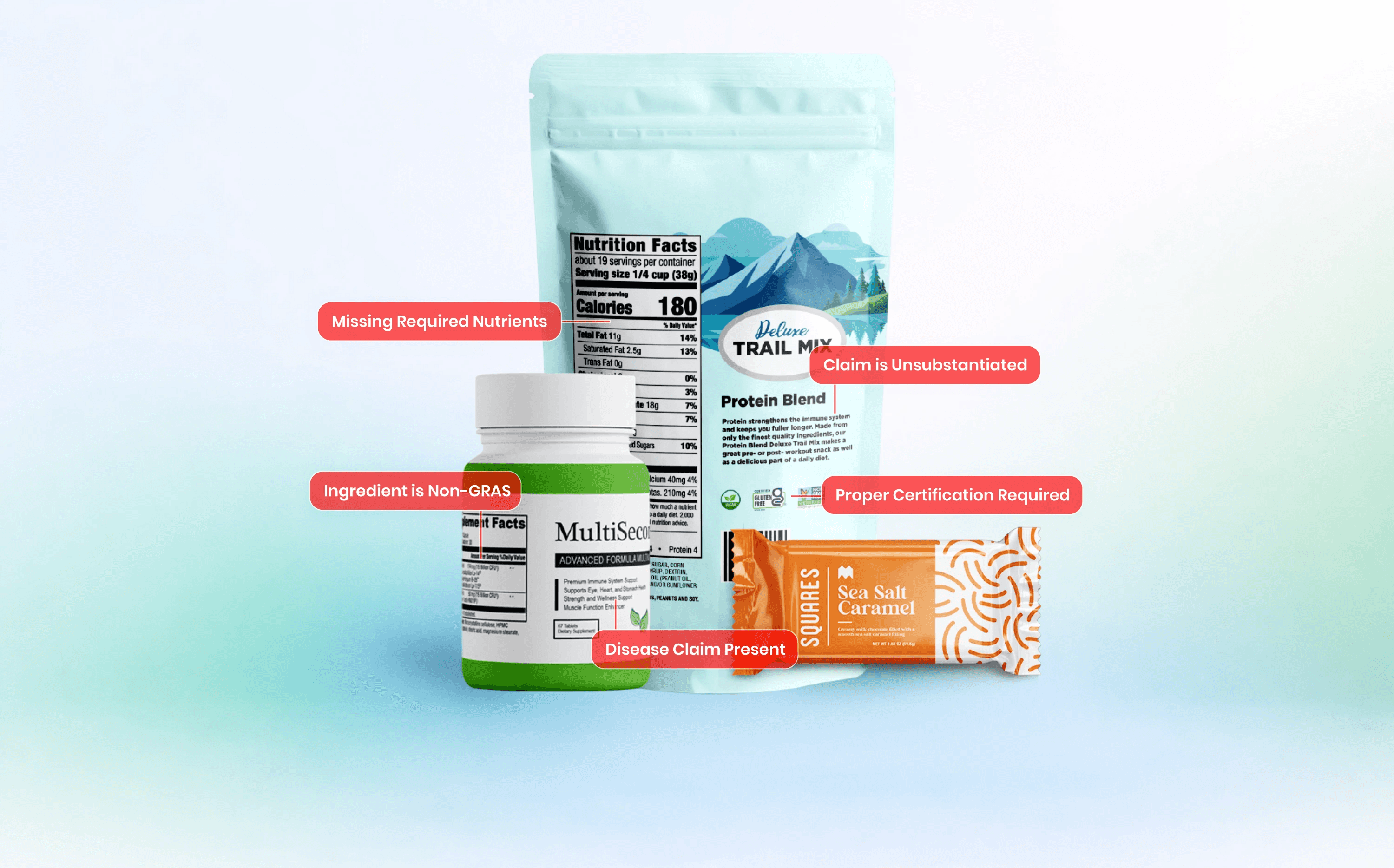
Most CPG brands approach label compliance as a format problem: Is the font the right size? Is the Nutrition Facts panel correctly formatted? Is the net quantity in the right place? These questions matter, but they're not where most enforcement originates. The mistakes that generate FDA warning letters, FTC civil investigative demands, and product recalls are almost always about what the label says — not how it looks.

Catherine Zhou
| Co-founder at Truli

A review of recent FDA warning letters and recall notices shows the same patterns repeating across brands in the supplement, food, and beverage categories. The mistakes aren't obscure regulatory edge cases. They're predictable failures in how brands understand the rules governing what they can claim about their products. Here are the five that show up most often.
Mistake 1 — Disease Claims Hidden in Marketing Language
The most common and most consequential CPG compliance mistake is using disease claim language without recognizing it as such. FDA defines a disease claim broadly under 21 CFR 101.93(g): any statement that explicitly or implicitly claims the product diagnoses, treats, cures, mitigates, or prevents a disease.
The problem is that brands routinely use language that meets this definition without using the obvious trigger words. "Reduces blood sugar levels" is a disease claim — blood sugar management is associated with diabetes. "Supports healthy inflammatory response" is usually compliant; "reduces inflammation" is often a disease claim depending on context. "Promotes heart health" is a structure/function claim; "lowers cholesterol" is a disease claim.
The line isn't always intuitive, and marketing teams — writing product copy under pressure to differentiate — frequently cross it. Common examples from recent warning letters:
"Clinically proven to reduce joint pain" (pain reduction + disease association)
"Helps prevent seasonal illness" (prevention = disease claim)
"Supports people with diabetes" (explicit disease population targeting)
"Anti-aging" language tied to specific disease mechanisms
A label bearing a disease claim is misbranded as a drug under 21 U.S.C. 331 unless the product is an approved drug or the claim qualifies as an FDA-authorized health claim. The enforcement consequences range from warning letters requiring immediate corrective action to product seizure.
Why it keeps happening
Marketing copy and label copy often go through different approval processes. Marketing writes for conversion; legal reviews for obvious red flags. The nuanced, implied disease claims — the ones that stop just short of saying "treats" but communicate the same thing through clinical terminology or disease population targeting — frequently survive internal review because no single person is looking at the regulatory framework with the attention it requires.
Mistake 2 — Missing or Misconfigured FDA Disclaimers
Dietary supplement brands making structure/function claims must include a specific disclaimer under 21 CFR 101.93(b): "This statement has not been evaluated by the Food and Drug Administration. This product is not intended to diagnose, treat, cure, or prevent any disease."
This disclaimer must appear:
Prominently on the label
In boldface type
Adjacent to the structure/function claim, or with a referencing symbol linking the claim to the disclaimer elsewhere on the label
Missing the disclaimer entirely is the most obvious violation. But misconfigured disclaimers — placed in a font too small to be "prominent," separated from claims without a linking symbol, or present on the label but not on the website where the same structure/function claims appear — generate the same warning letter outcome.
The disclaimer is also required on labeling, not just the physical label. FDA's definition of labeling extends to any written, printed, or graphic material that accompanies the product or is used in connection with its sale — including the brand's website, Amazon product pages, and promotional materials. A supplement brand that has the correct disclaimer on its bottle but runs the same structure/function claims on its website without the disclaimer is non-compliant.
The notification requirement most brands miss
Paired with the disclaimer is a notification requirement that brands consistently overlook: under 21 CFR 101.93(a), brands must notify FDA within 30 days of first marketing a supplement bearing a structure/function claim. The notification goes to FDA's Office of Dietary Supplement Programs and must include the text of the claim. Failure to notify doesn't automatically generate an enforcement action, but it's a separate violation that compounds the exposure when a product is reviewed.
Mistake 3 — Allergen Declaration Failures After FASTER Act
Undeclared allergens remain the leading cause of FDA food recalls year over year. The Food Allergen Labeling and Consumer Protection Act (FALCPA) established the mandatory declaration framework for the original eight major food allergens. The FASTER Act added sesame as the ninth, effective January 1, 2023.
Three years after the FASTER Act compliance date, sesame remains underdetected in CPG formulations. The issue isn't ignorance of the rule — most brands know sesame is now a declared allergen. The issue is that sesame appears in places that aren't obvious from the brand's own formulation records:
Seasoning blends and flavor compounds from ingredient suppliers
Shared manufacturing equipment at contract manufacturers
Carrier ingredients in botanical extracts and herbal blends
Natural flavor formulations that incorporate sesame-derived components
A brand that reformulated products before 2023 and hasn't conducted a post-FASTER Act allergen audit of every ingredient and every contract manufacturer facility may have undeclared sesame exposure in current production.
The compliance obligation isn't just about the label — it's about having an auditable supply chain process that catches allergen introductions before they reach consumers. FDA doesn't accept supplier certificates of analysis as a substitute for independent verification when conducting inspections.
Mistake 4 — "Natural," "Clean," and Sustainability Claims Without Substantiation
"Natural" has no formal FDA definition for food products. FDA's informal policy from 1993 considers "natural" to mean that nothing artificial or synthetic has been included in or added to the food that would not normally be expected to be there. But that policy is not a regulation, and FDA has specifically declined to finalize a formal definition despite multiple rulemaking efforts.
The practical consequence is that "natural" claims on food products are highly litigable. Class action plaintiffs' attorneys have filed hundreds of lawsuits against brands whose products contain high-fructose corn syrup, synthetic preservatives, artificial colors, or processing aids while bearing "natural" or "all natural" labeling. The litigation risk has proven to be a more immediate compliance consequence than FDA enforcement in many cases.
"Clean label" has even less regulatory definition than "natural" — it has no FDA meaning at all. Brands using "clean" to imply ingredient purity or absence of synthetic additives have no regulatory backstop if the claim is challenged.
FTC's Green Guides govern environmental claims — "sustainable packaging," "eco-friendly," "compostable," "recyclable" — and require that such claims be specific, truthful, and not misleading. Claims like "environmentally responsible" without qualification are considered deceptive under the Green Guides. With the EU Green Claims Directive tightening disclosure requirements internationally, brands with global distribution face simultaneous pressure from multiple enforcement frameworks.
Mistake 5 — Treating the Physical Label as the Only Compliance Risk
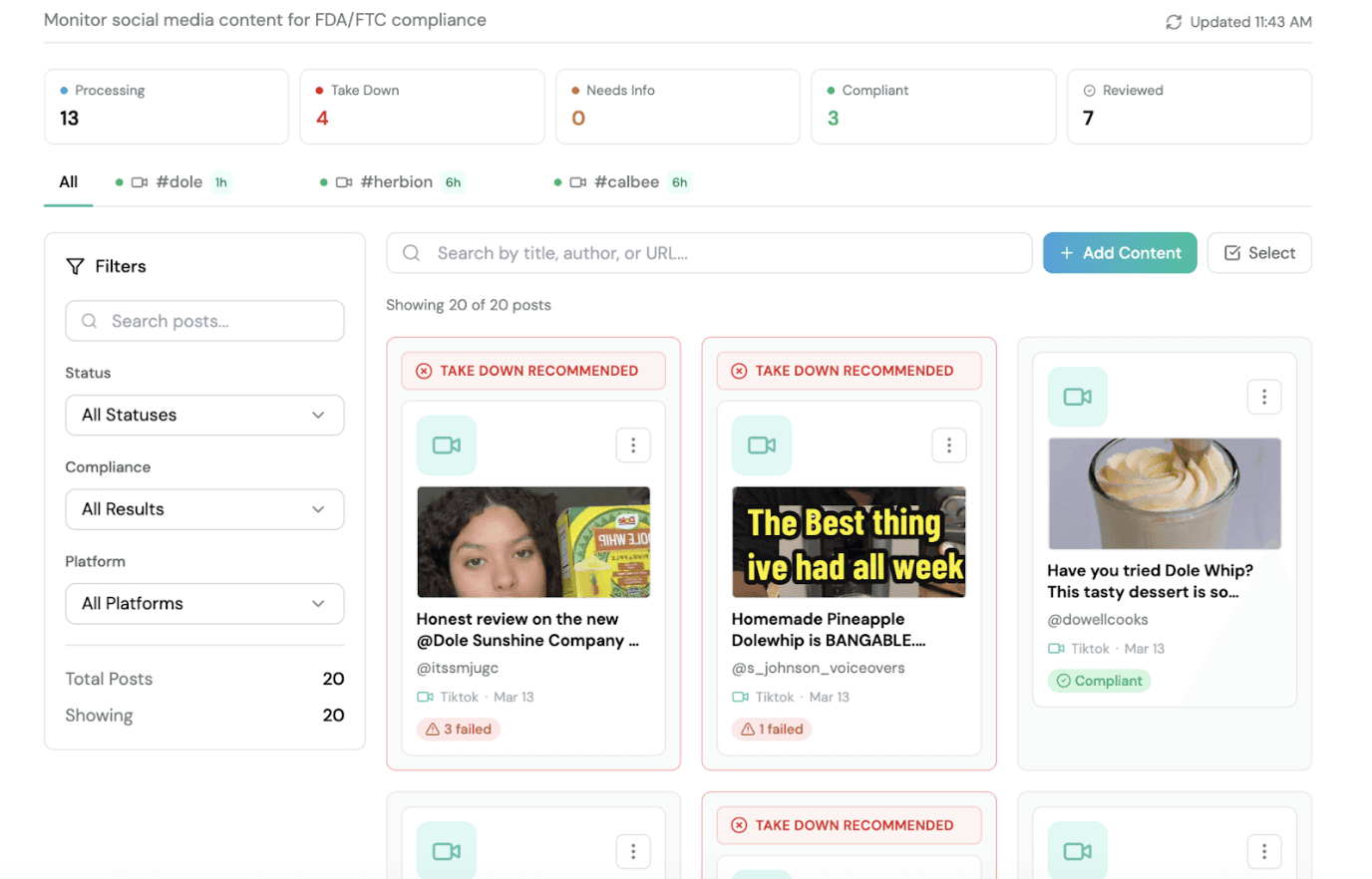
The most structurally significant CPG label compliance mistake is the narrowest definition of what "the label" includes. Brands that carefully review their physical label copy and then run the same — or looser — claims across their website, Amazon listing, social media, and influencer partnerships have not achieved compliance. They have achieved partial compliance in the channel that is hardest to change and left themselves exposed everywhere else.
FDA's definition of "labeling" under 21 U.S.C. 321(m) is intentionally broad: "all labels and other written, printed, or graphic matter (1) upon any article or any of its containers or wrappers, or (2) accompanying such article." FDA has long interpreted "accompanying" to include promotional materials used in connection with a product's sale — including websites.
In recent enforcement activity, FDA warning letters have quoted product website content, Amazon storefront copy, and social media posts with the same authority as physical label text. A brand whose supplement bottle carries only permitted structure/function claims but whose Instagram bio says "helps reverse insulin resistance" has a disease claim violation — on the label, as FDA construes it.
FTC takes the same comprehensive view of advertising and marketing channels. The FTC Act prohibits deceptive acts or practices "in or affecting commerce" — which means every channel, every platform, every piece of sponsored content.
Compliance requires a full-surface audit
The brands that avoid enforcement consequences approach compliance as a continuous audit of every channel where they make claims about their products — not a one-time review of the physical label. Truli's scanning covers label images, website copy, marketing content, and Amazon listings against the same regulatory framework, flagging claims that require remediation before they reach an enforcement reviewer.
A note from Truli: Truli is not a law firm, and this article does not constitute or contain legal advice or create an attorney-client relationship. When determining your obligations and compliance with respect to relevant laws and regulations, you should consult a licensed attorney.
About

Truli is an AI compliance platform for food, beverage, and supplement brands. Automate FDA/FTC label reviews, claims validation, and post-market monitoring — 10x faster.

Platform
See Truli in action
If regulatory delays are consuming months and thousands in fees, see how Truli delivers fast and continuous compliance coverage at a fraction of the cost.
Book a demo