CPG Label Compliance Checklist — Before Your Label Goes to Print
Every CPG brand needs a label compliance checklist — and most use one that's too short. Checking that the Nutrition Facts panel is formatted correctly isn't the same as checking that every claim on the label is legally permissible. This checklist covers both dimensions: the format requirements that generate inspection findings and the claims requirements that generate warning letters.

Catherine Zhou
| Co-founder at Truli

This checklist is structured as a pre-print review process for food and supplement brands. It separates format compliance — required elements, placement, and formatting — from claims compliance, which requires regulatory interpretation rather than a checklist lookup. Both need to happen before a label goes to print.
Use this as a working document alongside the actual label artwork, not as a post-production review. Finding a format error after 50,000 units are printed is expensive. Finding a disease claim violation after the product is in distribution is more expensive.
Section 1 — Principal Display Panel (PDP)
The PDP is the part of the label most likely to be examined under customary retail display conditions, defined at 21 CFR 101.1.
Statement of identity
The common or usual name of the food appears on the PDP
If the product is a dietary supplement, the label includes "Dietary Supplement" or the appropriate supplement category (e.g., "Herbal Supplement") as part of the statement of identity
The statement of identity is in bold type and prominent relative to the rest of the label
Net quantity of contents under 21 CFR 101.7
Net quantity appears in the bottom 30% of the PDP
Declared in both metric and U.S. Customary units (e.g., "16 fl oz (473 mL)")
Type size meets the minimum based on PDP area (1/16 inch minimum for PDPs up to 5 sq in; larger minimums for larger PDPs)
For multiunit packages: both total net quantity and per-unit count declared
PDP claims review
Every claim on the PDP has been evaluated against the claims checklist in Section 4
Section 2 — Information Panel
The information panel is the label panel immediately to the right of the PDP under 21 CFR 101.2. It must carry the Nutrition Facts or Supplement Facts panel, ingredient list, allergen declaration, and manufacturer information — all grouped together without intervening unrelated material.
Nutrition Facts panel under 21 CFR 101.9
Serving size matches FDA's reference amounts customarily consumed (RACC) for the product category under 21 CFR 101.12
Servings per container accurately reflects the total units divided by serving size
All required nutrients declared with correct Daily Value percentages using current (2020 update) Daily Values
Added sugars declared separately from total sugars
Vitamin D, calcium, iron, and potassium declared with %DV
Panel format matches FDA's current format specifications (type size, bold/non-bold, dividing lines)
If qualifying for small business exemption under 21 CFR 101.9(j), eligibility confirmed
Supplement Facts panel under 21 CFR 101.36 (supplements only)
Panel header reads "Supplement Facts" not "Nutrition Facts"
Serving size and servings per container declared
Each dietary ingredient listed with quantity per serving
Ingredients with established Daily Values (vitamins, minerals) show %DV
Proprietary blends declared as a blend with total weight; individual ingredients listed within the blend in descending order of predominance
Ingredient list under 21 CFR 101.4
All ingredients listed in descending order of predominance by weight
Ingredient blends and compound ingredients declared correctly (sub-ingredients in parentheses)
Water added as a processing aid that remains in the finished product is included
Spices, natural flavors, and artificial flavors declared using those terms (or specific names if required)
Color additives declared by name (not as "color" or "coloring")
Allergen declarations under FALCPA and the FASTER Act
All nine major allergens present in the product are declared: milk, eggs, fish, shellfish, tree nuts, wheat, peanuts, soybeans, sesame
Allergens declared either in the ingredient list using the common name (e.g., "wheat flour") or in a "Contains:" statement immediately following the ingredient list
Tree nuts declared by specific type (e.g., "almonds," "cashews")
Fish and shellfish declared by species (e.g., "salmon," "shrimp")
Contract manufacturer's allergen cross-contact risk has been assessed and documented
Name and place of business under 21 CFR 101.5
Name of the manufacturer, packer, or distributor appears on the label
Address includes street address (if not in a current city directory or phone book), city, state, and ZIP code
If the product is distributed by a company other than the manufacturer, the label includes "Distributed by" or "Manufactured for" with the appropriate name
Section 3 — Type Size and Prominence Requirements
Under 21 CFR 101.15, required label statements must be prominent, conspicuous, and easy to read.
Minimum type size for required label statements: 1/16 inch for labels on packages with ≤12 sq in of total surface; larger minimums for larger packages
All required statements appear in English (additional languages may be added but cannot replace English)
No required statement is obscured by graphics, design elements, or color contrast issues
For supplements: FDA disclaimer appears in boldface type and is not smaller in type size than the accompanying structure/function claim
Section 4 — Claims Review
This section requires regulatory evaluation, not just a checklist lookup. Each claim type has its own compliance framework — verify which framework applies before checking compliance against it.
Structure/function claims (dietary supplements) under 21 CFR 101.93
Every structure/function claim has been reviewed against FDA's disease claim criteria under 21 CFR 101.93(g)
No claim explicitly or implicitly names a disease, names a disease population, describes characteristic signs or symptoms of a disease, or uses clinical/medical terminology implying drug effects
The required FDA disclaimer appears on the label, prominently and in boldface: "This statement has not been evaluated by the Food and Drug Administration. This product is not intended to diagnose, treat, cure, or prevent any disease."
Disclaimer placement meets requirements: adjacent to the claim or linked by a referencing symbol
FDA has been notified of structure/function claims within 30 days of first marketing under 21 CFR 101.93(a)
Nutrient content claims (food and supplement) under 21 CFR 101.13 and related sections
Each nutrient content claim (e.g., "high fiber," "low sodium," "good source of vitamin C") meets the defined threshold for that term
"High" or "excellent source" claims require ≥20% DV per serving
"Good source" claims require 10–19% DV per serving
"Free" claims meet the applicable threshold (e.g., "fat free" requires <0.5g fat per serving)
"Healthy" claims satisfy the updated 21 CFR 101.65 criteria (food group requirement + sodium/saturated fat/added sugar limits)
Health claims under 21 CFR 101.14
Any claim about the relationship between a nutrient or food and a disease is either an FDA-authorized health claim or a qualified health claim with the appropriate disclaimer
If an authorized health claim: the product meets all qualifying criteria (nutrient thresholds, food category eligibility)
If a qualified health claim: the required disclaimer accurately reflects the level of scientific evidence supporting the claim
General marketing language
"Natural" claims reviewed against FDA's informal policy (nothing artificial or synthetic added that would not normally be expected)
"Clean" or "clean label" language reviewed — no FDA definition exists; litigation risk assessed
Environmental/sustainability claims reviewed against FTC Green Guides (see Section 5)
"Non-GMO" claims reviewed — no FDA definition; USDA BE disclosure requirements assessed
Section 5 — Digital Channel Review
FDA's definition of "labeling" extends to product websites and promotional materials. FTC's truth-in-advertising standards apply across every marketing channel. The label review isn't complete until the same review has been applied to:
Brand website — every health claim, function claim, and benefit statement reviewed against the same standards as the physical label
Amazon listing — title, bullet points, product description, and A+ content reviewed for disease claim language; required disclaimers present if structure/function claims appear
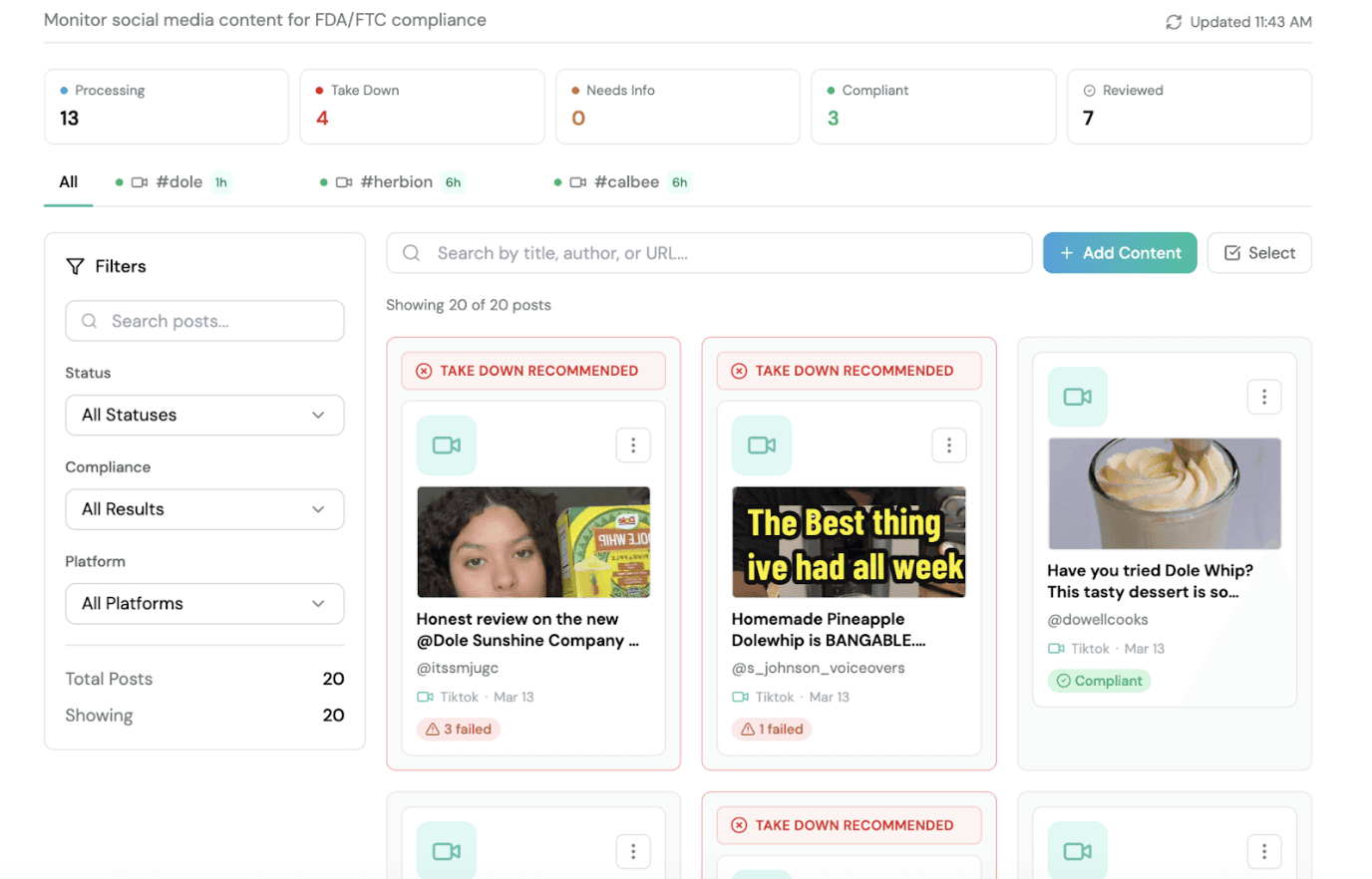
Social media profiles and posts — disease claim language, testimonials citing health outcomes, influencer content reviewed
Email marketing and advertising — claim language consistent with what the physical label supports
Influencer partnerships — sponsored content reviewed for undisclosed disease claims; FTC disclosure language confirmed
Section 6 — Retailer-Specific Requirements
Major retailers impose label requirements beyond FDA and FTC that function as additional compliance layers for brands seeking distribution.
Whole Foods Market: formulation reviewed against Whole Foods unacceptable ingredients list; any ingredients on the banned list addressed before submission
Amazon: supplement listings reviewed for disease claim language in all text fields; Amazon's SCP program requirements reviewed if applicable
Costco and club channels: package size and net quantity labeling requirements for club format reviewed
Natural channel retailers (Sprouts, Natural Grocers, Fresh Market): retailer-specific formulation and claim standards confirmed with buyer or retailer compliance documentation
Section 7 — Pre-Print Approval
Before the label file goes to the printer:
Format compliance confirmed by someone with knowledge of 21 CFR Part 101 requirements
Claims compliance confirmed against the applicable regulatory framework for each claim type
Label artwork file matches the final approved version — no unapproved changes between the reviewed version and the print file
Allergen review confirmed with current contract manufacturer documentation
For new supplement products: FDA structure/function claim notification submitted or calendar reminder set for within 30 days of first sale
Run this checklist through Truli before print
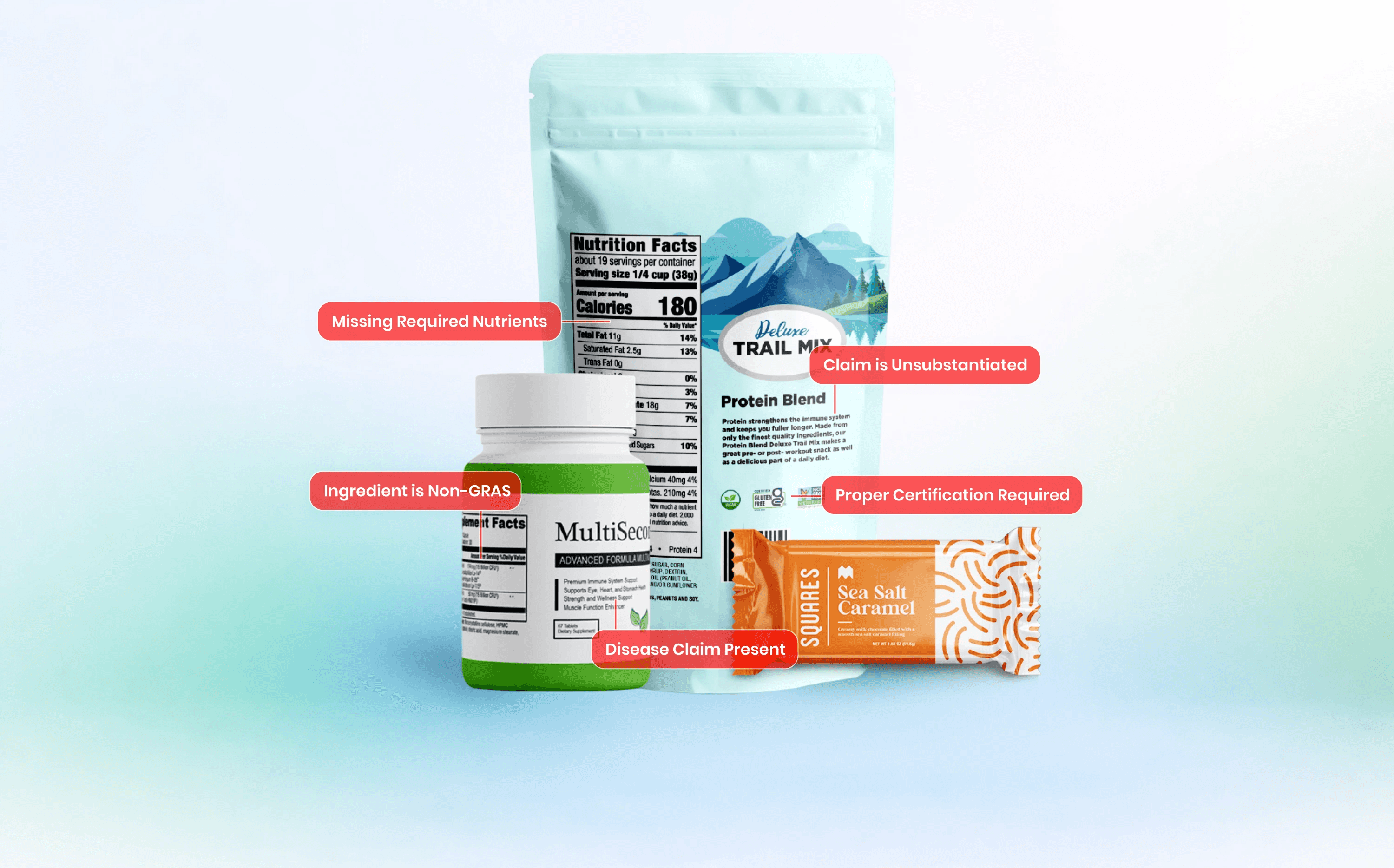
Truli's label compliance scanning runs the format and claims review simultaneously — checking mandatory element placement, evaluating every claim against FDA's regulatory framework, flagging disease claim language and missing disclaimers, and extending the same scan to website and Amazon copy. For brands preparing a new label for print or reviewing an existing label before scaling, Truli surfaces what the checklist would flag, faster and more consistently than a manual review.
A note from Truli: Truli is not a law firm, and this article does not constitute or contain legal advice or create an attorney-client relationship. When determining your obligations and compliance with respect to relevant laws and regulations, you should consult a licensed attorney.
About

Truli is an AI compliance platform for food, beverage, and supplement brands. Automate FDA/FTC label reviews, claims validation, and post-market monitoring — 10x faster.

Platform
See Truli in action
If regulatory delays are consuming months and thousands in fees, see how Truli delivers fast and continuous compliance coverage at a fraction of the cost.
Book a demo