CPG Compliance for New Brands — Before Your First Product Ships
New consumer packaged goods brands discover compliance in one of two ways: proactively, before the first product ships, or reactively, when a retailer rejects the label, a competitor files a complaint, or FDA sends a warning letter. The proactive path is cheaper and faster. But it requires understanding which compliance obligations are actually non-negotiable before launch — and which ones can be addressed iteratively.

Catherine Zhou
| Co-founder at Truli

The compliance landscape for a new CPG brand looks overwhelming from the outside. FDA, FTC, USDA, state regulators, retailer compliance requirements, allergen frameworks, claim restrictions — the list of things that could generate an enforcement action seems endless. The practical reality is more manageable than it appears, but only if you understand what's actually required at launch versus what can develop alongside the business.
This guide is for brand operators who are building their first food or supplement product and need to understand what compliance actually requires before the product reaches a consumer.
What Federal Law Actually Requires at Launch
The Food, Drug, and Cosmetic Act (FD&C Act) requires that food products sold in interstate commerce not be adulterated or misbranded. Misbranding means the label is false or misleading, missing required information, or otherwise doesn't meet FDA's labeling regulations under 21 CFR Part 101. There is no pre-market label approval for food products — FDA doesn't review and approve food labels before products hit shelves. The brand is responsible for getting the label right, and FDA acts after the fact if it doesn't.
This structure has an important implication for new brands: there's no checkpoint between you and the market. A label that goes to print with a disease claim on a supplement, a missing allergen declaration, or an improperly formatted Nutrition Facts panel isn't caught by a regulatory gatekeeper. It goes to consumers, and the consequences come later.
The mandatory elements every food label must include before launch:
Statement of identity — the common or usual name of the food, on the Principal Display Panel.
Net quantity of contents — declared in both metric and U.S. Customary units, in the bottom 30% of the PDP, with minimum type size based on PDP area under 21 CFR 101.7.
Name and place of business — the manufacturer, packer, or distributor name and address under 21 CFR 101.5.
Ingredient list — every ingredient in descending order of weight predominance under 21 CFR 101.4.
Nutrition Facts or Supplement Facts panel — formatted to FDA's current specifications under 21 CFR 101.9 or 21 CFR 101.36.
Allergen declarations — for any of the nine major food allergens present in the product, under FALCPA and the FASTER Act. The nine allergens are milk, eggs, fish, shellfish, tree nuts, wheat, peanuts, soybeans, and sesame.
None of these are optional for any food product sold through interstate commerce. Small business exemptions exist for the Nutrition Facts panel under 21 CFR 101.9(j) — brands with fewer than 100 full-time employees and fewer than 100,000 units of a product sold annually can qualify — but the other mandatory elements apply regardless of company size.
Where New Brands Actually Go Wrong
The most common compliance failures for new CPG brands aren't format errors on the mandatory elements. They're claims errors — statements about what the product does that cross regulatory lines new founders don't know exist.
Calling a supplement a food (or a food a supplement)
The regulatory category a product falls into determines which rules govern its labeling. A dietary supplement and a conventional food with the same ingredient can carry very different claim sets. Supplements may make structure/function claims under 21 CFR 101.93 that conventional foods generally can't. But supplements face stricter restrictions on disease claims and can't be sold with an implied intent to treat or prevent a disease.
New brands sometimes don't make a deliberate category decision — they pick a product format and start writing label copy without knowing which regulatory framework governs their claims. The result is label copy that doesn't fit either category cleanly, generating exposure under both.
Disease claims on supplement labels
Structure/function claims describe how a nutrient or ingredient affects normal body structure or function. Disease claims describe the product's effect on a disease or its symptoms. The line between them is not intuitive, and marketing-oriented founders frequently write copy that crosses it.
"Supports immune health" is a structure/function claim. "Helps prevent colds and flu" is a disease claim — cold and flu are diseases. "Promotes joint comfort" is a structure/function claim. "Relieves arthritis pain" is a disease claim. Any supplement bearing a disease claim is misbranded as a drug unless it qualifies under a narrow set of authorized health claims — which virtually no new supplement product will.
Missing the FDA disclaimer
Every dietary supplement label bearing a structure/function claim must include, prominently and in boldface, the disclaimer under 21 CFR 101.93(b): "This statement has not been evaluated by the Food and Drug Administration. This product is not intended to diagnose, treat, cure, or prevent any disease." New supplement brands routinely omit it entirely or place it in a font too small to be considered prominent.
Allergen blind spots in contract manufacturing
New brands almost universally use contract manufacturers. Contract manufacturers run multiple products through shared equipment. The allergen cross-contact risks at a contract manufacturer are real and the brand's responsibility to audit. A new supplement brand that hasn't confirmed its contract manufacturer's allergen management procedures — shared equipment lines, cleaning validation, cross-contact risk disclosure — has an undisclosed allergen exposure it doesn't know about.
The FTC Layer New Brands Miss Entirely
The Federal Trade Commission's jurisdiction over health claims doesn't depend on the product category or the label. FTC's truth-in-advertising standards apply to every claim a brand makes across every channel: website, Amazon listing, social media, email, influencer content.
New brands often establish a careful label that passes review, then write unrestricted website copy and social content without applying the same claim standards. An Instagram post from a sponsored influencer saying your supplement "cured my chronic pain" is a disease claim made by the brand under FTC's endorsement guidelines. The fact that the influencer said it, not the brand's own copy, doesn't create distance — the brand is responsible for claims made in sponsored content under 16 CFR Part 255.
FTC's substantiation standard for health claims — "competent and reliable scientific evidence" — means well-designed human clinical trials. New brands without clinical evidence behind their health claims need to confine their claim language carefully to what the regulatory framework permits without substantiation requirements.
What a Pre-Launch Compliance Review Should Cover
Before the first production run, a new CPG brand should have reviewed:
Every mandatory label element for presence, placement, and formatting against 21 CFR Part 101
Every claim on the label — health, function, nutrient content — against the specific regulatory framework governing it
Allergen declarations against the current nine-allergen list, including contract manufacturer risk assessment
Website and marketing copy against the same claim standards as the physical label
For supplements: the structure/function claim notification requirement (FDA notification within 30 days of first marketing)
This isn't a lengthy process for a single-SKU brand, but it requires knowing what you're looking for. The most expensive compliance failures for new CPG brands are the ones that make it through an entire production run, into distribution, and to consumers before anyone catches the problem.
Truli is built for exactly this
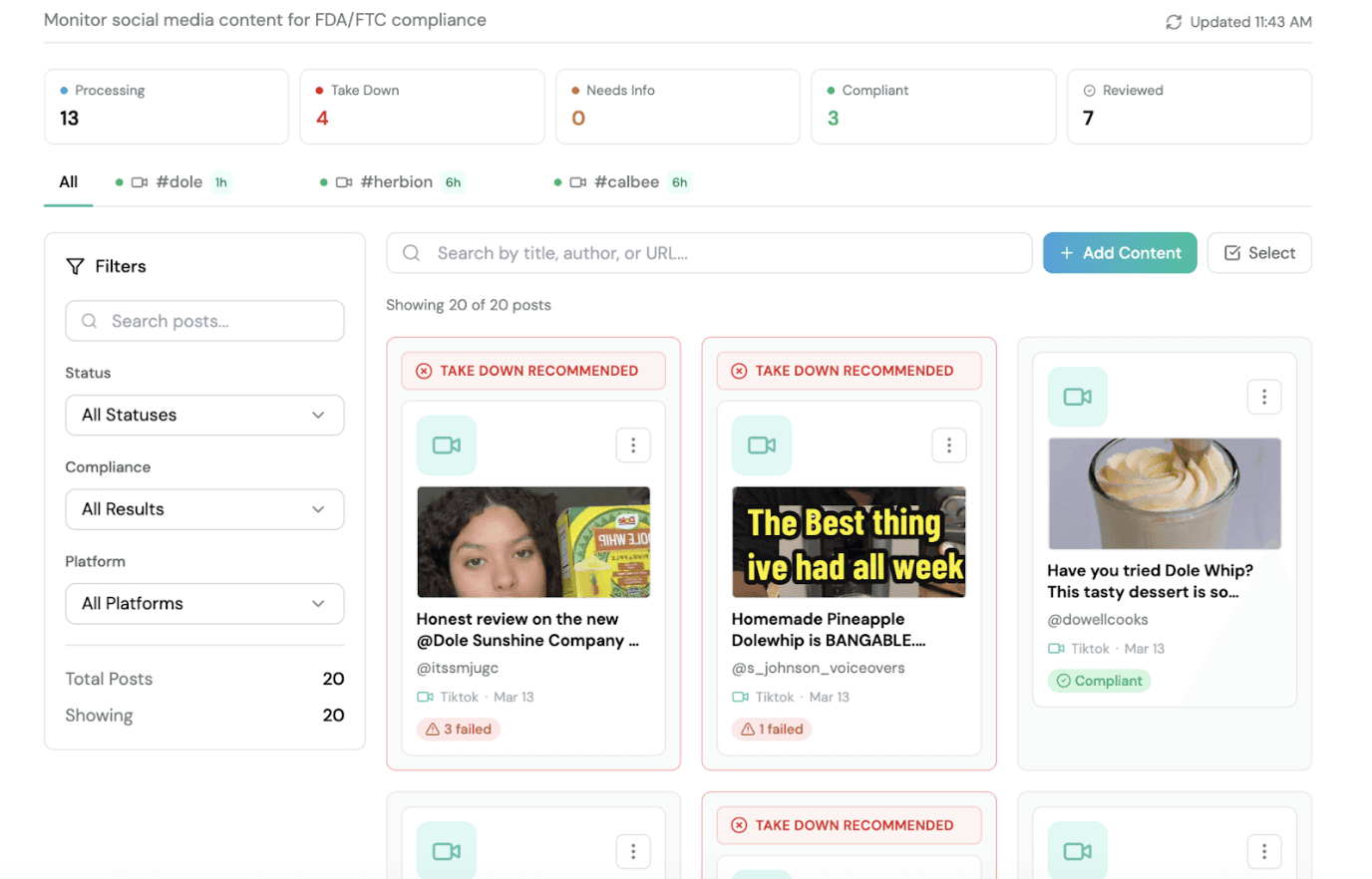
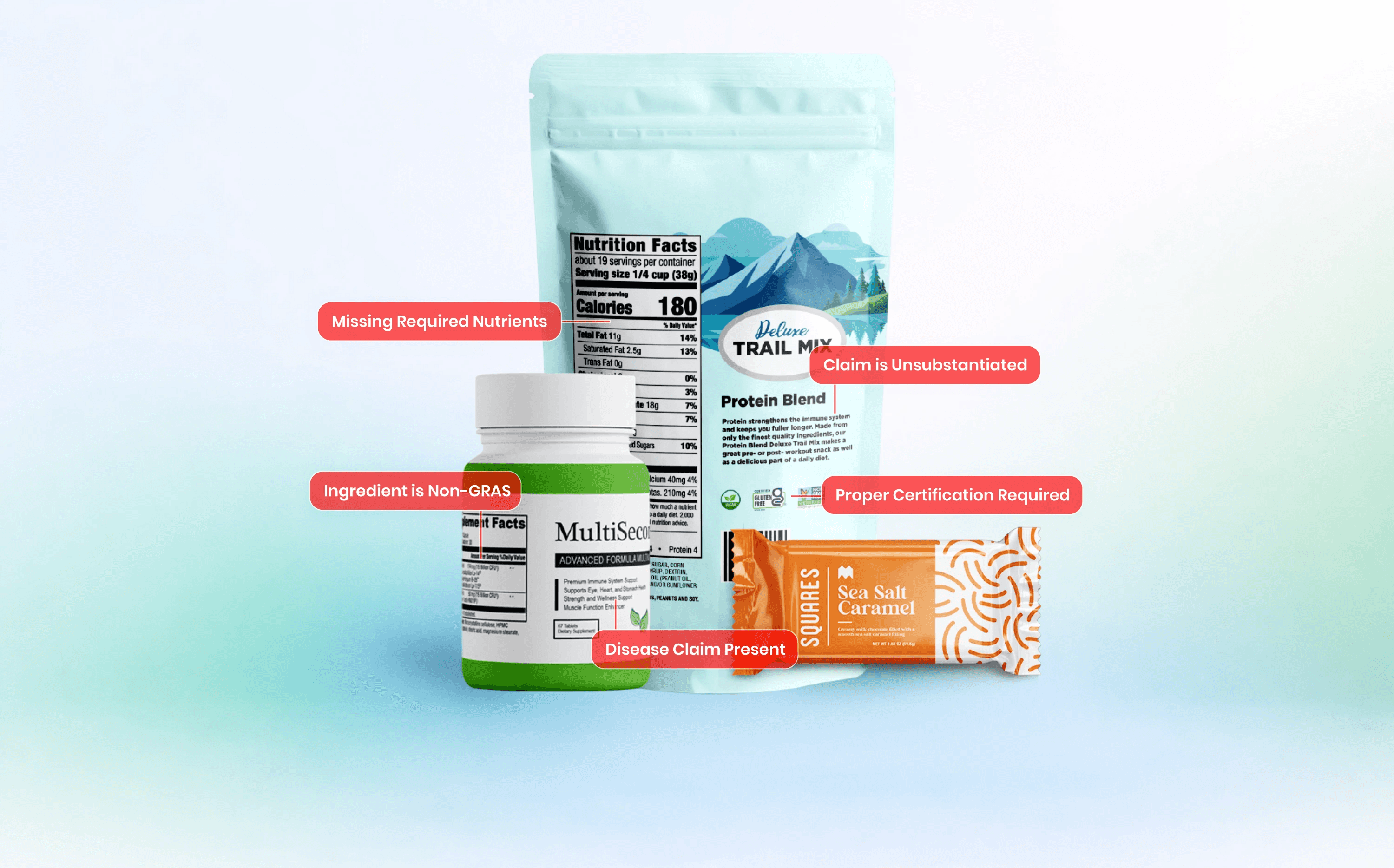
Truli runs label compliance scanning against FDA's regulatory framework for new product launches — checking mandatory elements, flagging disease claim language, verifying the FDA disclaimer, and scanning website copy for claims that don't match what the label supports. If you're preparing your first product for launch or reviewing an existing label before scaling, Truli surfaces the issues before they become enforcement problems.
A note from Truli: Truli is not a law firm, and this article does not constitute or contain legal advice or create an attorney-client relationship. When determining your obligations and compliance with respect to relevant laws and regulations, you should consult a licensed attorney.
About

Truli is an AI compliance platform for food, beverage, and supplement brands. Automate FDA/FTC label reviews, claims validation, and post-market monitoring — 10x faster.

Platform
See Truli in action
If regulatory delays are consuming months and thousands in fees, see how Truli delivers fast and continuous compliance coverage at a fraction of the cost.
Book a demo