Collagen Peptide Claims — What FDA Lets Brands Say
Collagen peptides are the rare peptide ingredient that is unambiguously legal to sell as a supplement. The claims are where brands get hurt. Joint, bone, protein, and sourcing claims each carry a specific FDA or FTC rule, and the protein one surprises almost everyone.

Catherine Zhou
| Co-founder at Truli

Collagen peptides anchor the lawful end of the peptide market. Unlike the research-peptide gray zone, hydrolyzed collagen is a conventional dietary ingredient with a long food-use history. That settles the ingredient question, but not the claims question. Collagen marketing runs on joint, bone, skin, and protein promises — and each of those has a regulatory line. This guide covers the full claims picture for collagen brands, beyond the beauty-claim angles we've covered separately.
Collagen Peptides Are a Lawful Dietary Ingredient
The ingredient status is not in doubt. Hydrolyzed collagen from bovine hide, fish skin, chicken, or eggshell membrane comes from proteins with decades of food use — gelatin is the obvious ancestor. That gives collagen peptides clear dietary ingredient status under DSHEA, with no New Dietary Ingredient fight for standard hydrolysates. This is exactly the line that separates collagen from BPC-157 and the GLP-1 copycats: food-derived hydrolysates can be supplements, pharmacological peptides cannot.
Structure/Function Claims That Work
Collagen brands can claim support for normal structure and function, and nothing more. Claims like these sit comfortably inside the lane:
"Supports skin elasticity"
"Supports joint health and flexibility"
"Supports healthy bones"
"Supports cartilage and connective tissue health"
"Supports healthy hair and nails"
Each claim describes maintaining normal function in healthy people. The moment copy shifts from maintaining to fixing — restoring, rebuilding, repairing — it drifts toward drug territory.
The 101.93 disclaimer is not optional
Every structure/function claim triggers 21 CFR 101.93. You must notify FDA of the claim's exact wording within 30 days of first marketing, and the label must carry the disclaimer: "This statement has not been evaluated by the Food and Drug Administration. This product is not intended to diagnose, treat, cure, or prevent any disease." Placement and type-size rules are spelled out in the regulation. Missing or reworded disclaimers are among the easiest violations for FDA to spot.
Where Collagen Claims Become Disease Claims
Arthritis, osteoporosis, and wound healing are the three lines collagen marketers cross most. All three are diseases or disease treatment, which makes any claim about them a drug claim requiring FDA approval collagen will never have.
You can say | You cannot say |
|---|---|
Supports joint comfort and mobility | Relieves arthritis or joint pain |
Supports healthy bones | Prevents or reverses osteoporosis |
Supports skin health and elasticity | Heals wounds or repairs damaged skin |
Supports cartilage health | Rebuilds worn cartilage |
Supports recovery from exercise | Repairs tendon and ligament injuries |
The pattern is consistent. Naming a disease, promising repair of damage, or implying treatment of pain converts a supplement into an unapproved drug under FDA's reading, regardless of how strong the ingredient science looks.
"Clinically Proven" and Percentage Claims
"Clinically proven" claims are FTC territory, and the standard is competent and reliable scientific evidence — for your claim, at your dose, in your form. Most collagen clinical literature involves branded ingredients studied at specific daily doses, typically 2.5 to 10 grams. Borrowing that science for a product with a different dose, source, or peptide profile is the classic substantiation gap FTC's Health Products Compliance Guidance warns about.
Specific-percentage claims raise the bar further. "Reduces wrinkle depth by 32%" or "improves joint comfort in 12 weeks" are quantified outcome claims. They require controlled human data showing that result — not directionally similar results from a different formulation. If your substantiation is a supplier study, your dose and ingredient must match the study before the number goes anywhere near your label.
The Protein Claim Trap — Collagen Scores Zero
Collagen cannot support protein content claims. Collagen contains no tryptophan, which gives it a PDCAAS (protein digestibility-corrected amino acid score) of zero. Under 21 CFR 101.9(c)(7), when protein quality scores below 20 percent, the label must either state "not a significant source of protein" or show the corrected percent Daily Value — which for collagen is 0%.
That zero cascades through the claims rules. "High protein" requires 20% or more of the Daily Value under 21 CFR 101.54, and "good source" requires 10 to 19 percent — both computed on the corrected amount. A quality-adjusted zero can never clear either threshold. Even a bare front-panel callout like "10g protein" functions as a protein claim that triggers the corrected %DV declaration, and a 0% Daily Value next to a protein flag is a deceptive-labeling problem waiting for a class action.
What compliant brands do instead
State the collagen, not the protein. "10g collagen peptides per serving" makes the same quantity point without invoking the protein claim framework. Blended products that add a complete protein can make protein claims — but the %DV math must run on the blend's actual corrected score, not the label's total grams.
Marine vs Bovine Sourcing Claims
Sourcing claims carry two separate obligations. First, marine collagen is derived from fish — a major food allergen. Federal allergen law requires declaring fish by species on the label, so "marine collagen" alone does not satisfy the allergen declaration. Second, sourcing adjectives are advertising claims: "wild-caught," "grass-fed," and "pasture-raised" all require documentation running back through your supply chain, and FTC treats unsupported sourcing claims as deceptive.
Comparative absorption claims deserve special caution. "Marine collagen absorbs 1.5x better than bovine" is a quantified comparative claim that needs head-to-head evidence for the specific peptide preparations compared. Molecular-weight talking points from a supplier deck are not a clinical comparison.
Scan your collagen claims before the regulators do
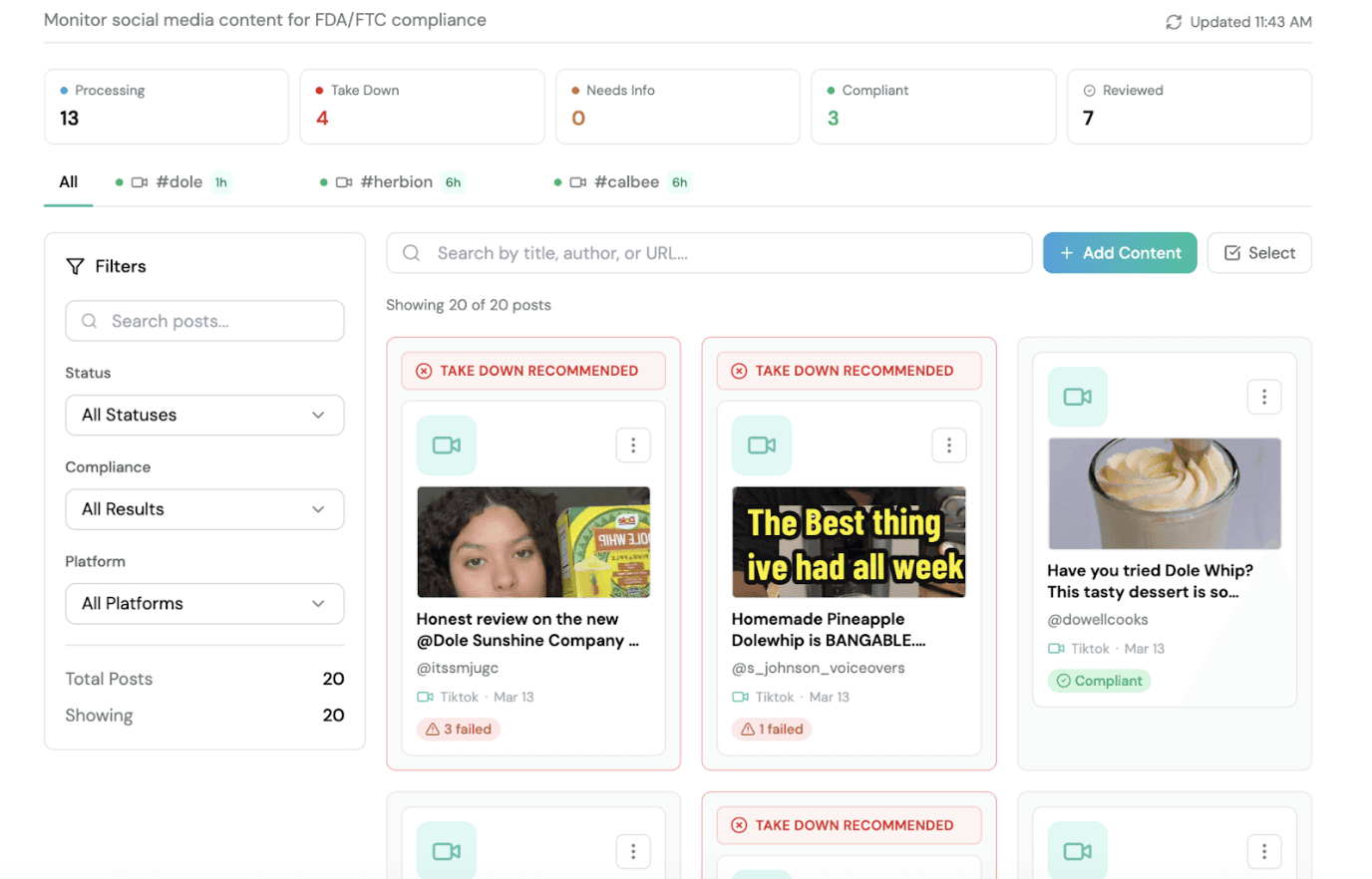
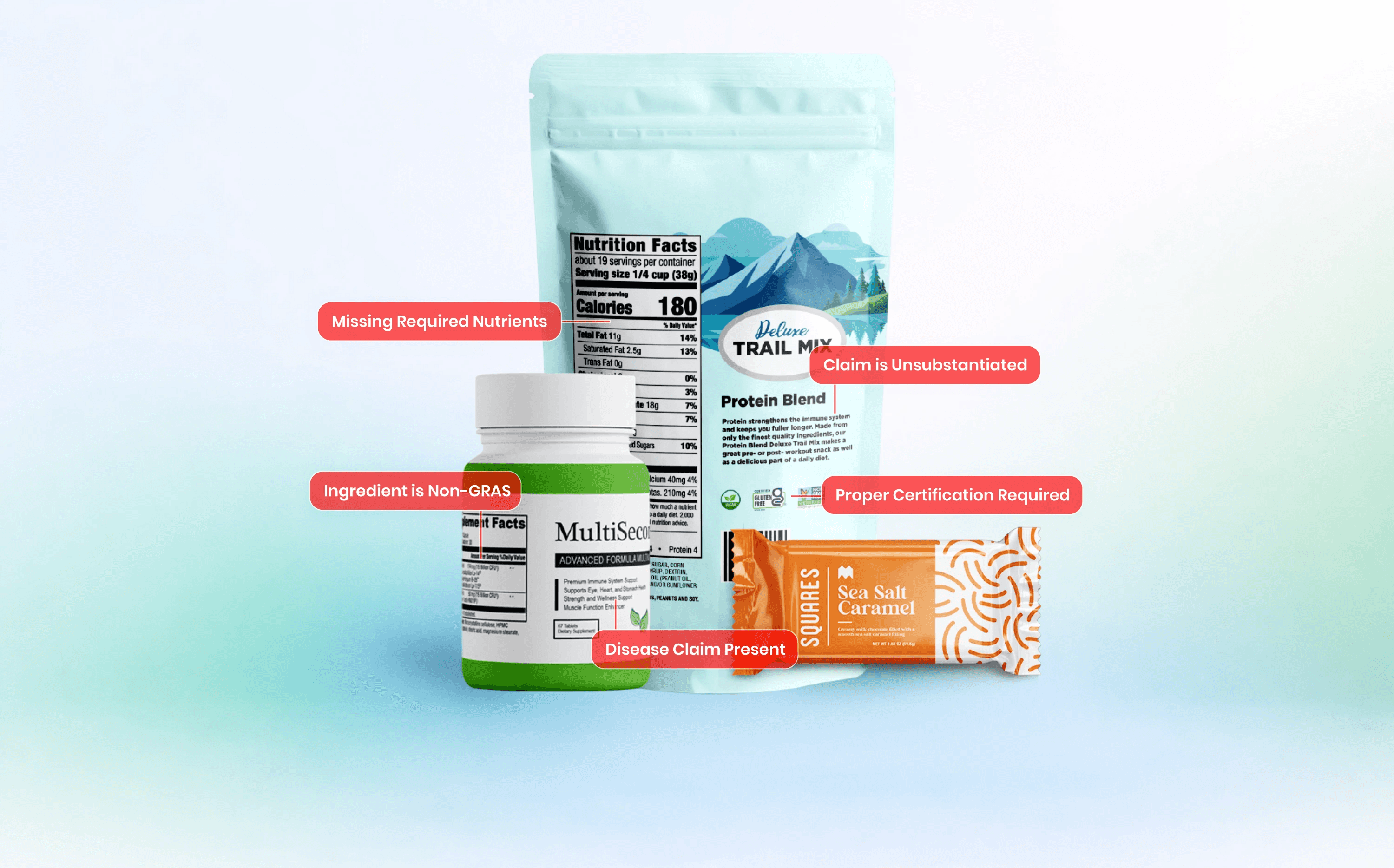
Collagen brands rarely fail on the ingredient — they fail on a "rebuilds cartilage" blog post, a missing disclaimer, or a protein callout that ignores PDCAAS. Truli's AI agents scan your labels, website, and influencer content against FDA and FTC rules, flagging disease claims, missing disclaimers, and unsupported claims with the specific regulation cited. Book a demo to see every finding across your collagen line.
A note from Truli: Truli is not a law firm, and this article does not constitute or contain legal advice or create an attorney-client relationship. When determining your obligations and compliance with respect to relevant laws and regulations, you should consult a licensed attorney.
About

Truli is an AI compliance platform for food, beverage, and supplement brands. Automate FDA/FTC label reviews, claims validation, and post-market monitoring — 10x faster.

Platform
See Truli in action
If regulatory delays are consuming months and thousands in fees, see how Truli delivers fast and continuous compliance coverage at a fraction of the cost.
Book a demo