Class Actions Are the New Enforcer for Food and Supplement Claims
When brands think about claim risk, they think about FDA and FTC. But the fastest-moving enforcement force in food and supplements right now isn't a federal agency — it's the plaintiff's bar. Consumer class actions over benefit and label claims are piling up on federal dockets, and a compliant label is no guarantee of safety.

Michael Wu
| Co-founder at Truli
There's a version of claim compliance that ends at the FDA and FTC rulebook. Get your structure/function language right, carry the DSHEA disclaimer, hold your substantiation, and you're safe. That version is incomplete. A separate enforcement track — private consumer class actions — is now one of the biggest financial risks a food or supplement brand faces, and it operates on different rules than the agencies do.
We track litigation activity through Truli's Regulatory Radar, which monitors federal court dockets alongside FDA and FTC actions. The signal over the past two months is unambiguous: claim-related consumer lawsuits are being filed at a steady, high clip against beverage, supplement, and food brands of every size. This post covers what's driving the wave, the cases worth watching, and why your label passing FDA review doesn't close your exposure.
FDA and FTC Aren't the Only Enforcers Anymore
FDA and FTC decide whether your claims violate federal law. But they enforce selectively — a few hundred warning letters a year across an industry of hundreds of thousands of products. Consumer class actions fill that gap. A plaintiff's firm doesn't need FDA to act first. It needs a claim on your label or website, a consumer who says they relied on it, and a theory that the claim was false or misleading.
The economics favor volume. These suits are filed in batches, often recycling the same theory across many defendants. Most resolve in settlement because litigating a class action to verdict is more expensive than paying to make it go away. That dynamic means a single questionable claim — the kind FDA might never send a letter about — can still cost a brand six or seven figures.
What Our Radar Sees in the Docket Data
Truli's litigation tracker ranks claim-substantiation disputes as the single hottest theme in the food and supplement space right now, well ahead of contamination or manufacturing litigation. The activity is concentrated in a handful of recurring claim types.
The highest-volume claim disputes right now
Ranked by federal docket filings referencing each theme over a recent 60-day window, the most active claim-litigation categories are:
Structure/function and substantiation disputes — by far the largest category, and the core battleground for supplement benefit claims
"Natural" labeling — products with synthetic or highly processed ingredients marketed as natural
Serving size and RACC misrepresentation — claims that depend on an unrealistic serving basis
"Healthy" and implied nutrient content claims — heightened after the FDA's updated "healthy" definition
"No added sugar" and sweetener claims — how sweetness and sugar content are represented
Heavy metals and Proposition 65 — lead, cadmium, and arsenic disclosure exposure
The pattern is that the claims drawing lawsuits are the same ones drawing regulatory scrutiny — but the litigation volume is far higher than the enforcement volume. Where FDA might issue a handful of letters on a claim type, the docket shows dozens to hundreds of filings on the same theme.
The Cases Brands Are Watching
The named cases from the past two months show how broad the target list is — this is not a small-brand problem.
Walsh v. PepsiCo, Inc. (filed June 18, 2026) — a consumer-fraud action challenging benefit claims across multiple Gatorade products
Caryn Hart v. Niagen Bioscience, Inc. and Jacobs v. Niagen Bioscience, Inc. (filed June 18 and May 28, 2026) — two separate false-advertising suits against a nicotinamide riboside supplement maker over its marketed benefits
Pitre v. Chobani, LLC and Knox v. Chobani, LLC (filed July 7 and June 16, 2026) — consumer-fraud suits touching protein and nutritional representations
All were filed as consumer-fraud claims, the docket category that captures false and misleading advertising. The lesson in the clustering — two suits against Niagen, two against Chobani within weeks — is that once a claim theory works, plaintiff's firms replicate it fast.
Why Your Compliant Label Still Isn't Safe
The most important thing to understand is that private plaintiffs apply a different test than FDA does. FDA asks whether your claim violates a regulation. A class action asks whether a "reasonable consumer" would be misled — a standard that turns on perception, not on whether you technically followed the rule.
That gap is where brands get caught:
A claim can be within the structure/function framework and still be attacked as misleading if the consumer takeaway overstates the benefit
A "natural" claim carries no FDA definition — which makes it a favorite target, because there's no regulatory safe harbor to point to
Substantiation that satisfies a quick internal review often won't meet the "competent and reliable scientific evidence" standard a plaintiff's expert will demand in discovery
Marketing surfaces beyond the label — website, ads, social, influencer content — are all fair game, and often carry looser language than the panel
A label that clears FDA scrutiny can still read as misleading to a jury. The two standards overlap, but they are not the same, and closing only the regulatory gap leaves the litigation gap open.
What This Means for Your Brand
Treat claim substantiation as litigation-grade, not just regulation-grade. Practical steps:
Inventory every benefit claim across the label, website, ads, and social — the plaintiff's bar reads all of them
Pressure-test each claim against the "reasonable consumer" standard, not just the CFR: would an ordinary buyer feel misled if the benefit underdelivered?
Hold documented, human-evidence substantiation for every efficacy claim before it goes live
Scrutinize the high-risk categories — "natural," "healthy," "no added sugar," serving-size-dependent claims, and structure/function benefit claims
Watch the docket in your category — the theory filed against a competitor this month is the one aimed at you next quarter
Turn Litigation Signal Into Prevention
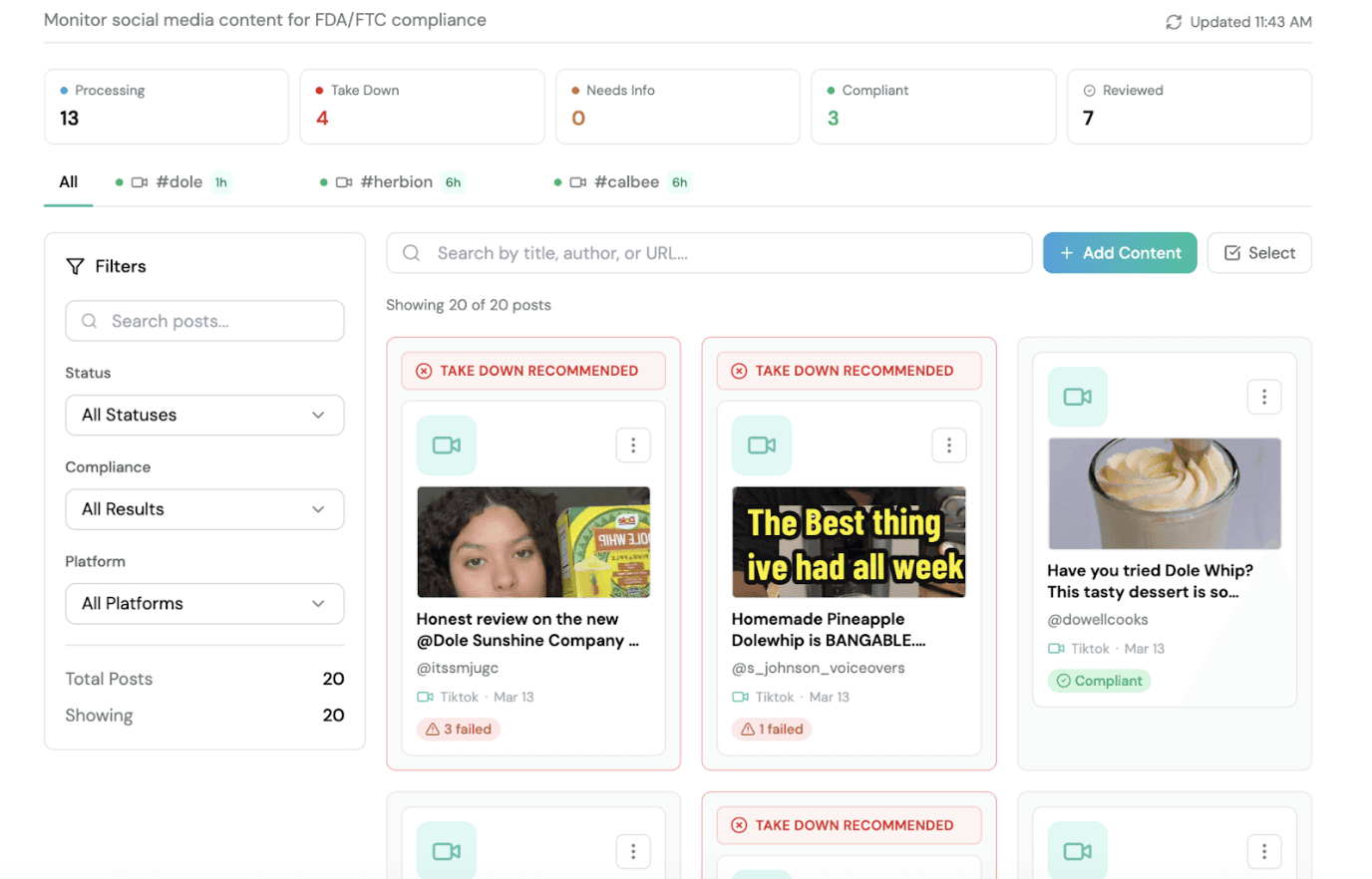
The class-action wave rewards brands that catch weak claims before they ship. Truli's Regulatory Radar monitors federal court dockets, FDA warning letters, and FTC actions relevant to your products — so you see the litigation theories building in your category before they reach your label. Truli's AI compliance platform audits your labels, website copy, ads, and social content against FDA and FTC rules and flags the unsubstantiated benefit claims that draw both regulators and plaintiffs. Book a demo to see how Truli helps you close the litigation gap, not just the regulatory one.
About

Truli is an AI compliance platform for food, beverage, and supplement brands. Automate FDA/FTC label reviews, claims validation, and post-market monitoring — 10x faster.

Platform
See Truli in action
If regulatory delays are consuming months and thousands in fees, see how Truli delivers fast and continuous compliance coverage at a fraction of the cost.
Book a demo