Best CPG Label Compliance Software in 2026
The average FDA food recall costs $8–12 million in direct expenses, and undeclared allergens — the most preventable recall cause — remain the top trigger year after year. For food brands managing multiple SKUs and marketing channels, the question isn't whether to invest in label compliance software. It's which tool actually solves the problem.

Catherine Zhou
| Co-founder at Truli

CPG food brands face a compliance surface that supplement brands don't. The mandatory label elements are more complex — Nutrition Facts panels, RACC-based serving sizes, Daily Value declarations, FALCPA allergen requirements — and the claim categories are different, with authorized health claims and nutrient content claims governed by defined thresholds that supplement structure/function claims aren't. Most compliance software is built for one category or the other. Very few handle both well.
Here's how the leading tools compare for CPG food brands in 2026, evaluated against what actually generates FDA enforcement and recall risk.
What to Look for in CPG Label Compliance Software
For a food brand, compliance software needs to cover four distinct functions:
Mandatory element verification — checking that every required label element (PDP statement of identity, net quantity, information panel components, allergen declarations) is present, correctly placed, and formatted
Claims compliance analysis — evaluating nutrient content claims, health claims, and any structure/function or benefit language against the specific regulatory framework governing each
Allergen detection — confirming allergen declarations against formulation records and flagging cross-contact risk from contract manufacturing
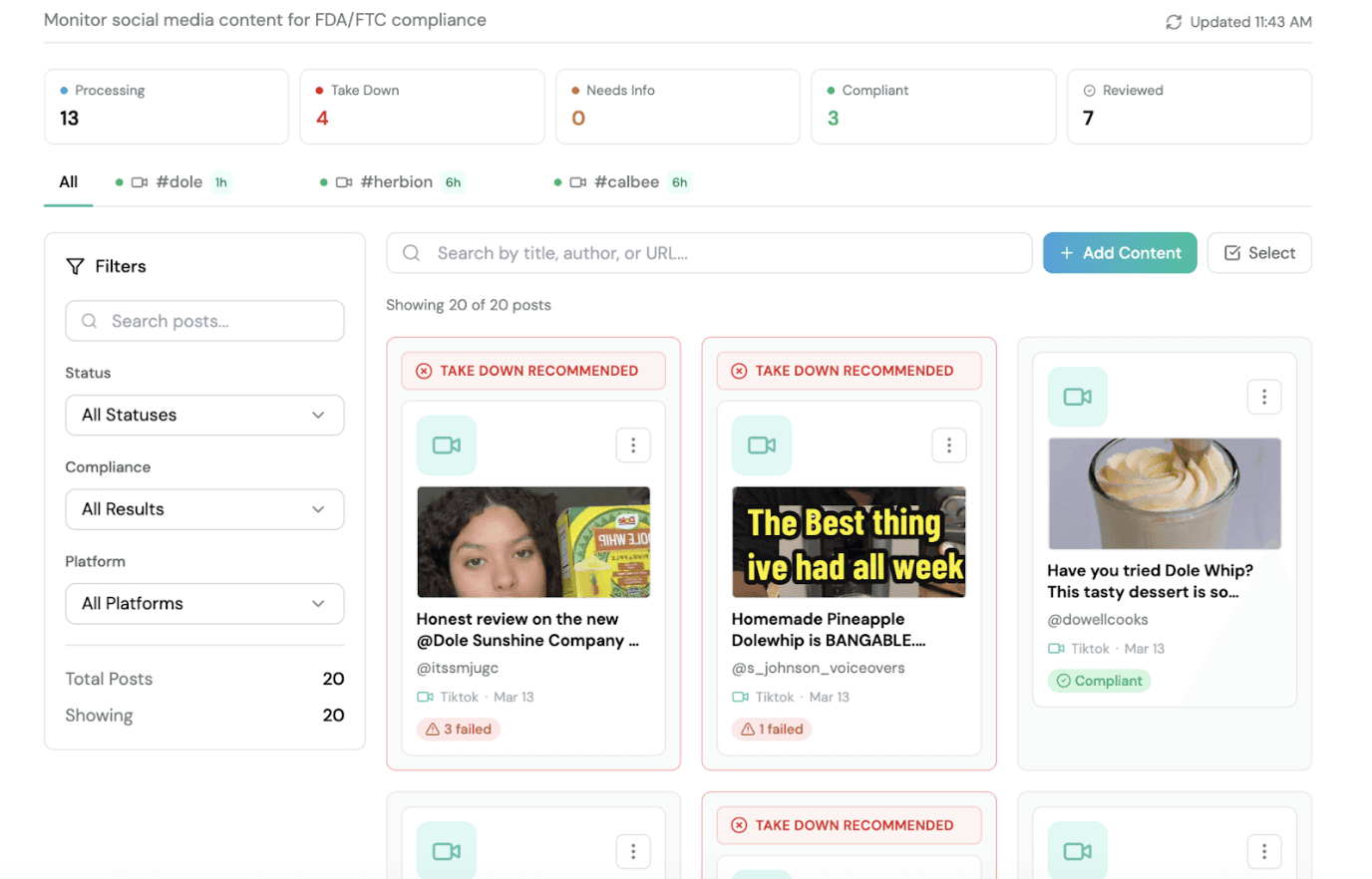
Digital channel coverage — applying the same review to website copy, Amazon listings, and marketing content, where FDA and FTC are actively enforcing
Most legacy tools cover one or two of these. The tools that cover all four are the ones worth evaluating.
1. Truli — Best for Claims Compliance Across All Channels
Truli's focus is on what drives FDA warning letters and FTC enforcement actions: the claims a food brand makes about its products, across every channel where it makes them. The platform uses a multi-agent AI workflow — specialized agents handling label structure, claims analysis, allergen detection, and required element verification in parallel — with each finding anchored to its exact location in the label or marketing copy.
The core differentiator for food brands is claim-level analysis that goes beyond format checking. Truli retrieves current FDA regulation text at review time rather than querying a static ruleset, which means the analysis reflects current Daily Values, current RACC definitions, and current authorized health claim language — not the rules as they existed when the software was last updated.
Format and Mandatory Element Audit
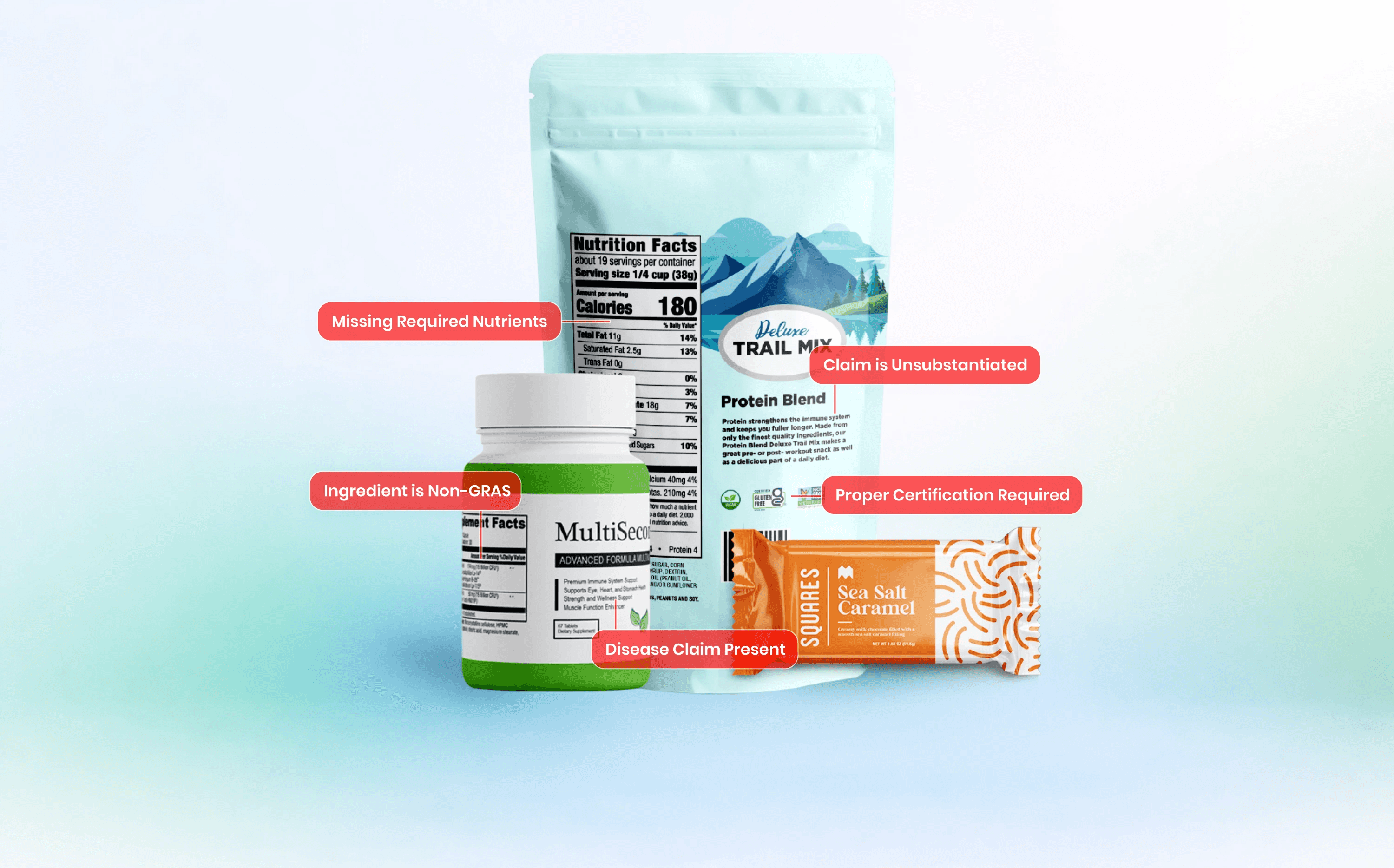
Truli scans label images against 21 CFR Part 101 requirements — verifying PDP element presence and placement, Nutrition Facts panel format, serving size accuracy against RACC tables, allergen declaration completeness including sesame under the FASTER Act, and information panel grouping requirements. Each finding includes the specific regulation citation and a description of what needs to change.
Claims Analysis for Food Products
For conventional food products, Truli evaluates nutrient content claims against defined thresholds (21 CFR 101.54 and related sections), flags health claim language that requires FDA authorization or qualified health claim disclaimers, and identifies implied disease language in general marketing copy. Food brands making functional claims — "supports digestive health," "promotes heart health" — get analysis of whether those claims fit within permitted categories or cross into disease claim territory.
Allergen Detection
Truli's allergen agents scan ingredient lists against the nine declared allergens, flag potential cross-contact disclosures from contract manufacturer documentation, and identify allergen-containing ingredients that may be hidden in compound ingredients, flavor systems, or processing aids.
Full Marketing Surface Coverage
Website copy, Amazon listings, and marketing materials are scanned against the same regulatory framework as the physical label — catching FTC-actionable health claims, Amazon policy violations, and claims that exceed what the label supports. For brands with active digital marketing, this is where compliance gaps most commonly live.
Best for: Food and supplement brands that need claims-level compliance review across physical labels and all marketing channels.
2. Sieve / Taama — Best for Multi-Jurisdiction Ingredient Compliance
Sieve (now Taama) is an AI label scanner built around global regulatory coverage. Its core strength is ingredient-level compliance checking across FDA (US), EFSA (EU), SFA (Singapore), CFIA (Canada), and FSANZ (Australia/New Zealand). For food brands distributing across multiple international markets, Taama's jurisdiction-matching capability — checking whether each ingredient is permitted, restricted, or prohibited in each target market — is purpose-built functionality.
For US-focused brands, Taama handles allergen flagging and ingredient status checks at scale and validates label structure against jurisdiction-specific requirements. The limitation is claims depth: Taama is stronger on ingredient compliance and label format than on evaluating the regulatory line between compliant nutrient content claims, authorized health claims, and prohibited disease claims in FDA's specific framework.
Best for: CPG brands with international distribution who need multi-jurisdiction ingredient compliance checking as a primary workflow.
3. GlobalVision (Verify CheckAI) — Best for Print File Verification
GlobalVision is a print and packaging quality control platform, not a regulatory compliance tool. Verify CheckAI performs text comparison, graphics comparison, barcode and QR code verification, color inspection, Braille validation, and OCR — all designed to catch errors between an approved artwork file and a print-ready file.
For food brands with complex packaging workflows — multiple package sizes, co-brand formats, regional variants — GlobalVision's file comparison capabilities catch costly print errors before they reach production. A transposed allergen declaration, a wrong barcode, a font substitution that changes meaning — these are real and expensive mistakes that pre-press verification catches.
What GlobalVision doesn't do is evaluate whether the approved artwork file is itself compliant. A label that reads "reduces the risk of heart disease" (a disease claim for a non-qualifying product) passes GlobalVision's verification perfectly if the text matches the approved file. The compliance risk isn't in the print — it's in what was approved.
GlobalVision and a regulatory claims review tool serve different functions and are used at different stages of the label development process. Brands with high SKU volume often use both.
Best for: Food brands with complex packaging production workflows who need print file accuracy verification alongside a separate compliance review.
4. RegulateCPG — Best for Food and Beverage Product Lifecycle Management
RegulateCPG is an integrated product lifecycle management platform built for CPG food and beverage brands. It handles nutrition analysis, Nutrition Facts label generation, ingredient management, recipe formulation, and manufacturing specifications in a single system — generating FDA, CFIA, and EU-format labels automatically and flagging allergen and safety risks during formulation.
The core value for food brands is workflow integration: RegulateCPG connects recipe formulation to label output, so nutritional calculations and ingredient changes flow directly into label updates. This reduces transcription errors and keeps label data synchronized with formulation records across a product portfolio.
The limitation is claims compliance depth. RegulateCPG generates accurate Nutrition Facts panels and validates format requirements, but it's a formulation and label generation tool rather than a regulatory claims analysis tool. It doesn't evaluate whether health claims, benefit language, or marketing copy on those labels meets FDA and FTC requirements — and it doesn't cover digital channels.
Best for: Food and beverage brands who need an integrated formulation-to-label system with nutrition data management and PLM workflow features.
5. ESHA Genesis — Best for Nutrition Analysis and Label Generation
ESHA Genesis is the industry-standard nutrition analysis and Nutrition Facts panel generation tool. It maintains a large food ingredient database, calculates nutrient profiles from formulations, and produces FDA-format Nutrition Facts panels. For food brands building new products or updating existing formulations, ESHA Genesis is the most accurate tool for generating the nutritional data that appears in the Nutrition Facts panel.
ESHA Genesis is not a compliance tool in the regulatory sense. It generates accurate nutrition labels from formulation data — it doesn't evaluate whether the claims on the label are legally permissible, whether allergen declarations are complete, whether the serving size matches FDA's RACC tables, or whether the marketing copy on the website is consistent with what the label supports.
Most food brands use ESHA Genesis for nutrition calculation and either pair it with a compliance tool or rely on manual review for claims compliance. The two functions are complementary.
Best for: Food brands who need accurate nutrition analysis and Nutrition Facts panel generation as a core workflow, typically paired with a separate compliance review process.
6. Manual Review and Outside Consultants
Most food brands at early and mid stages rely on some version of manual review: regulatory affairs staff cross-checking label copy against FDA guidance, periodic audits by outside consultants, and legal review of specific claims. Enterprise brands spend significantly on regulatory teams doing this work manually with spreadsheets and shared drives.
Manual review by qualified regulatory professionals remains the appropriate approach for high-complexity decisions — novel ingredient GRAS assessments, authorized health claim petitions, FDA warning letter responses. It is not viable as a primary mechanism for ongoing compliance monitoring across a brand with multiple SKUs and active digital marketing.
The specific limitations of manual review for CPG brands:
Digital channel coverage is practically impossible at volume — website copy, Amazon listings, and influencer content are rarely reviewed with the same rigor as the physical label
Review is reactive, not continuous — labels are checked at launch and at periodic audits, not when marketing copy changes
Regulatory staff and consultants charge by the hour; scaling review to match marketing output is not cost-effective
Comparison Summary
Tool | Format Audit | Claims Analysis | Allergen Detection | Digital Channels | Food-Focused |
|---|---|---|---|---|---|
Truli | ✓ | ✓ | ✓ | ✓ | ✓ |
Sieve / Taama | ✓ | Partial | ✓ | ✗ | ✓ |
GlobalVision | Print QA only | ✗ | ✗ | ✗ | ✓ |
RegulateCPG | ✓ | Partial | ✓ | ✗ | ✓ |
ESHA Genesis | Label generation | ✗ | ✗ | ✗ | ✓ |
Manual / consultants | Inconsistent | Inconsistent | Inconsistent | ✗ | ✓ |
How to Choose
If your primary need is multi-jurisdiction ingredient compliance across international markets, Sieve/Taama is built for that. If you need print file accuracy verification before production, GlobalVision belongs in your pre-press workflow. If you're building out a formulation-to-label PLM system for a food or beverage portfolio, RegulateCPG is worth evaluating. If nutrition analysis and Nutrition Facts generation is the core need, ESHA Genesis is the industry standard.
If your concern is whether the claims your brand is making — on the label, on the website, in ads, and in the content your influencers are posting — are legally compliant with FDA and FTC requirements, Truli is built specifically for that problem, across the full marketing surface.
See how Truli handles CPG label compliance
Truli was built after experiencing the CPG compliance problem firsthand. Book a demo to see how the platform handles label audits, claims analysis, allergen detection, and marketing channel review for your specific product categories — and how it catches the issues that format checkers and manual review consistently miss.
A note from Truli: Truli is not a law firm, and this article does not constitute or contain legal advice or create an attorney-client relationship. When determining your obligations and compliance with respect to relevant laws and regulations, you should consult a licensed attorney.
About

Truli is an AI compliance platform for food, beverage, and supplement brands. Automate FDA/FTC label reviews, claims validation, and post-market monitoring — 10x faster.

Platform
See Truli in action
If regulatory delays are consuming months and thousands in fees, see how Truli delivers fast and continuous compliance coverage at a fraction of the cost.
Book a demo