Best AI Food Label Review Tools in 2026
FDA label-related product recalls cost the food industry $1.92B annually. A single labeling violation can trigger fines of $53K per infraction, retailer delistings, and lawsuits reaching $90M. AI food label review tools exist to catch those problems before they reach the shelf — but they work very differently from each other.

Catherine Zhou
| Co-founder at Truli

There's an important distinction most food brand operators only discover after evaluating multiple tools: there's a difference between a tool that generates food labels and a tool that audits them for regulatory compliance. Both get called "food label software," but they solve different problems.
There's also a third category worth naming: legacy PLM and label tools that larger CPG brands have relied on for years. TraceOne and beCPG are PLM (product lifecycle management) platforms — they manage formulation specs, ingredient lists, and label versions across teams, which is valuable, but they don't evaluate whether the claims on a label cross the FDA enforcement line. ESHA Genesis (now Trustwell) is a sophisticated nutrition analysis and label generation tool — closer to ReciPal than to a compliance auditor, just with a much larger ingredient database and multi-regional support. None of these tools were built for the kind of claims-aware, cross-channel analysis that FDA and FTC enforcement actually requires.
Label generators like ReciPal and Food Label Maker create compliant Nutrition Facts panels from recipe data. They're valuable tools for getting your label formatted correctly. But generating a label and verifying that the claims on your label are FDA-compliant are two separate functions — and most brands need both.
This guide covers the tools that review and audit food labels for regulatory compliance, with context on where label generators fit in the stack.
The Two Categories of Food Label Software
Label Generators — Create the Nutrition Facts Panel
Tools like ReciPal and Food Label Maker calculate nutrient data from your recipe and output an FDA-formatted Nutrition Facts panel. They do not review whether the claims, health statements, or marketing language on your packaging comply with FDA or FTC requirements. They generate the panel; your team is still responsible for everything else on the label.
These tools are useful and often the right starting point for early-stage brands. But they are not compliance review tools.
Label Review and Audit Tools — Analyze the Full Label
Label audit tools analyze the complete label — structure/function claims, health claims, allergen declarations, ingredient list format, disclaimer language, and marketing copy — against FDA regulatory requirements. Some extend their analysis to marketing channels beyond the physical label.
This is the category that matters for compliance risk management.
1. Truli — Best for Claims-First Label Review
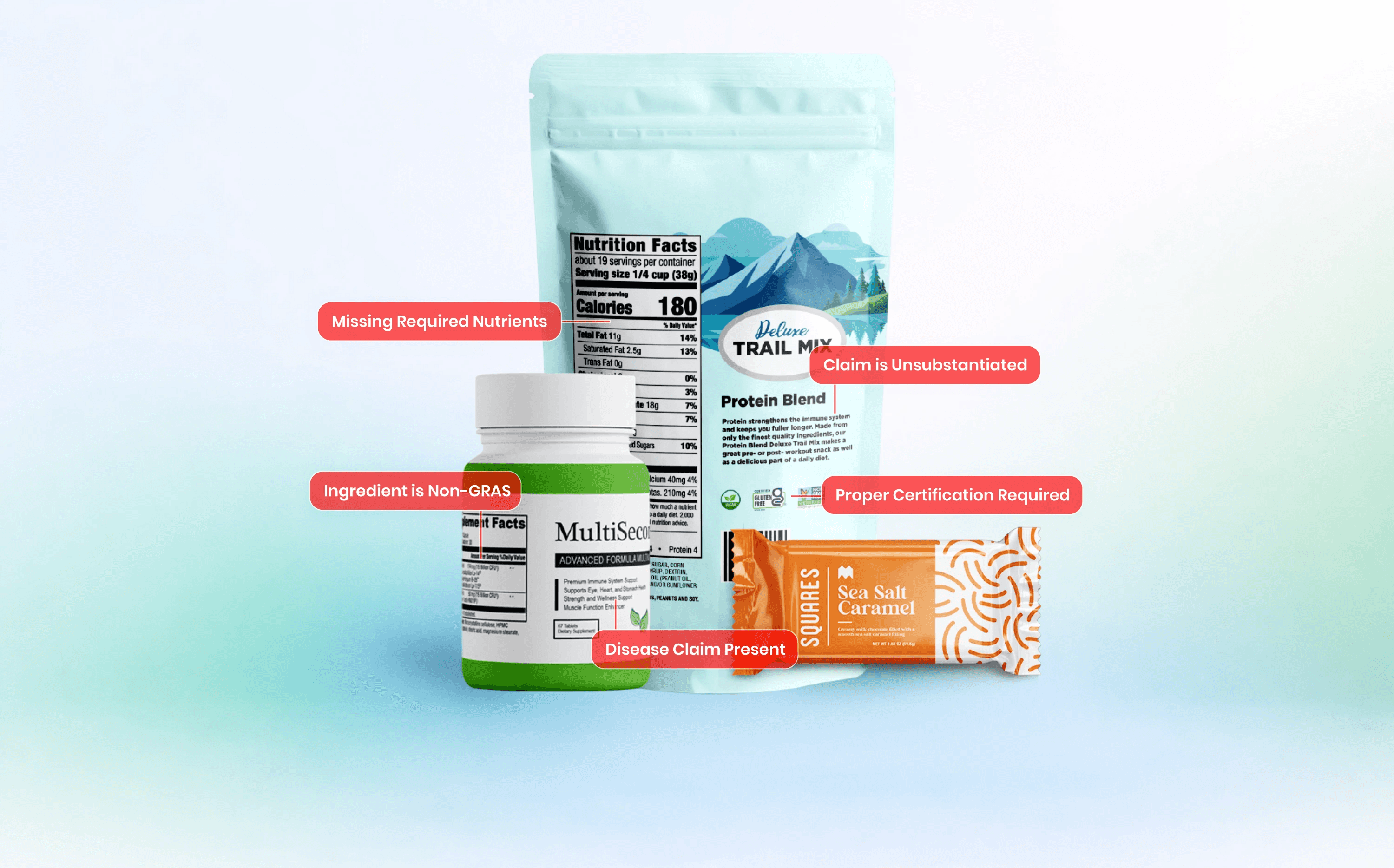
Truli's label review is built around claims analysis — the part of food labeling that carries the highest FDA enforcement risk. The platform scans labels for disease claims, unsubstantiated structure/function claims, health claim authorization requirements, and missing or incorrectly worded disclaimers.
Under the hood, Truli runs a multi-agent workflow: specialized agents handle different aspects of label review in parallel — OCR and text extraction (with each piece of text anchored to its exact location on the label), claims verification, ingredient checks, required elements, and suggestion generation. Regulation text is fetched from a database at review time, so the analysis is always grounded in current rule text rather than static rules.
What this means practically: Truli understands claim intent, not just claim wording. The FDA's enforcement standard isn't about specific words — it's about whether a claim implies the product diagnoses, treats, cures, or prevents a disease. Truli identifies claims that cross that line, including implied violations that don't use explicit disease language.
Coverage Across the Full Marketing Surface
Food brands don't just make claims on their physical labels. The same compliance requirements apply to:
Website product pages and ingredient callouts
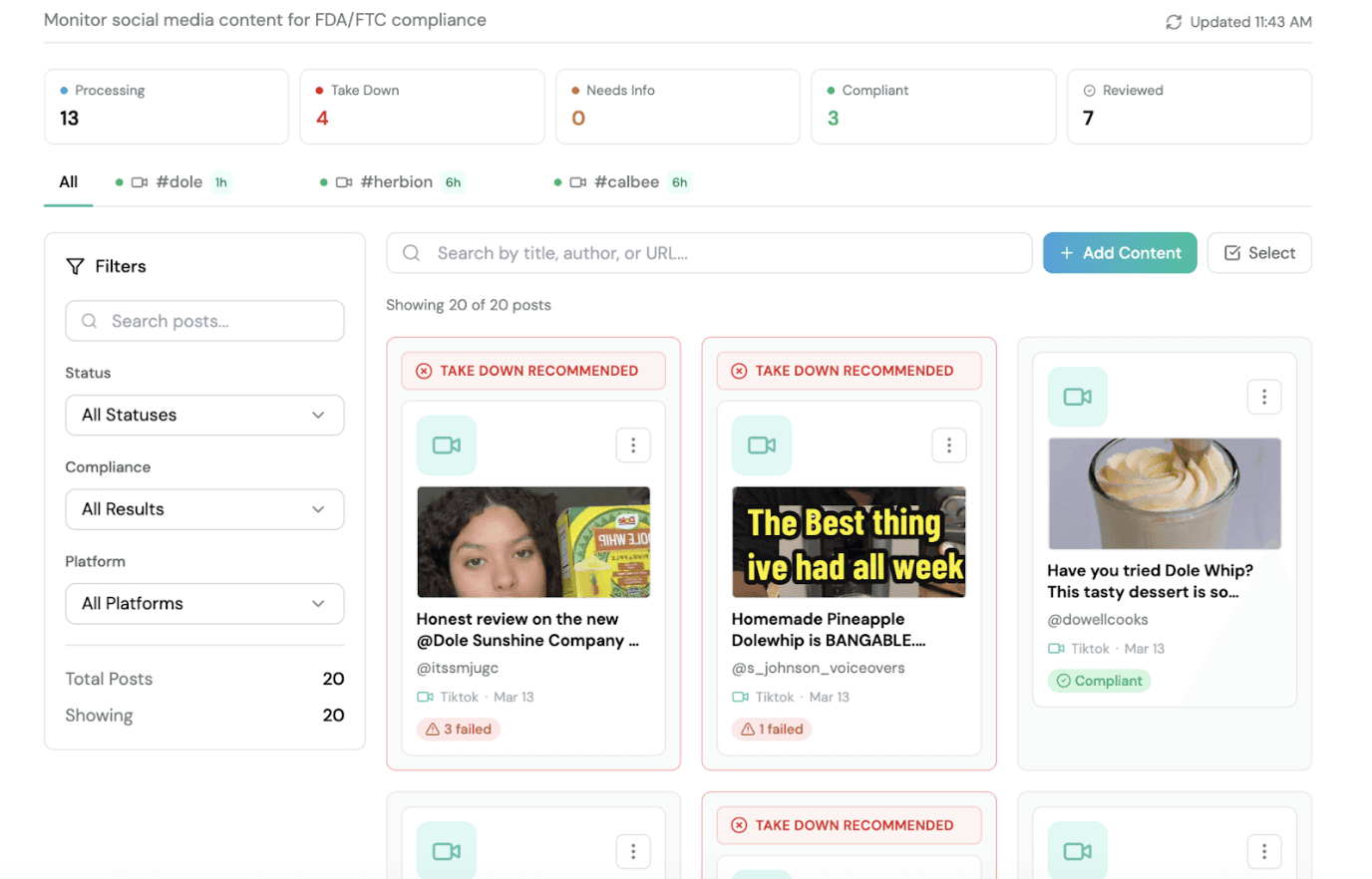
Social media posts and captions
Digital and print advertising
Influencer and affiliate content
Truli reviews all of these channels using the same regulatory framework. A brand that clears its label through a careful review but then posts a TikTok with a prohibited claim is still exposed. Truli catches that.
FTC as Well as FDA
Health claims in food marketing are subject to FTC substantiation requirements, not just FDA labeling rules. Truli covers both — flagging claims that lack the "competent and reliable scientific evidence" standard the FTC requires, and identifying influencer disclosures that don't meet 16 CFR Part 255 requirements.
Best for: Food and supplement brands making health-related claims who need full-label and full-channel review against both FDA and FTC standards.
2. Sieve / Taama — Best for Multi-Jurisdiction Ingredient Compliance
Sieve, now operating as Taama, is strongest at the ingredient level across international markets. The platform checks ingredients and formulations against regulatory databases for FDA (US), EFSA (EU), SFA (Singapore), CFIA (Canada), and FSANZ (Australia/New Zealand) — with a claimed 99.7% accuracy rate across its regulatory databases.
For food brands, Taama is useful for validating that every ingredient in a formulation is permitted in the target market, checking allergen declarations, and identifying additives or ingredients that require disclosure or are restricted in certain jurisdictions.
Where Taama is less precise is on the claims side. The tool's strength is ingredient-status matching, not evaluating whether a marketing claim on a label is compliant with FDA's health claim authorization requirements or the FTC substantiation standard. For a brand launching across five countries, Taama is a strong fit. For a brand primarily concerned with US regulatory compliance for health claims, the coverage depth is limited.
Best for: Food brands with multi-country launches who need ingredient-level compliance checking across jurisdictions.
3. GlobalVision (Verify CheckAI) — Best for Pre-Press Label Accuracy
GlobalVision is a packaging inspection platform, not a regulatory compliance tool. Its core functions — text compare, graphics compare, barcode and QR verification, color inspection, OCR, Braille inspection — are designed to catch errors between a digital artwork file and an approved master during the pre-press process.
For food brands with complex packaging workflows, high SKU volumes, or frequent label updates, GlobalVision solves a real problem: catching text changes, barcode errors, and formatting deviations before a label goes to print. A single incorrect allergen in a printed label that doesn't match the digital master is a costly error that GlobalVision is built to prevent.
What GlobalVision does not do is evaluate whether the claims on a label are FDA-compliant. It confirms the label matches the approved version; it does not evaluate whether the approved version should have passed regulatory review in the first place.
Best for: Brands with print-intensive packaging workflows who need pre-press verification alongside their compliance review stack.
4. RegulateCPG — Best for Integrated Food Product Development
RegulateCPG is positioned as a product lifecycle management platform for food and beverage CPG brands. It integrates nutrition data capture, label generation, ingredient sourcing, and manufacturing workflows — generating FDA, CFIA, and EU-format labels automatically and flagging allergen and safety risks during recipe formulation.
For food brands, RegulateCPG's integrated approach is valuable because it ties compliance to the product development process rather than treating it as a separate step. Compliance review happens during formulation, not after.
The notable limitation: RegulateCPG is focused on food and beverage — not dietary supplements. Brands in the supplement category won't find the Supplement Facts panel support, DSHEA-specific claim review, or structure/function claim analysis they need.
Best for: Food and beverage brands building a product development and compliance workflow from scratch, especially those managing multiple SKUs with frequent reformulation.
5. ReciPal, Food Label Maker, and ESHA Genesis — Label Generation, Not Audit
ReciPal, Food Label Maker, and ESHA Genesis (now Trustwell) are all nutrition label generators. They take recipe or formulation data, calculate nutrient values against a database, and produce FDA-formatted Nutrition Facts panels. ESHA Genesis is the most sophisticated of the three — with a database of 120,000+ ingredients, multi-regional format support (US, EU, Canada, Mexico), and a separate Supplements module for Supplement Facts panels — but it operates in the same category. These are label creation tools, not compliance auditors.
None of them evaluate whether the claims on your label are FDA-compliant. They don't flag health claim violations, identify disease claims, or check whether your marketing copy matches what's on the label. They generate the panel; your team is still responsible for the regulatory validity of everything else.
Best for: Brands of any size that need accurate Nutrition or Supplement Facts panels generated from formulation data. ESHA Genesis fits larger brands with complex multi-SKU portfolios; ReciPal and Food Label Maker fit early-stage brands with simpler needs.
Comparison Summary
Tool | Nutrition Facts | Claims Audit | Allergen Check | Multi-Jurisdiction | Social/Marketing |
|---|---|---|---|---|---|
Truli | ✗ | ✓ | ✓ | US focus | ✓ |
Sieve / Taama | ✓ | Partial | ✓ | ✓ | ✗ |
GlobalVision | ✗ | ✗ | Pre-press only | ✓ | ✗ |
RegulateCPG | ✓ | Partial | ✓ | Partial | ✗ |
TraceOne / beCPG | ✗ | ✗ | Via spec mgmt | ✓ | ✗ |
ESHA Genesis / ReciPal | ✓ | ✗ | Partial | Partial (ESHA) | ✗ |
Building the Right Stack
Most food brands end up combining tools rather than relying on a single platform. A practical stack might look like:
ReciPal or RegulateCPG — to generate and manage Nutrition Facts panels during formulation
Truli — to audit health claims, structure/function claims, marketing copy, and social content for FDA and FTC compliance
GlobalVision — to verify print files against approved artwork before production
The mistake most brands make is assuming the label generator handles compliance. It doesn't. And the mistake larger brands make is assuming that periodic reviews through legacy software cover the full surface. They don't — your website, ads, and social content carry the same FDA/FTC exposure as the label itself.
Compliance review is a separate workflow. The claims on a food label — and across every channel where those claims also appear — are where the enforcement risk actually lives.
Get your food labels reviewed by Truli
Truli reviews food and supplement labels for claim compliance, not just format. Book a demo to see how the platform catches the issues that formatting tools miss.
About

Truli is an AI compliance platform for food, beverage, and supplement brands. Automate FDA/FTC label reviews, claims validation, and post-market monitoring — 10x faster.

Platform
See Truli in action
If regulatory delays are consuming months and thousands in fees, see how Truli delivers fast and continuous compliance coverage at a fraction of the cost.
Book a demo