Alcohol Marketing Compliance — TTB Rules Meet Social Media
Every Instagram post, TikTok, and influencer collab your alcohol brand touches is an advertisement under federal rules written decades before social media existed. TTB says so explicitly — and the FTC, state regulators, and industry codes all pile on. Here is the compliance stack for alcohol marketing in 2026.

Catherine Zhou
| Co-founder at Truli

Alcohol brands operate under the most layered marketing rulebook in CPG. TTB regulates the content of your ads, the FTC regulates how endorsements are disclosed, industry codes set audience-targeting standards, and state ABC agencies add their own restrictions. Critically, TTB has long taken the position that its advertising rules apply to websites and social media — a branded post is an "advertisement" just like a magazine page, and so is influencer content you paid for.
The TTB rules live in dedicated advertising subparts of each commodity's regulations: 27 CFR Part 4 subpart G for wine, and — after the 2022 recodification — subpart N of 27 CFR Part 5 for distilled spirits and subpart N of 27 CFR Part 7 for malt beverages. If your compliance checklist still cites the old spirits ad sections, it is out of date.
What TTB requires in every ad — including a caption
The baseline mandatory element is the responsible advertiser statement. Under 27 CFR 4.62 (wine), 27 CFR 5.233 (spirits), and 27 CFR 7.233 (malt beverages), an advertisement must display the responsible advertiser's name and city/state — or the name plus other contact information such as a website — so consumers know who stands behind the ad. Additional product-specific mandatory information applies depending on the commodity and what the ad shows.
Two practical exceptions make social feasible. Ads covering a brand's general product line can carry just the responsible-advertiser information. And consumer specialty items — t-shirts, hats, stickers — need only the company or brand name. For a brand profile on Instagram, the widely accepted practice is to satisfy the advertiser-identification requirement through the bio and linked website rather than repeating it in every post.
The prohibited-practices rules travel with the ads too. Health-related statements, false or misleading claims, and disparaging competitor statements are barred in advertising under 27 CFR 4.64, 27 CFR 5.235, and 27 CFR 7.235. A "supports recovery" caption violates the same rule a label would.
The FTC layer — influencer posts are endorsements
Do influencer posts for alcohol need disclosure? Yes, unambiguously. The FTC's Endorsement Guides at 16 CFR Part 255 require clear and conspicuous disclosure of any material connection between a brand and an endorser — payment, free product, affiliate commissions, or an employment relationship all count.
The 2023 update to the Guides tightened what "clear and conspicuous" means for social:
The disclosure must be unavoidable — hidden hashtags, "more" folds, and bio-only disclosures do not cut it
Video endorsements need disclosure in the video itself, not just the caption
"#ad" or "#sponsored" at the front of a caption works; buried in a hashtag wall it does not
The brand is responsible for monitoring its influencers — outsourcing the post does not outsource the liability
For alcohol, the FTC layer stacks on TTB's: the influencer's content must carry the FTC disclosure and stay clear of TTB's prohibited claims. Your contract and creative brief should mandate both.
Age-gating — the 73.8% LDA standard
Federal law does not set a numeric audience-composition rule; the industry codes do, and regulators treat them as the de facto standard. The current figure across the major codes is 73.8%: alcohol advertising should only be placed in media where at least 73.8% of the audience is reasonably expected to be of legal drinking age. The Beer Institute and Brewers Association moved to 73.8% in 2022 and DISCUS followed in 2023, each updating from the old 71.6% threshold after 2020 Census data showed 73.8% of the U.S. population is 21 or older.
On social platforms that translates into concrete controls:
Age-gate every owned profile using the platform's alcohol-brand restrictions (Instagram/Facebook age restrictions, TikTok's LDA controls where alcohol content is permitted at all)
Verify audience composition for paid placements and influencer partners — an influencer whose followers skew under 21 fails the code even with perfect disclosures
Use responsibility statements ("Please drink responsibly," "21+") — industry codes expect them, and DISCUS's Code of Responsible Practices treats responsible-drinking messaging as a core commitment
User-generated content — the risk nobody budgets for
Here is the trap: UGC is not your advertising until you touch it. Once your brand reposts, shares, or embeds a consumer's content, industry codes and regulators treat it as brand advertising — which means it inherits every rule above. A repost of a fan's video showing excessive consumption, an under-21 face, or an implied health benefit becomes your compliance violation.
Marketing surface | Primary rules that apply |
|---|---|
Label and packaging | TTB Parts 4/5/7 labeling subparts, COLA |
Owned social posts | TTB advertising subparts + platform age-gating + industry codes |
Paid influencer content | All of the above + FTC 16 CFR Part 255 disclosure |
Reposted UGC | Treated as brand advertising once shared — full stack applies |
Website and email | TTB advertising rules + state ABC restrictions |
Practical hygiene: moderate comments for minors' content, get rights and review UGC before resharing, and keep a documented takedown process. Several industry-code complaint decisions have turned on exactly this.
Building a review loop that keeps up
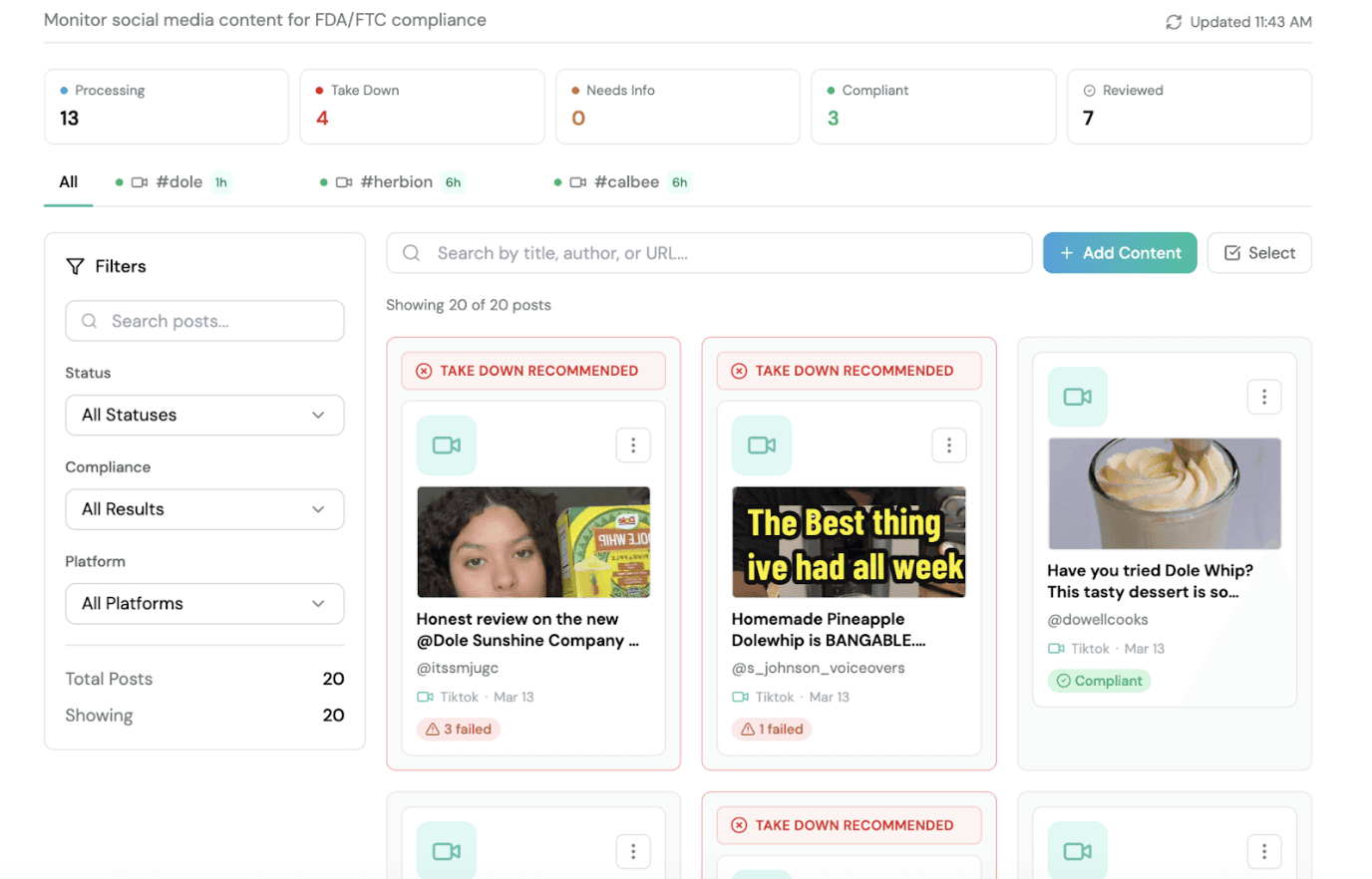
The hard part is not knowing the rules — it is applying them to hundreds of posts a month across brand channels, influencer feeds, and regional pages. High-volume social teams need the same systematic review labels get: mandatory statements present, no health or strength implications, disclosures unavoidable, audience data on file. Manual spot-checking misses the post that becomes the screenshot in a complaint.
Put an AI compliance layer on your feed
Truli's AI agents scan social content, websites, and marketing assets against the actual regulatory text — TTB's advertising subparts, FTC's endorsement rules, and your label claims — and cite the specific rule behind every finding. One platform covers the label on the can and the caption promoting it. Book a demo to see your channels through a regulator's eyes.
A note from Truli: Truli is not a law firm, and this article does not constitute or contain legal advice or create an attorney-client relationship. When determining your obligations and compliance with respect to relevant laws and regulations, you should consult a licensed attorney.
About

Truli is an AI compliance platform for food, beverage, and supplement brands. Automate FDA/FTC label reviews, claims validation, and post-market monitoring — 10x faster.

Platform
See Truli in action
If regulatory delays are consuming months and thousands in fees, see how Truli delivers fast and continuous compliance coverage at a fraction of the cost.
Book a demo