How AI Is Transforming Food Label Compliance Review
The conventional approach to food label compliance review is a manual process: a compliance officer or regulatory attorney reads through label copy, checks claims against a reference list of prohibited language, and signs off. It works until it doesn't — and the failures tend to be expensive. AI is changing the economics and the accuracy of that review, but not in the way most software vendors describe it.

Catherine Zhou
| Co-founder at Truli

Most vendor marketing about AI for label compliance focuses on artwork verification — OCR text comparison, barcode validation, pixel-level file checking against an approved master. These are legitimate quality control functions, and they catch real production errors. But artwork verification answers the wrong question for regulatory compliance. The question isn't whether the printed label matches the approved artwork file. The question is whether the approved artwork file contains claims that comply with FDA and FTC requirements in the first place.
That's a different problem, and it requires a different kind of AI.
What Artwork Verification Misses
Pre-press label verification tools are designed to catch transcription errors and print defects. They compare two versions of a document and flag discrepancies. They're excellent at catching transposed digits in a phone number, a mismatched font, or a color shift between the proof and the production print. They do not assess whether a health claim is legally permissible.
A label that reads "Clinically proven to reduce joint pain" will pass artwork verification perfectly — the text matches the approved file exactly. It will also fail FDA scrutiny immediately, because "reduces joint pain" is a disease claim that requires drug approval the product doesn't have. The artwork matched. The claim is still a violation.
This is the gap that claims-first AI compliance review addresses. The regulatory risk in food and supplement labeling isn't that the label says something different from what was approved. The risk is that what was approved contains language that violates 21 CFR Part 101, FDA's structure/function claim rules, FTC's substantiation standards, or the specific regulations governing the product category.
How AI Claims Analysis Actually Works
Claims-first AI compliance review starts with regulatory text, not a master artwork file. The system is trained on and retrieves from the actual regulatory framework — FDA's food labeling regulations under 21 CFR Part 101, the structure/function claim requirements under 21 CFR 101.93, FDA enforcement guidance, and the FTC's substantiation standards — and evaluates label and marketing copy against that framework directly.
The evaluation involves several distinct analytical tasks that require different capabilities:
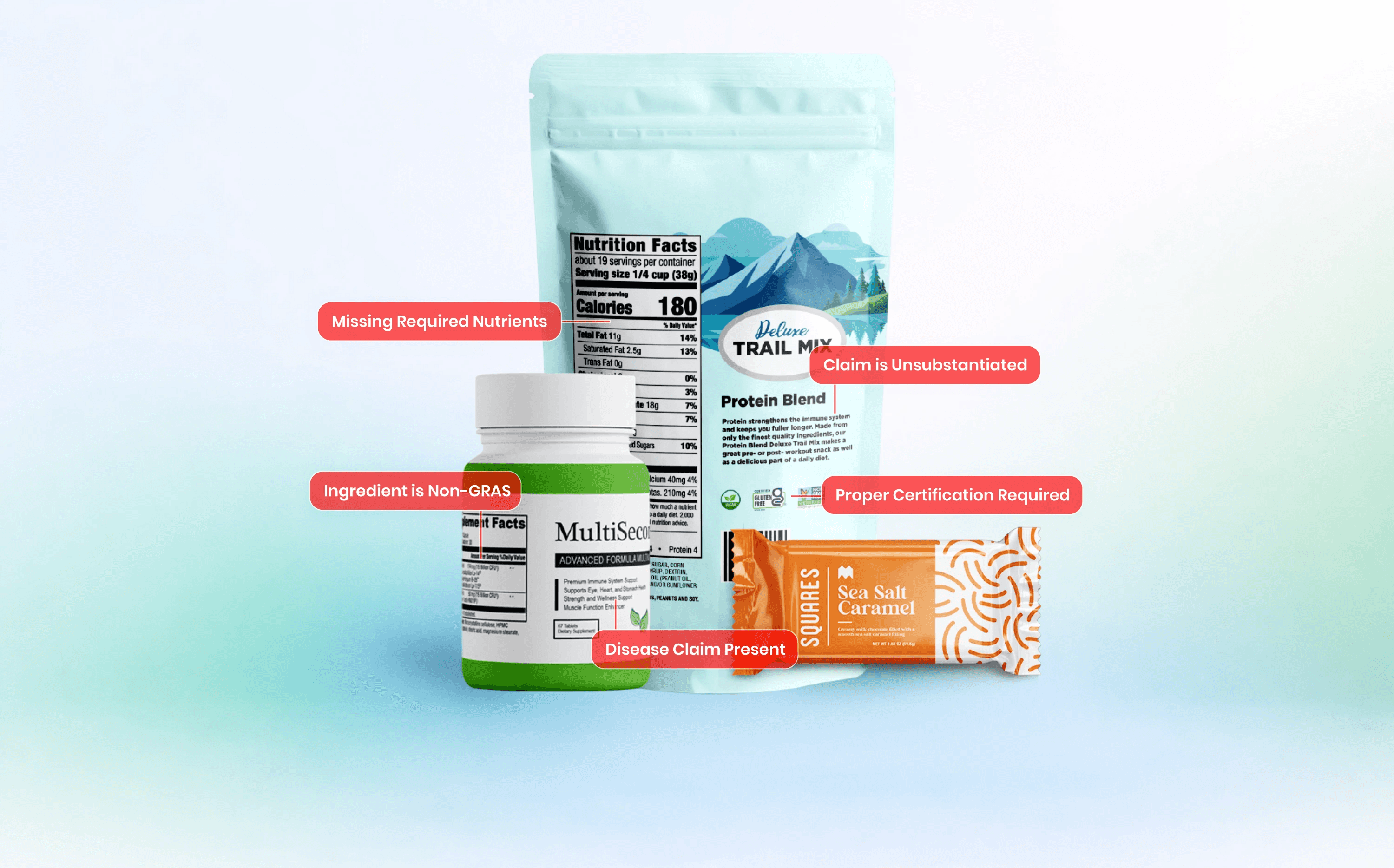
Disease claim detection requires understanding not just explicit trigger words ("treats," "cures," "prevents") but implied disease associations. A statement that a product "supports healthy blood sugar levels already in the normal range" may be permissible; "supports healthy blood sugar" without the qualification may imply glycemic management in diabetic patients. Detecting this distinction requires understanding the regulatory criteria under 21 CFR 101.93(g) and the enforcement patterns in FDA warning letters, not just pattern-matching against a prohibited-words list.
Disclaimer verification requires checking not just that the required FDA disclaimer text is present but that it meets all the conditions under 21 CFR 101.93(b): correct text, bold type, proximity to the claim or proper referencing symbol, and presence across all labeling — not just the physical label.
Claim category classification requires distinguishing between structure/function claims, nutrient content claims, health claims, and disease claims — each of which has different regulatory requirements, different permitted language, and different disclosure obligations. A single label may contain claims across multiple categories simultaneously, each requiring separate evaluation.
Cross-channel consistency requires applying the same regulatory analysis to website copy, Amazon listings, and marketing materials as to the physical label, and flagging channels where claims exceed what the label supports or where required disclosures are missing.
The Multi-Agent Architecture
Each of these analytical tasks requires different data, different reasoning, and different output. Running them as a single monolithic model produces mediocre results on all of them. The architectural choice that produces reliable compliance analysis is a multi-agent workflow: specialized agents handling different analytical domains in parallel, with results integrated into a coherent review.
Truli's approach uses this structure. OCR and text extraction agents process the label image and anchor each piece of text to its location on the label — so a claim flagged as problematic can be traced to exactly where it appears. Claims verification agents run extracted text against current FDA regulation text retrieved from a regulatory database at review time, not from a static ruleset that may not reflect recent guidance. Required-elements agents check for the presence and format of mandatory label components. Allergen agents specifically analyze ingredient lists and supplier documentation against the nine declared allergens.
The "at review time" regulation retrieval is significant. Regulatory requirements change — serving size definitions, Daily Value reference amounts, allergen lists, authorized health claim language. A compliance system that evaluates claims against a static internal ruleset that was accurate when the system was built will drift from current requirements without the brand knowing. Pulling regulation text fresh at review time ensures the analysis is always grounded in what the regulation currently says, not what it said when the software was last updated.
What AI Still Needs Humans For
AI compliance review substantially reduces the time and expertise required to conduct a thorough label review, but it doesn't eliminate the need for human judgment in specific situations.
Borderline claims require interpretation in context. Whether "supports healthy inflammatory response" is a permissible structure/function claim or an implied disease claim for arthritis or inflammatory bowel disease depends on the full label context — other claims, the product name, the target audience signaled by the marketing, the product's ingredient profile. AI can surface the question with high reliability. It cannot always resolve it with the certainty that a regulatory attorney's judgment provides.
Novel ingredients and new enforcement guidance require ongoing human oversight. When FDA issues new guidance on a category — the NMN/NAD+ guidance on structure/function claim boundaries, the updated definition of "healthy" under 21 CFR 101.65 — human review is needed to interpret how the guidance applies to the brand's specific product claims before it's built into the automated system.
The appropriate model is human-in-the-loop: AI handles the high-volume, repeatable analysis that makes systematic review tractable for a brand with multiple SKUs and multiple marketing channels, and flags the items that require human judgment rather than attempting to resolve them autonomously.
The Business Case in 2026
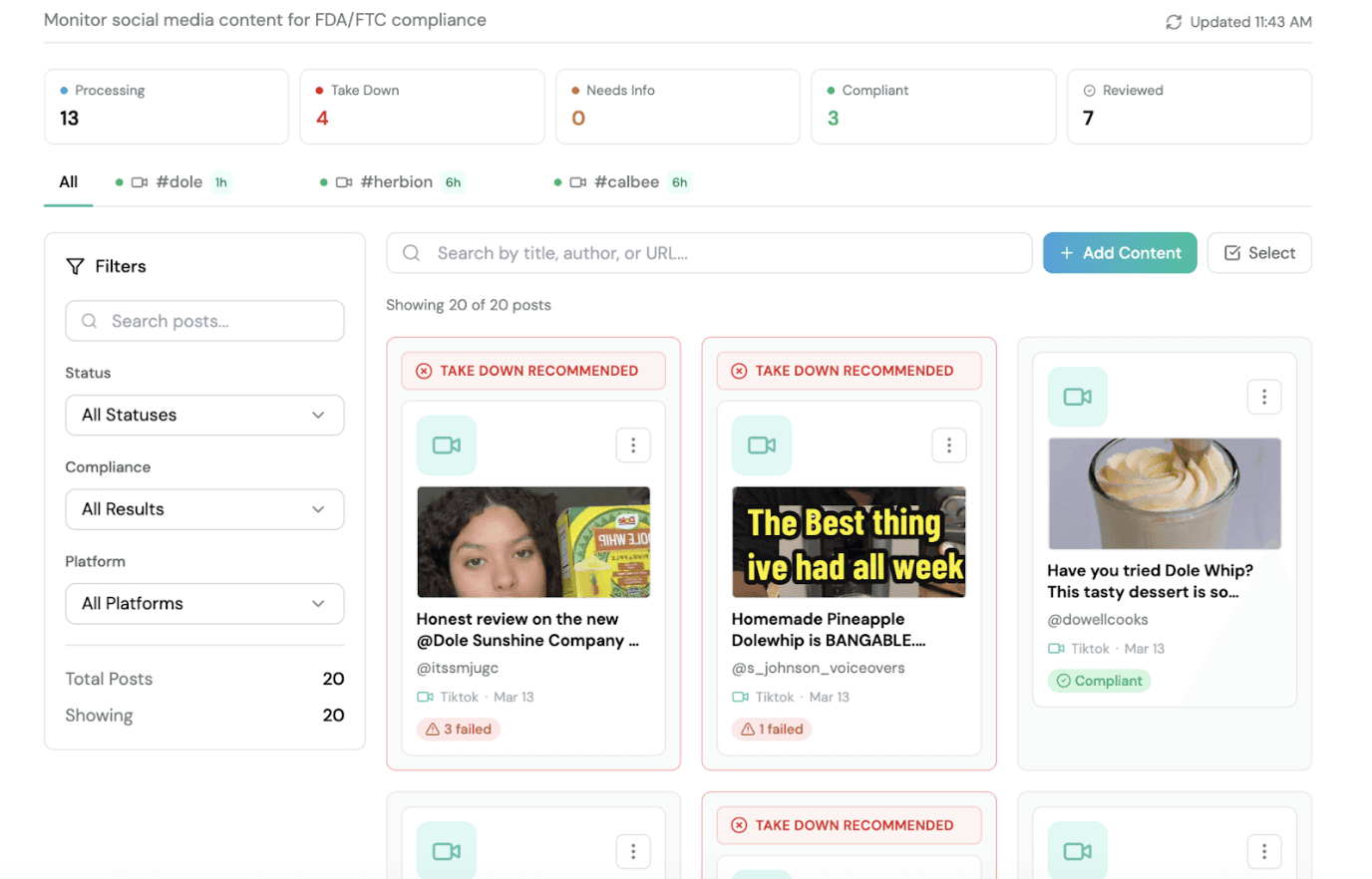
FDA's enforcement posture has moved firmly into digital channels. Warning letters in 2024 and 2025 routinely cited product websites, Amazon listings, and social media posts. Monitoring dozens of marketing channels manually for compliance with evolving FDA and FTC requirements is not a tractable problem for most brands without AI assistance.
The cost comparison is straightforward. A regulatory attorney reviewing a supplement label for disease claim compliance costs several hundred dollars per hour and may take two to four hours to cover the physical label alone. Extending that review to website copy, marketing materials, and a multi-SKU product portfolio is not economically feasible at that rate. AI compliance review runs the same analysis in minutes, across all channels, and surfaces the specific issues that require attorney time — making the attorney review faster, more focused, and more reliable.
The compliance cost avoided is significant. An FDA warning letter requires a response within 15 business days and typically demands immediate corrective action across all channels. A product recall averages over $10 million in direct costs. Preventing either outcome with upstream compliance review is the clearest ROI case in regulatory risk management.
The AI compliance layer every food brand needs
Truli's label compliance platform runs claims analysis, required-element verification, allergen detection, and cross-channel scanning in a single workflow — retrieving current regulation text at review time, anchoring findings to their exact location in the label or marketing copy, and generating specific remediation guidance. If you're scaling a food or supplement brand in 2026 and reviewing your labels manually, you're operating with a structural compliance gap.
A note from Truli: Truli is not a law firm, and this article does not constitute or contain legal advice or create an attorney-client relationship. When determining your obligations and compliance with respect to relevant laws and regulations, you should consult a licensed attorney.
About

Truli is an AI compliance platform for food, beverage, and supplement brands. Automate FDA/FTC label reviews, claims validation, and post-market monitoring — 10x faster.

Platform
See Truli in action
If regulatory delays are consuming months and thousands in fees, see how Truli delivers fast and continuous compliance coverage at a fraction of the cost.
Book a demo