How to use AI agents for label compliance without hallucinated citations
A citation that looks convincing is not enough. When an AI agent helps research label compliance, the useful output is a traceable explanation: the question, the source text, the citation and the limits of what the evidence establishes.

Catherine Zhou
| Co-founder at Truli

A language model can produce a fluent answer and a plausible-looking citation without retrieving the regulation. It can mix up similar provisions, paraphrase a condition too broadly, or attach a reference that does not support the claim. Confidence in the writing is not evidence that the underlying rule was checked.
For label research, ask the agent to retrieve sources before drawing conclusions. The Truli MCP server makes that workflow available inside Claude, ChatGPT, Cursor and other MCP clients.
What grounded retrieval changes
MCP, the Model Context Protocol, connects an AI application to external tools and data. With Truli, the agent can look up a compliance topic, search regulations across jurisdictions and retrieve full regulation text by citation.
Every answer from Truli returns the citation and source text. That gives the agent material to quote and gives the reviewer something to inspect. It does not guarantee that the agent will interpret every passage correctly. A source can be real while the conclusion drawn from it is incomplete.
A worked research question
Imagine your team is preparing a food label for the US market. Ask:
Which sections cover allergen labeling for this food product in the US? Retrieve the relevant text, show the citations beside the passages, and identify the product details you still need before applying the rules.
The agent would begin with curated topic lookup to get the complete list of sections for the compliance topic. Starting from a topic helps frame the review around a set of provisions rather than a single search result.
It would then use regulation search to investigate the product-specific question within the relevant jurisdiction. If the product description leaves important context unclear, ask the agent to name the missing information rather than assume it.
Next, it would use full regulation text by citation to retrieve the passages it plans to rely on. Ask it to separate quoted text from its explanation and preserve qualifications in the source. The reviewer should be able to follow each claim back to the passage that supports it.
The output should be a research brief for your compliance team: relevant citations, the source text, an explanation of how the passages may apply, and unresolved questions. This example describes the tool flow; it does not assert an allergen labeling requirement or a compliance result for a real product.
Extend the research when the question calls for it
An ingredient question may need GRAS, food additive or color additive status lookup, including FDA GRAS notices, 21 CFR 182/184, SCOGS, EAFUS and NOT-GRAS enforcement. US state ingredient bans and branded ingredient lookup provide other research paths. A question about what is happening with a rule in a country can use the policy pipeline.
Truli’s library includes 200K+ regulations ingested from 15K+ primary sources, plus 25K+ enforcement records. Broad coverage helps with research across jurisdictions, but an agent still needs a clearly scoped question: which product, which market and which issue is being reviewed.
Keep the evidence and the limits visible
Ask the agent to distinguish direct quotations from interpretation. Check that each citation supports the sentence beside it, and read the source in context. If a tool cannot find an answer, keep that gap visible; a missing result is not proof that no requirement exists.
Do not treat a proposed rule as an established obligation merely because it appears in a research result. Ask the reviewer to check the source’s status and applicability. A retrieved passage also cannot supply product details that were never provided.
Grounded retrieval reduces reliance on model memory, but it does not remove the need for judgment. Truli is an information tool, not legal advice. Final sign-off stays with the customer’s qualified compliance or legal team.
Try the workflow in your agent
Connect Truli through MCP and start with a narrow research question. The free tier includes 250 tool calls a month; regulation text lookups and topic lookups do not count toward it, and no card is needed. The setup guide includes the server URL and copyable client configuration.
About

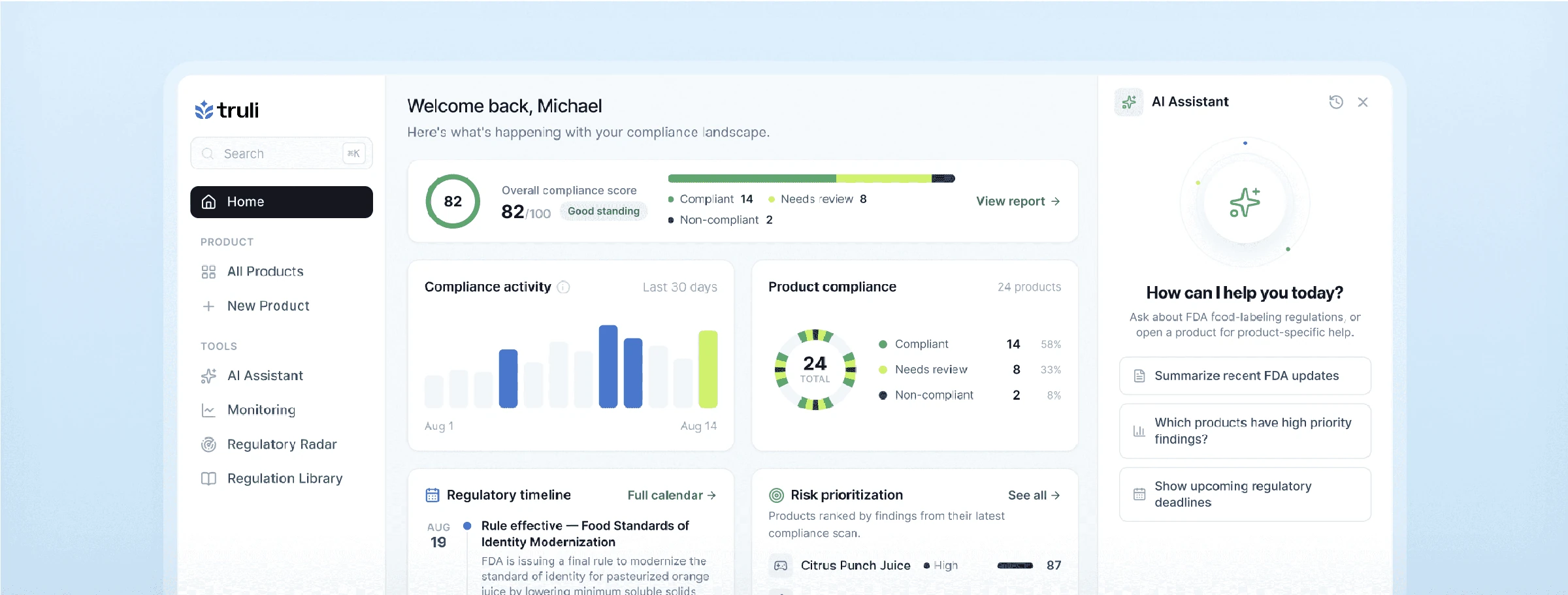
Truli is an AI compliance platform for food, beverage, and supplement brands. Automate FDA/FTC label reviews, claims validation, and post-market monitoring — 10x faster.
Platform
See Truli in action
If regulatory delays are consuming months and thousands in fees, see how Truli delivers fast and continuous compliance coverage at a fraction of the cost.
Book a demo