USDA Organic — National Organic Program Requirements for Food Brands
The USDA National Organic Program (7 CFR 205) sets the certification and labeling requirements for organic claims on food products. Using 'organic' on a label without meeting NOP requirements is a federal violation carrying civil penalties up to $22,246 per violation. There are four distinct claim tiers, and each has specific composition, labeling, and certification requirements.

Catherine Zhou
| Co-founder at Truli
The USDA National Organic Program (NOP), codified at 7 CFR Part 205, is the federal regulatory framework governing the production, handling, and labeling of organic agricultural products. Administered by the USDA Agricultural Marketing Service (AMS), the NOP establishes certification requirements, allowed and prohibited substances, and precise labeling rules for every organic claim tier.
Knowingly selling or labeling a product as organic in violation of the NOP carries civil penalties of up to $22,246 per violation under 7 CFR 205.100(c)(1).
The Four Organic Claim Tiers
Under 7 CFR 205.301, there are four distinct tiers for organic labeling, each with specific composition requirements:
1. "100 Percent Organic"
The product must contain (by weight or fluid volume, excluding water and salt) 100 percent organically produced ingredients. May display the USDA Organic seal. Must be certified.
2. "Organic"
The product must contain at least 95 percent organically produced ingredients (by weight or fluid volume, excluding water and salt). Remaining ingredients must be organically produced where commercially available, or must be nonagricultural substances or nonorganic agricultural ingredients on the National List. May display the USDA Organic seal. Must be certified.
3. "Made with Organic [Specified Ingredients or Food Groups]"
The product must contain at least 70 percent organically produced ingredients (by weight or fluid volume, excluding water and salt). The label may name up to three specific organic ingredients or food groups. May not display the USDA Organic seal. Must be certified.
4. Organic Ingredient Identification (Less Than 70%)
Products with less than 70 percent organic ingredients may only identify organic content by listing individual organic ingredients in the ingredient statement — they may not use "organic" in the product name and may not display the USDA seal. Certification not required for this tier, but must comply with production requirements.
Certification Requirement
Under 7 CFR 205.100, any operation producing or handling agricultural products to be sold, labeled, or represented as "100 percent organic," "organic," or "made with organic" must be certified by a USDA-accredited certifying agent. Certification must be renewed annually and requires:
A written Organic System Plan approved by the certifying agent
On-site inspection of the operation
Recordkeeping demonstrating compliance
Use of only allowed substances on the National List
Certification Exemptions
Operations with annual gross agricultural income from organic sales of $5,000 or less are exempt from certification but must still comply with organic production requirements and may not display the USDA seal.
The National List
7 CFR 205.601–205.606 contains the National List of Allowed and Prohibited Substances — a comprehensive list specifying which synthetic substances are allowed and which natural substances are prohibited in organic production and handling. A food ingredient is not permitted in organic products unless it is on the National List or is itself organically produced.
All synthetic substances and non-agricultural ingredients in multi-ingredient organic products must be on the National List. Brands must verify that every non-organic ingredient in an "organic" or "made with organic" product is either organically produced or appears on the National List.
Label Requirements for Organic Products
Under 7 CFR 205.303–205.311:
The certifying agent's name must appear on the information panel, preceded by "Certified organic by..."
For "organic" products (95%+), organic ingredients must be identified in the ingredient statement with the word "organic" or an asterisk
The USDA Organic seal may be used for products labeled "100 percent organic" or "organic"; it may not be used for "made with organic" products
Products labeled "made with organic" may not exceed 3 specified ingredients or food groups in the "made with" claim
Import Documentation Requirements
Tightened import documentation requirements — effective 2023 — require that organic products imported into the US be certified pursuant to an equivalency arrangement or recognition agreement, with complete audit trail documentation tracing the product back to the last certified operation. Brands sourcing organic ingredients or finished products from overseas must ensure their suppliers maintain compliant certification and documentation.
How Truli Helps with NOP Compliance
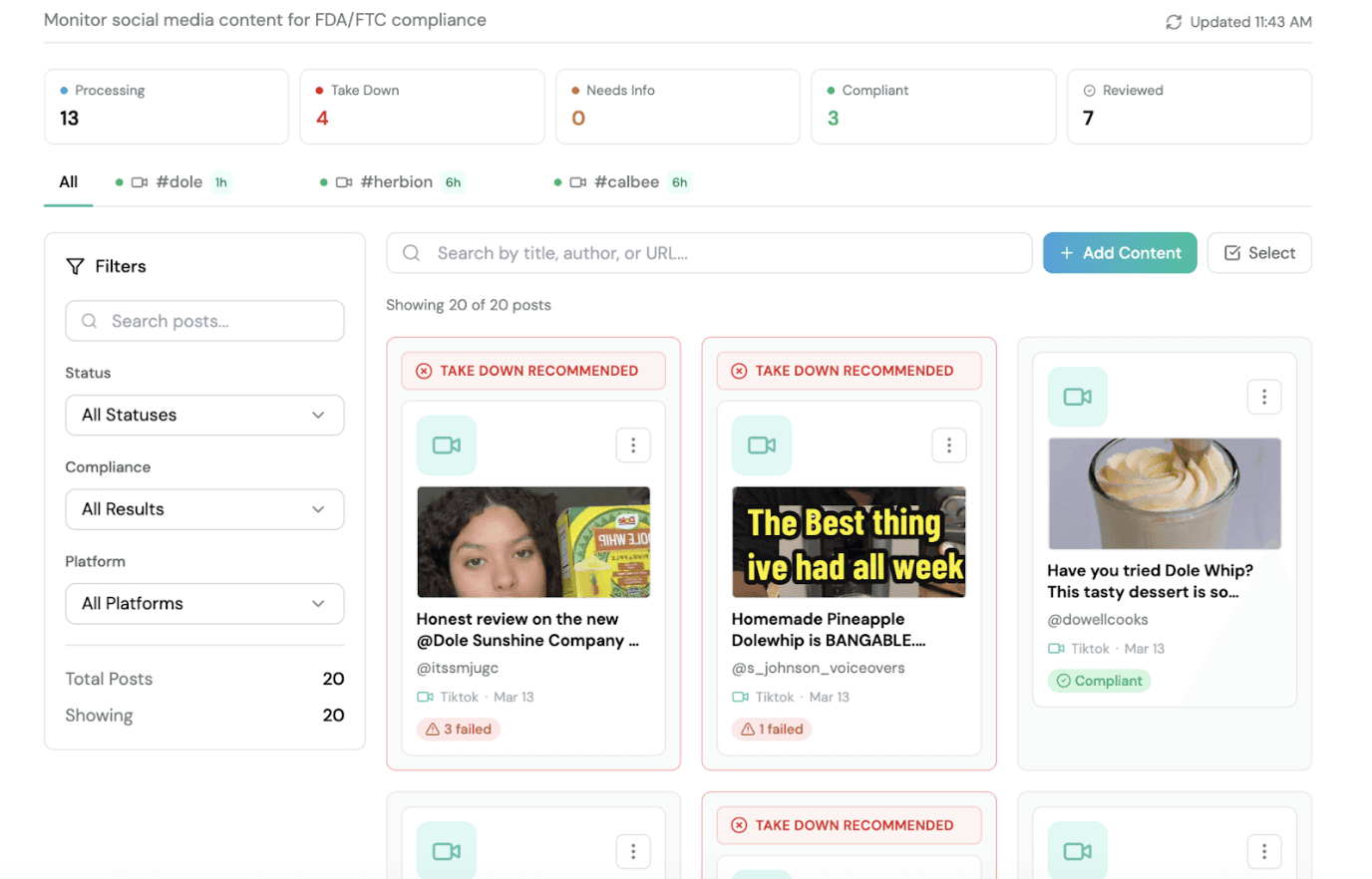
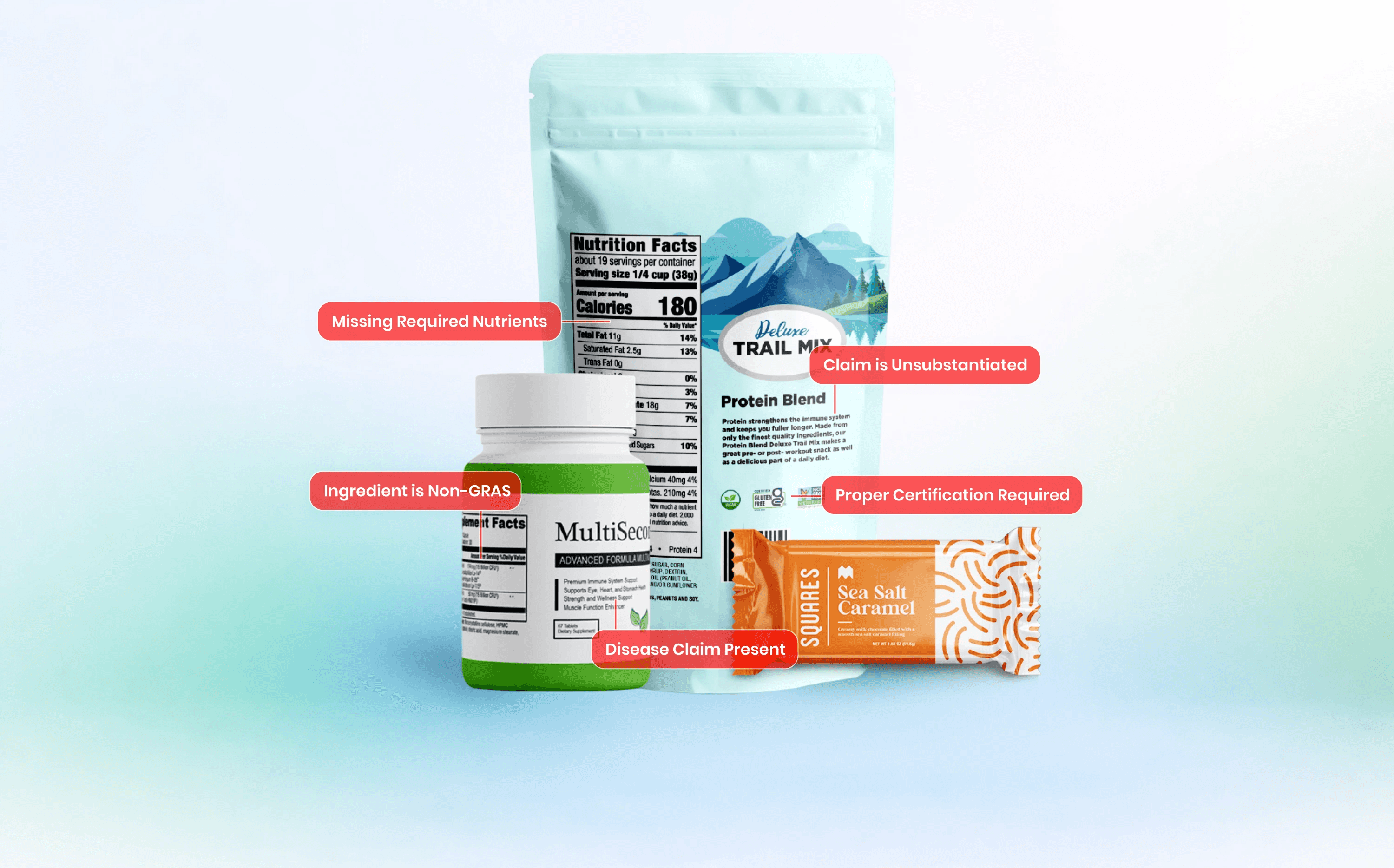
Organic claim audit: Truli verifies that organic claims on labels and in marketing match the product's certified composition tier
Ingredient verification: Truli checks that non-organic ingredients in "organic" and "made with organic" products are on the National List
Label review: Truli flags missing certifying agent disclosures, incorrect USDA seal usage, and "made with organic" claims that exceed three specified ingredients
Related Regulations
USDA Bioengineered Food Disclosure (7 CFR 66) — BE disclosure requirements, which interact with organic labeling
21 CFR Part 101 — FDA food labeling requirements that apply alongside NOP rules
Frequently Asked Questions
Can I use the USDA Organic seal if my product is "made with organic" ingredients?
No. The USDA Organic seal may only be used on products labeled "100 percent organic" or "organic" (95%+ organic content). "Made with organic" products (70–95% organic) may display the certifying agent's seal but not the USDA Organic seal.
Does the NOP apply to dietary supplements?
Yes, if the supplement contains agricultural ingredients and makes an organic claim. The NOP applies to any agricultural product sold, labeled, or represented as organic.
What happens if my product contains a nonorganic ingredient that isn't on the National List?
The product cannot be labeled as "100 percent organic" or "organic" if it contains a nonorganic ingredient not on the National List. You would need to either source that ingredient organically or remove the organic claim.
A note from Truli: Truli is not a law firm, and this article does not constitute or contain legal advice or create an attorney-client relationship. When determining your obligations and compliance with respect to relevant laws and regulations, you should consult a licensed attorney.
Last updated: April 2026. Reflects current 7 CFR 205 as of April 9, 2026. Truli monitors NOP updates and USDA AMS guidance. Book a demo to see how.
About

Truli is an AI compliance platform for food, beverage, and supplement brands. Automate FDA/FTC label reviews, claims validation, and post-market monitoring — 10x faster.
Platform
See Truli in action
If regulatory delays are consuming months and thousands in fees, see how Truli delivers fast and continuous compliance coverage at a fraction of the cost.