Organic Food Labeling — What the USDA Seal Actually Requires
The USDA organic seal is one of the most recognized and regulated label claims in the food industry. It also generates consistent compliance violations among CPG brands that use 'organic' language without understanding the certification requirements, the four labeling tiers, or what it means when an ingredient supplier says their ingredient is 'organic.' Here's what organic food labeling actually requires.

Catherine Zhou
| Co-founder at Truli
Organic food labeling is governed by the USDA National Organic Program (NOP) under 7 CFR Part 205. The NOP establishes the production, handling, and labeling standards that products must meet to be sold as organic — and it is enforced through USDA-accredited certifying agents, not FDA. That distinction matters: FDA doesn't regulate the "organic" claim for most food products. USDA does.
For CPG brands, the compliance implications depend on what level of organic content the product contains and how the brand wants to represent that on the label.
The Four Organic Labeling Tiers
USDA's organic labeling rules create four tiers based on organic content percentage, each with specific labeling requirements and restrictions on seal use.
"100% Organic"
Products that are 100% organic — every ingredient and processing aid is certified organic — may use the "100% organic" designation and display the USDA Organic seal on the principal display panel. The certifying agent's name or seal may also appear on the label.
This tier requires that every agricultural ingredient in the product be certified organic. Water and salt are excluded from the percentage calculation.
"Organic"
Products that contain at least 95% organic ingredients (by weight or fluid volume, excluding water and salt) may be labeled "organic" and display the USDA Organic seal. The remaining up to 5% of ingredients must consist of substances on the National List of Allowed and Prohibited Substances under 7 CFR 205.605 — ingredients that are not commercially available in organic form.
This is the most common tier for multi-ingredient packaged foods. A granola bar with 96% organic ingredients by weight qualifies.
"Made with Organic [Ingredient/Food Group]"
Products that contain at least 70% organic ingredients may be labeled "made with organic [specified ingredients or food groups]" — for example, "made with organic oats" or "made with organic wheat and berries." The USDA Organic seal cannot appear on the PDP, but the certifying agent's seal may appear.
Up to three organic ingredients or food groups may be listed. The specified ingredients must actually be organic. The remaining ingredients that aren't organic must come from the National List.
Less Than 70% Organic
Products with less than 70% organic ingredients may identify specific organic ingredients in the ingredient list with an asterisk or other notation — "* certified organic" — but may not use "organic" in the product name or on the PDP, and may not use the USDA Organic seal.
Who Needs USDA Organic Certification
Any farm, handling operation, or processor that produces or handles organic products and wants to sell, label, or represent those products as organic must be certified under the NOP — unless they qualify for an exemption.
Small operation exemption: Operations that sell $5,000 or less of organic products annually are exempt from certification requirements. They may represent their products as organic but may not use the USDA Organic seal.
Retail food establishments: Restaurants and retailers that process and sell organic products directly to consumers are also exempt, provided they don't use the USDA Organic seal.
For CPG brands that manufacture products with organic ingredients but outsource the farming and ingredient production to certified suppliers: the brand itself needs to be certified if it handles, processes, or packages the organic product and wants to claim organic status. Sourcing certified organic ingredients from a certified supplier is necessary but not sufficient — the brand's own handling operation typically also needs certification.
The Ingredient-Level Organic Claim Trap
A common misunderstanding: a brand assumes that because its supplier sells them "organic" almonds, their product qualifies for organic labeling. The supplier may be certified organic and the almonds may be genuinely organic — but that doesn't mean the brand's product is certified organic.
For a product to carry any organic label tier, the entire supply chain from production through the brand's handling operation must be certified. If the brand's co-manufacturer is not certified for organic handling — meaning they don't maintain the separation, documentation, and controls required by the NOP — the product is not certifiable as organic regardless of the organic status of the individual ingredients.
This is the step that many brands miss when entering the organic market: supplier certification is necessary but not sufficient. The brand and its handling/processing operations must also hold organic certification through an accredited certifier.
"Natural" vs. "Organic": Not Interchangeable
These two terms create frequent consumer confusion and brands sometimes use them interchangeably in marketing — which creates regulatory risk.
"Organic" is a federally defined, certification-required claim governed by USDA/NOP. Using it without certification is a violation of the NOP and can result in civil penalties.
"Natural" is not a federally defined claim for most food categories. FDA has an informal policy that "natural" means no artificial or synthetic ingredients have been added, but FDA has not finalized a formal definition. Using "natural" on a label that contains artificial flavors, artificial colors, or synthetic preservatives creates FDA misbranding risk, but there's no certification requirement.
A product can be "natural" (in FDA's informal sense) without being certified organic. And an organic product can contain processing aids and non-agricultural ingredients that some consumers wouldn't describe as "natural." Treating them as synonyms in marketing copy creates compliance exposure on both the USDA and FDA sides.
Organic Ingredients in Dietary Supplements
Dietary supplements containing organic botanical ingredients or organic food components can carry organic labeling under the same NOP framework, subject to certification. However, non-agricultural ingredients common in supplements — minerals, synthetic vitamins, excipients — complicate the organic percentage calculation.
Purely synthetic vitamins and minerals cannot be considered organic. A supplement formula that is primarily synthetic vitamins is unlikely to qualify for any organic labeling tier. Brands formulating supplement products with organic botanical concentrates need to calculate the organic content percentage carefully and verify that non-organic ingredients are on the National List.
What Changed: The 2023 Strengthening Organic Enforcement Rule
USDA's Strengthening Organic Enforcement (SOE) rule took effect March 20, 2024. Key changes relevant to CPG brands:
Expanded certification requirements: More operations in the organic supply chain now require certification — including brokers, traders, and certain importers of organic products.
Enhanced fraud prevention: Increased documentation and audit trail requirements across the organic supply chain.
USDA Import Certificates: Organic products imported into the U.S. must now be accompanied by a USDA-accredited certifier-issued import certificate.
Brands sourcing organic ingredients from international suppliers need to ensure those suppliers comply with the SOE rule's import certificate requirements.
Organic Claims Come With Real Certification Obligations
Using "organic" on a food label isn't just a sourcing decision — it's a certification commitment that runs through your supply chain, your co-manufacturer, and your own operations. The USDA Organic seal is one of the most valuable claims in food marketing. It's also one of the most specifically regulated.
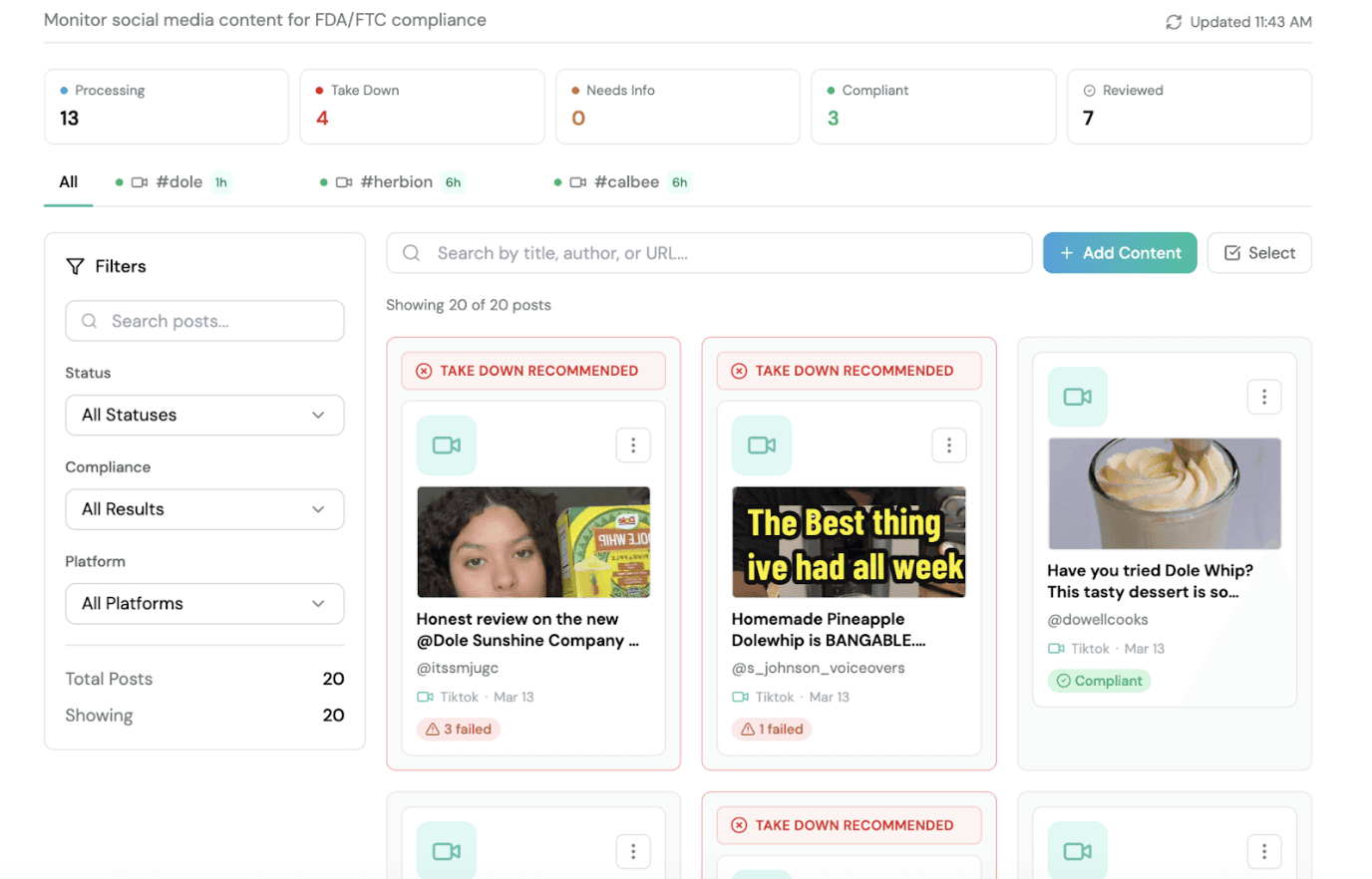
Truli's compliance platform monitors label claims including organic representations for accuracy and flags when labeling language may not align with verified certification status. For full organic certification management, brands work directly with USDA-accredited certifying agents. Book a demo to see how Truli integrates into your claims compliance workflow.
About

Truli is an AI compliance platform for food, beverage, and supplement brands. Automate FDA/FTC label reviews, claims validation, and post-market monitoring — 10x faster.
Platform
See Truli in action
If regulatory delays are consuming months and thousands in fees, see how Truli delivers fast and continuous compliance coverage at a fraction of the cost.