FTC Substantiation Standard for Supplement and Health Claims
FTC requires supplement and food brands to have substantiation for their advertising claims before making them — not after. The standard is 'competent and reliable scientific evidence,' which FTC has interpreted to mean randomized controlled trials (RCTs) for most supplement efficacy claims. Making a claim and then searching for supporting studies is the wrong order, and FTC enforcement actions targeting supplement advertising are among the highest-volume in FTC's consumer protection docket.

Catherine Zhou
| Co-founder at Truli

The Federal Trade Commission's substantiation standard requires that food and dietary supplement brands possess adequate substantiation for advertising claims before the claims are made. This pre-substantiation requirement is enforced under Section 5 of the FTC Act, which prohibits deceptive acts and practices — including claims that are not backed by the level of evidence consumers would reasonably expect.
The Core Standard: Competent and Reliable Scientific Evidence
For health-related claims — including structure/function claims, efficacy claims, and nutrient content claims in advertising — FTC's standard is "competent and reliable scientific evidence":
Evidence based on the expertise of professionals in the relevant area, and conducted and evaluated in an objective manner by persons qualified to do so, using procedures generally accepted in the profession to yield accurate and reliable results.
For most health efficacy claims about supplements, FTC has interpreted this standard to require at a minimum:
Randomized controlled trials (RCTs) in human subjects
Conducted in populations similar to the target audience for the product
Using the product or ingredient at the dose and form used in the product
Showing statistically significant results for the claimed outcome
How Many Studies Are Required
FTC has not specified an exact number of RCTs required for any given claim. FTC guidance and consent orders reflect a requirement that substantiation be adequate — meaning the totality of evidence supports the claim, not just that one study exists.
In practice:
One well-designed RCT from an independent laboratory may be adequate for a narrow, modest claim about a well-studied ingredient
Multiple RCTs with consistent results are expected for stronger or more specific claims
Meta-analyses and systematic reviews are considered higher-quality evidence and can strengthen substantiation
Mechanistic studies, animal studies, and in vitro studies alone are generally not sufficient to substantiate efficacy claims in humans
The "Two RCT" Rule — FTC Consent Orders
Many FTC consent orders for supplement companies require a minimum of two RCTs before any efficacy claim may be made. This has become a de facto industry standard for major supplement efficacy claims, particularly:
Weight loss claims
Cognitive enhancement claims
Sexual health claims
Cardiovascular health claims
Immune support claims when framed as efficacy claims
Brands that have settled FTC enforcement actions are often required to substantiate all future claims with at least two RCTs conducted on the product or its key ingredient.
Substantiation Must Exist Before the Claim Is Made
A critical FTC requirement that is frequently misunderstood: substantiation must be in the advertiser's possession before the claim is disseminated. FTC has explicitly stated that:
It is not a defense to say "we'll conduct studies" after making a claim
Finding a favorable study after the fact does not retroactively create substantiation for claims made before the study existed
Commissioning a study after FDA or FTC inquiry is not a defense
This pre-substantiation requirement means brands must conduct their evidence review before launching a product with health claims, not as an after-the-fact exercise.
Qualified Claims and Softening Language
Softening language — "may help," "helps support," "some studies suggest" — can reduce but does not eliminate the substantiation obligation. FTC evaluates the net impression of an ad, not just the technical language.
An ad that says "clinical studies show our product supports cardiovascular health" while prominently featuring before/after testimonials and dramatic health transformation imagery may create a net impression stronger than the qualified language suggests — and FTC will evaluate the whole ad.
Truly qualified claims — "preliminary research suggests X, but more evidence is needed" — require less substantiation but must accurately convey the state of the evidence.
Testimonials and Endorsements: The FTC Substantiation Connection
Under 21 CFR 255 (FTC Endorsement Guides), consumer testimonials in advertising are evaluated as advertising claims, not as mere opinions:
A testimonial claiming a supplement helped someone lose 30 pounds implies the typical user can expect similar results — unless the ad clearly discloses what typical results actually are
If a testimonial describes a health outcome the product is not substantiated to cause, the testimonial cannot be used even if it is truthful about one person's experience
FTC enforcement actions have frequently cited supplement companies for using atypical consumer testimonials without disclosing that results were not typical, combined with inadequate substantiation for the implied typical outcomes.
The FTC-FDA Coordination on Supplement Claims
FTC and FDA have memoranda of understanding governing their respective jurisdiction over supplement advertising and labeling:
FDA regulates the product label and labeling (the label and any material that accompanies the product)
FTC regulates advertising (including websites, social media, TV, print, Amazon listings)
A supplement label that complies with FDA's structure/function claim requirements may still generate FTC enforcement liability if the same claim in advertising is not supported by adequate substantiation under FTC's standard. The FDA disclaimer requirement on labels does not provide a safe harbor for advertising claims.
How Truli Helps with FTC Substantiation Compliance
Claim inventory and substantiation mapping: Truli catalogs advertising claims across label copy, website content, social media, and Amazon listings, and maps each claim to available substantiation documentation
Evidence quality assessment: Truli evaluates whether studies cited for substantiation meet FTC's standard — RCTs vs. observational studies, human vs. animal data, population relevance, dose and form alignment
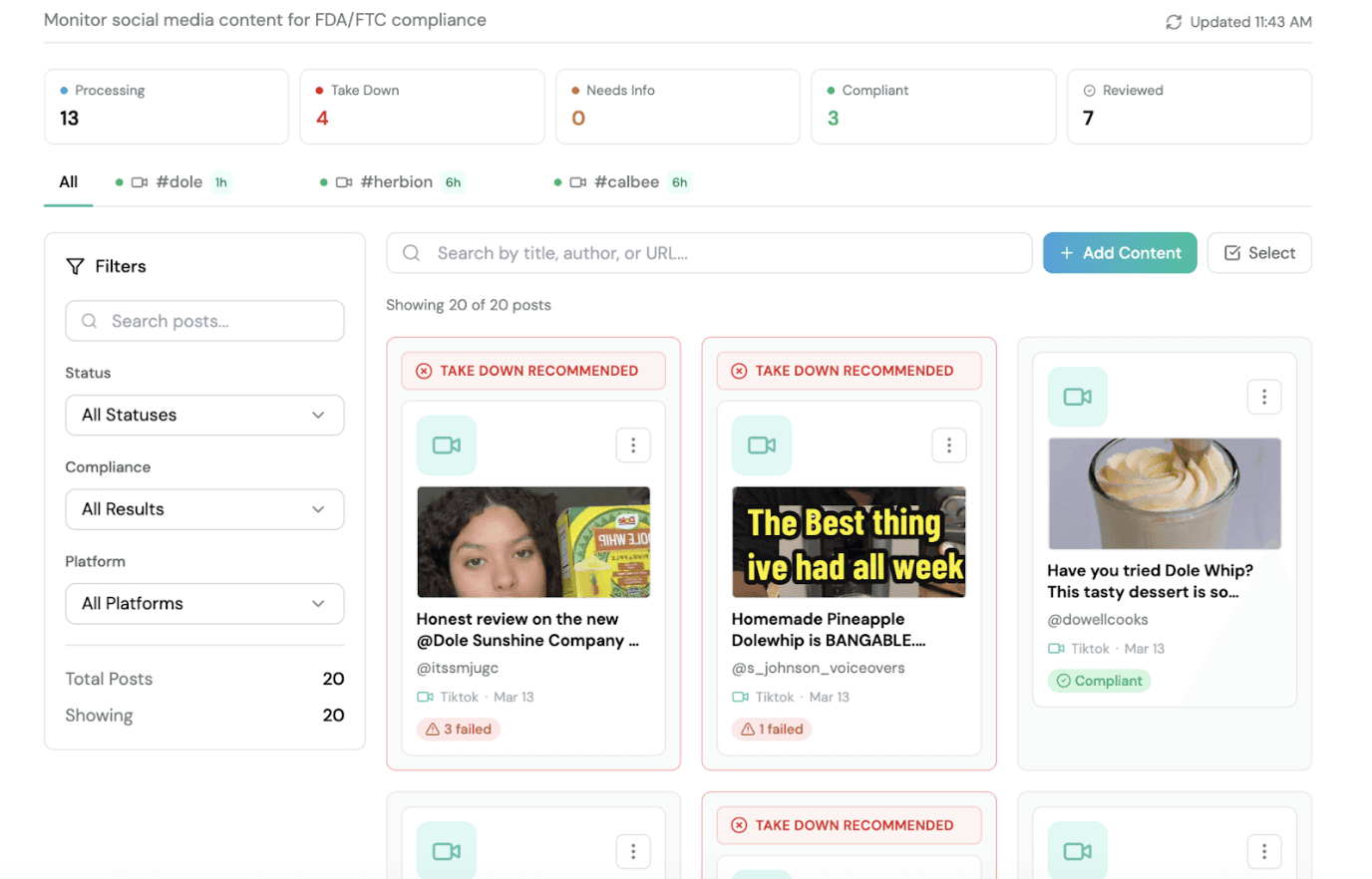
Testimonial and endorsement audit: Truli scans influencer content, brand-amplified testimonials, and endorsement arrangements for claims that may imply efficacy not supported by substantiation
Pre-launch claim review: Truli reviews planned advertising claims for new product launches against available substantiation before launch to identify substantiation gaps
Related Regulations
FTC Health Claims in Advertising — FTC's general enforcement framework for health claims
FTC Endorsement Guides — Influencer Marketing — Disclosure requirements for influencer and testimonial content
FDA Structure/Function Claims for Supplements — FDA's parallel requirements for label claim substantiation and notification
FDA Drug-Supplement Boundary — How claims that cross into disease territory trigger FTC as well as FDA enforcement
Frequently Asked Questions
We have one study showing our ingredient works. Is that enough?
It depends on the claim. For modest, narrowly worded structure/function claims about well-studied ingredients, one RCT may be adequate. For more aggressive efficacy claims ("clinically proven," "reduces [specific outcome]"), FTC's enforcement history suggests two or more RCTs are typically expected. A legal review of your specific claim against the specific study is the right approach.
Our ingredient has dozens of published studies. Do we still need product-specific studies?
Published studies on an ingredient are relevant substantiation, but FTC may evaluate whether the studies used the same form (e.g., extract vs. whole herb), dose, and population as your product. If the published studies used a higher dose than your product, or a different form, they may not adequately substantiate claims made for your specific product.
We want to make a "clinically proven" claim. What does that require?
"Clinically proven" is a strong efficacy claim that FTC treats as requiring at least two RCTs demonstrating the specific claimed outcome in populations similar to target consumers at the dose in the product. This is a high bar. Brands should conduct a substantiation review before using "clinically proven" or equivalent language.
A note from Truli: Truli is not a law firm, and this article does not constitute or contain legal advice or create an attorney-client relationship. When determining your obligations and compliance with respect to relevant laws and regulations, you should consult a licensed attorney.
Last updated: April 2026. FTC enforcement against supplement advertising claims continues to be a high-priority area. Truli monitors FTC enforcement actions affecting supplement and food brands. Book a demo to see how Truli monitors advertising compliance.
About

Truli is an AI compliance platform for food, beverage, and supplement brands. Automate FDA/FTC label reviews, claims validation, and post-market monitoring — 10x faster.
Platform
See Truli in action
If regulatory delays are consuming months and thousands in fees, see how Truli delivers fast and continuous compliance coverage at a fraction of the cost.