FTC Green Guides — Environmental and Sustainability Claims for Food and Supplement Brands
As consumers increasingly seek environmentally responsible products, food and supplement brands are adding sustainability claims — 'eco-friendly packaging,' 'carbon neutral,' 'recyclable,' 'plant-based' — to their labels and marketing. The FTC Green Guides (16 CFR Part 260) set the standard for when these claims are deceptive. The FTC is currently revising the Guides, and the revised version is expected to significantly tighten rules on 'carbon neutral,' 'net zero,' and broad sustainability claims.

Catherine Zhou
| Co-founder at Truli

The FTC Guides for the Use of Environmental Marketing Claims — known as the Green Guides — are published at 16 CFR Part 260. They provide guidance on how FDA interprets environmental claims in advertising and labeling under Section 5 of the FTC Act, which prohibits unfair or deceptive acts or practices.
The Guides are not formal regulations — violations are not subject to civil penalties under the Guides themselves — but the FTC treats environmental marketing claims that contradict the Guides as presumptively deceptive, and has brought enforcement actions using its Section 5 authority. The FTC announced a review of the 2012 Guides in 2022, with a revised version expected to be finalized and likely to include new rules on carbon claims and recyclability.
General Principles for All Environmental Claims
The Green Guides apply several overarching principles to any environmental marketing claim:
Qualifications and disclosures — If a claim is likely to be misleading without qualification, the brand must clearly and prominently disclose the qualifying information
Substantiation — Brands must have a reasonable basis for environmental claims before making them. What constitutes a "reasonable basis" depends on the nature of the claim — broad claims like "environmentally friendly" require more robust support than specific, limited claims
Comparative claims — Claims comparing a product's environmental attributes to another product or previous version must clearly identify what is being compared
Third-party certifications — Using a third-party seal or certification implies the product meets certain standards; the brand must verify that the certification is legitimate and that the product actually meets the certified standard
Specific Claim Guidance
"Eco-Friendly," "Sustainable," "Environmentally Friendly," "Green"
These general environmental benefit claims are among the highest-risk claims in the Green Guides. The FTC has stated that broad environmental claims like "eco-friendly" or "sustainable" convey that a product has broad environmental benefits across its entire lifecycle — a standard virtually no product can substantiate.
The FTC's guidance: avoid unqualified general environmental benefit claims. If a brand wants to communicate environmental attributes, use specific qualified claims (e.g., "made with 30% post-consumer recycled content") rather than broad unsubstantiated claims.
"Recyclable"
A product may claim to be "recyclable" only if it can be collected, separated, or otherwise recovered from the waste stream and used again or remanufactured into another product. Key guidance:
If recycling programs are not available to a substantial majority (approximately 60% or more) of consumers in the area where the product is sold, an unqualified "recyclable" claim is deceptive
If recycling is available to some but less than a substantial majority, the claim must be qualified: "Check locally — may not be recyclable in your area"
Caps, pumps, and multi-material packaging components affect recyclability — a "recyclable bottle" claim may be deceptive if the pump is not recyclable
For food and supplement brands, the recycling infrastructure for packaging types varies significantly:
PET #1 and HDPE #2 plastics: widely recyclable in most US markets
Flexible pouches, mylar bags, multi-layer packaging: rarely accepted in curbside recycling — "recyclable" claims require significant qualification or should be avoided
"Compostable"
A "compostable" claim is appropriate only if all materials in the product or package will break down into usable compost in a safe and timely manner in an appropriate composting program or facility.
If the product is only compostable in industrial composting facilities (not home compost bins), the claim must disclose this: "Compostable in industrial facilities — check if available in your area"
Many products marketed as "compostable" are only certified for industrial composting, which is available to a small fraction of US consumers
"Biodegradable"
A product may only be marketed as "biodegradable" if the entire product or package will completely break down and return to nature within a reasonably short period of time after customary disposal. The FTC has indicated that "a reasonably short period" means within approximately one year for products disposed of in landfills.
Many products marketed as biodegradable do not actually biodegrade in landfill conditions (the most common disposal environment). The FTC has brought enforcement actions against biodegradable plastic bag claims.
"Carbon Neutral," "Net Zero," "Climate Positive"
Carbon offset and carbon neutrality claims are among the most scrutinized in the upcoming Green Guides revision. Under current guidance and FTC enforcement signals:
A "carbon neutral" claim requires that all greenhouse gas emissions associated with the product's lifecycle have been offset — including Scope 1, 2, and increasingly Scope 3 emissions
Carbon offset purchases used to support carbon claims must come from high-quality, additional, permanent, and independently verified offsets
The basis for the claim (what is being offset, using what methodology) must be clearly disclosed
Claiming "carbon neutral" packaging while not addressing product emissions may be deceptive if it implies overall product carbon neutrality
"Recycled Content" and "Post-Consumer Recycled Content"
Recycled content claims must accurately represent the percentage of recycled material. Under the Guides:
"Recycled content" covers both pre-consumer and post-consumer recycled material
"Post-consumer recycled content" specifically refers to material diverted from the consumer waste stream
Percentage claims must be accurate — "made with recycled materials" without a percentage implies substantial recycled content
Certifications and Seals
The Green Guides address third-party certifications:
Certifications must come from legitimate, independent third parties
The certification criteria must be publicly available and meaningful
The brand must actually meet the certified standard — displaying a seal for a certification the brand does not hold is deceptive
Common certifications relevant to food and supplement brands:
USDA Certified Organic — governed by 7 CFR Part 205, not the Green Guides, but interacts with sustainability marketing
Non-GMO Project Verified — third-party non-GMO certification
B Corp — broad sustainability certification covering governance, workers, community, and environment
1% for the Planet — commitment to donate 1% of revenue, not a product-level environmental certification
How Truli Helps with Environmental Claim Compliance
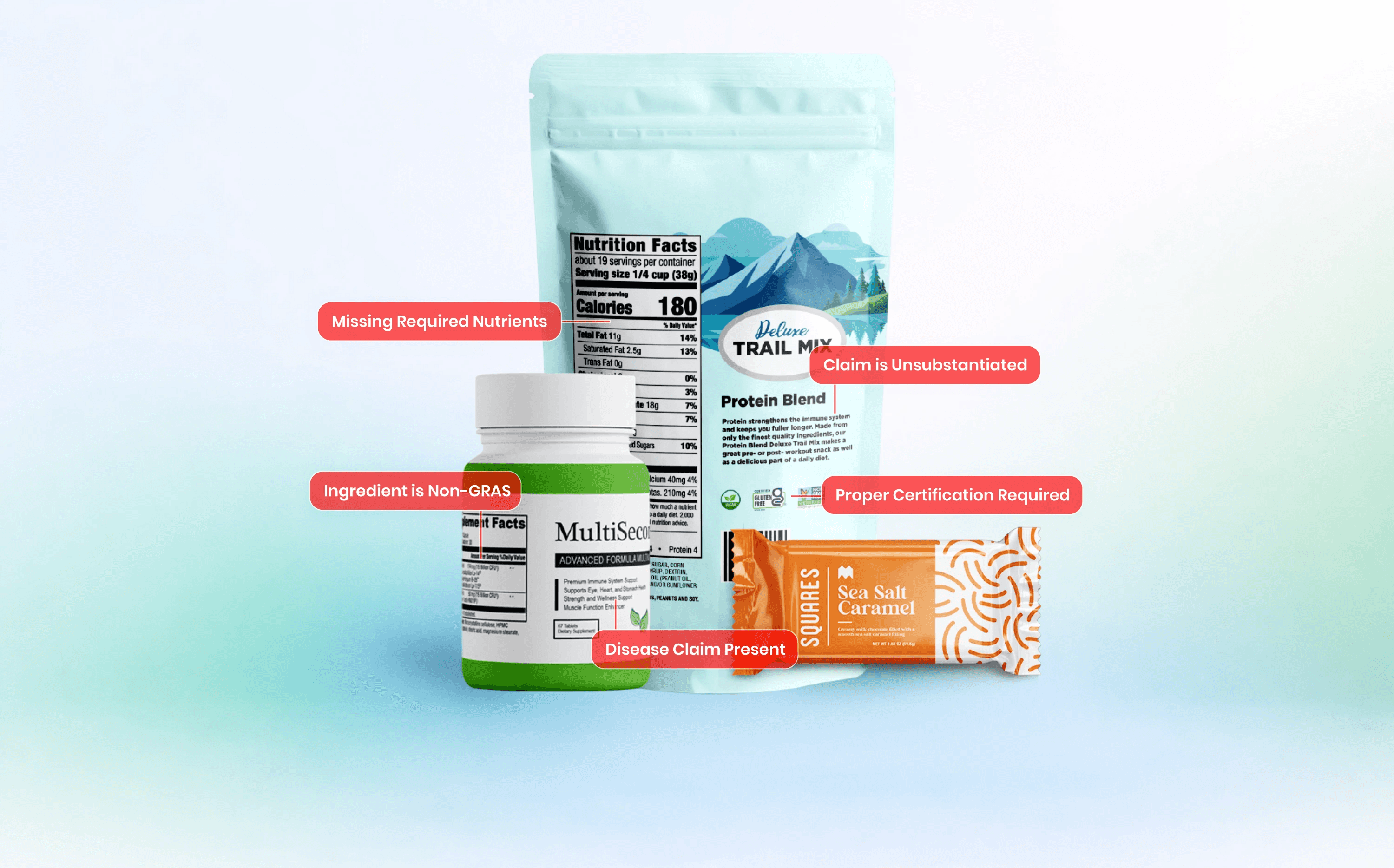
Claim classification: Truli identifies "eco-friendly," "sustainable," "carbon neutral," and similar environmental claims on labels and in advertising
Recyclability flagging: Truli surfaces packaging material types where unqualified "recyclable" claims are risky given current recycling infrastructure
Certification verification: Truli flags environmental seals and certifications displayed on labels without confirmed certification status
Substantiation gap detection: Truli identifies broad, unqualified environmental claims that require qualification or substantiation under FTC Green Guides standards
Related Regulations
FTC Health Claims in Advertising — FTC's substantiation requirements for health claims, parallel to its environmental claim standards
FTC Made in USA Labeling Rule — Origin claims that often appear alongside sustainability marketing
USDA Organic — National Organic Program — Organic certification that intersects with environmental marketing
Frequently Asked Questions
Can I say my packaging is "eco-friendly" if it uses some recycled content?
Likely not without qualification. "Eco-friendly" is a general environmental benefit claim that implies broad environmental benefit across the product's lifecycle. Specific, qualified claims — "made with 30% post-consumer recycled plastic" — are far less likely to be challenged than an unqualified "eco-friendly" claim.
My packaging supplier says the bottle is recyclable — can I put "recyclable" on the label?
Not automatically. The "recyclable" claim depends on whether recycling infrastructure exists for the specific packaging in the markets where you sell the product. A bottle that is technically recyclable but for which recycling programs are not available to a substantial majority of consumers requires a qualified claim or should not bear an unqualified "recyclable" claim.
Does the FTC Green Guides revision matter now if it isn't final yet?
Yes. The FTC has signaled the direction of the revision publicly through its 2022 request for public comment. Brands making carbon neutral or net zero claims now should anticipate that the revised Guides will require stronger substantiation and clearer disclosure of the basis for these claims. Building compliant practices now avoids a compliance cliff when the revised Guides take effect.
A note from Truli: Truli is not a law firm, and this article does not constitute or contain legal advice or create an attorney-client relationship. When determining your obligations and compliance with respect to relevant laws and regulations, you should consult a licensed attorney.
Last updated: April 2026. The FTC Green Guides revision is pending — Truli monitors FTC environmental claim enforcement and the revised Guides rulemaking. Book a demo to see how.
About

Truli is an AI compliance platform for food, beverage, and supplement brands. Automate FDA/FTC label reviews, claims validation, and post-market monitoring — 10x faster.

Platform
See Truli in action
If regulatory delays are consuming months and thousands in fees, see how Truli delivers fast and continuous compliance coverage at a fraction of the cost.