FDA GRAS — Generally Recognized as Safe for Food Ingredients
Under 21 U.S.C. 321(s), a substance is exempt from FDA's food additive pre-market approval requirement if it is 'generally recognized as safe' (GRAS) for its intended use. GRAS status is not a formal FDA certification — it is a legal determination that the safety of a substance is generally recognized by qualified scientific experts. Brands adding novel ingredients to food or supplement products need to understand whether those ingredients have an adequate GRAS basis or require a food additive petition.

Catherine Zhou
| Co-founder at Truli

Under the Federal Food, Drug, and Cosmetic Act (FD&C Act), any substance intentionally added to food is a food additive that requires FDA pre-market approval — unless it is generally recognized as safe (GRAS) for its intended use, or falls under another exemption. GRAS is codified at 21 U.S.C. 321(s) and implemented through FDA regulations at 21 CFR Part 170.
For food and supplement brands, GRAS is the foundational legal basis that allows the vast majority of conventional food ingredients to be used without an FDA petition for each one. Understanding GRAS also matters when introducing newer or non-traditional ingredients — where the GRAS basis may be weaker or contested.
The Two Paths to GRAS Status
A substance may be GRAS through either of two bases:
1. Common Use in Food Prior to January 1, 1958
A substance has a long history of common use in food in the United States prior to January 1, 1958. The use must have been widespread and the safety must have been generally recognized based on that history. Examples: salt, sugar, vinegar, spices with centuries of food use.
2. Scientific Procedures (Post-1958 Substances)
For substances first used after January 1, 1958, GRAS status requires scientific procedures — the same quantity and quality of scientific evidence that would be required to obtain FDA approval of a food additive, but the safety conclusion must be generally recognized (i.e., publicly available and broadly accepted by qualified experts, not proprietary to one company).
Self-Affirmed GRAS vs. FDA-Notified GRAS
There is no regulatory requirement for a company to notify FDA before using a GRAS ingredient. A company may conduct its own GRAS determination ("self-affirmed GRAS") and begin using the ingredient without any FDA involvement.
However, FDA operates a voluntary GRAS Notification Program under 21 CFR Part 170, Subpart E:
Pathway | Description | FDA Involvement |
|---|---|---|
Self-affirmed GRAS | Company convenes a qualified expert panel, reviews the evidence, and concludes the ingredient is GRAS for the intended use | None — no FDA filing required |
GRAS Notification | Company submits a GRAS notice to FDA summarizing the basis for the GRAS determination | FDA reviews and responds: "no questions," "insufficient basis," or ceases review — but does not formally "approve" GRAS |
A GRAS notification response of "no questions" is not FDA approval — it means FDA did not identify a reason to question the conclusion. FDA can revisit a prior "no questions" response if new safety information emerges.
The GRAS Requirement: Generally Recognized
The key legal element that distinguishes GRAS from a food additive approval is general recognition. The safety information must be:
Publicly available — not proprietary trade secrets
Broadly accepted by qualified experts in the relevant scientific field
Based on studies generally accepted in the scientific community
An ingredient whose safety evidence exists only in proprietary, undisclosed studies cannot be GRAS — the evidence must be publicly available so that qualified experts can independently arrive at the same safety conclusion.
This requirement is why novel ingredients developed through recent research often cannot immediately achieve GRAS status even if a company's own scientists believe they are safe.
GRAS and Dietary Supplements
GRAS applies to conventional foods. Dietary supplements are regulated under DSHEA, not as conventional foods, and the relevant safety standard for supplement ingredients is the NDI (New Dietary Ingredient) framework under 21 U.S.C. 350b and 21 CFR Part 190 — not GRAS.
However, when a dietary supplement contains a conventional food ingredient (e.g., a botanical that is also widely consumed as a food), GRAS status for that ingredient as a food may be relevant context, though it does not substitute for NDI analysis when the ingredient is used as a dietary supplement.
Common GRAS Categories
FDA maintains a list of substances generally recognized as safe at 21 CFR Part 182, 21 CFR Part 184 (direct food substances affirmed as GRAS), and 21 CFR Part 186 (indirect food substances). These lists include:
Common spices, seasonings, and flavoring substances
Vitamins and minerals used in food fortification
Common food processing aids (enzymes, emulsifiers, stabilizers)
Nutrients and dietary substances with long food use histories
FDA also maintains a GRAS Notices inventory on its website listing substances for which the agency has issued "no questions" responses.
GRAS Risks for Brands
Using a GRAS determination — particularly a self-affirmed GRAS — creates regulatory risk if:
The expert panel was not independent — conflicts of interest on the expert panel undermine the "generally recognized" standard
The evidence base was too narrow — a few in-house studies may not constitute general scientific recognition
The intended use differs from the GRAS basis — GRAS is use-specific; a substance GRAS as a flavor may not be GRAS as a functional ingredient at higher doses
FDA questions the determination later — FDA can contest a self-affirmed GRAS determination through enforcement action if it determines the ingredient is not GRAS for its actual use
FDA's 2010 report on the GRAS notification program raised concerns about the GRAS process, noting that the self-affirmation pathway creates a gap in oversight.
How Truli Helps with GRAS Compliance
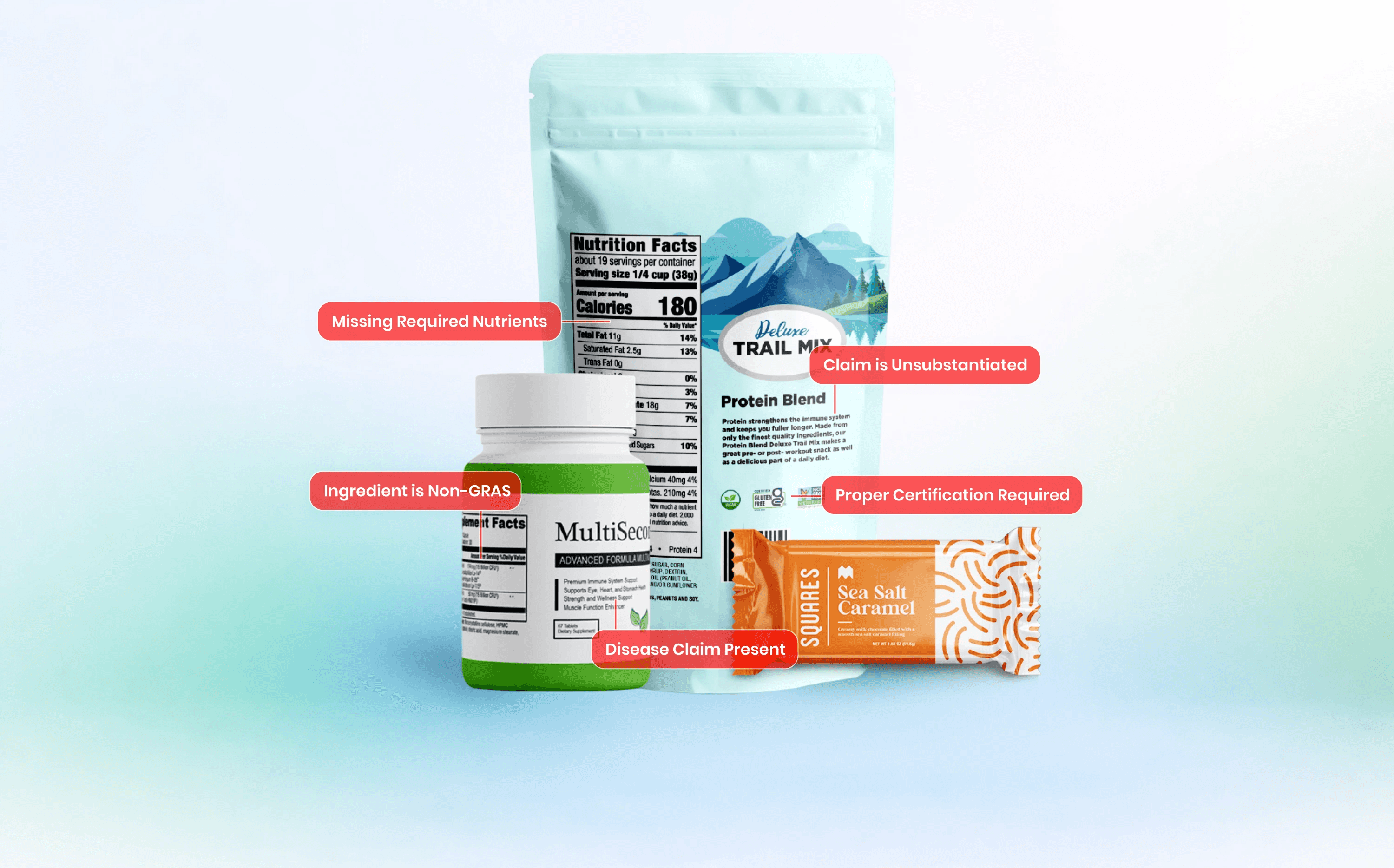
Ingredient GRAS status screening: Truli identifies ingredients in formulations that may lack an adequate GRAS basis or that FDA has questioned in prior enforcement actions
Novel ingredient flagging: Truli surfaces recently introduced food ingredients where GRAS status is unclear or contested
Use-level monitoring: Truli flags ingredients used at levels that exceed the level on which existing GRAS determinations are based
Related Regulations
DSHEA — Dietary supplement safety standard, distinct from GRAS
FDA NDI Notification — Pre-market notification for new dietary supplement ingredients
21 CFR Part 117 — FSMA Preventive Controls — Food safety plan requirements that intersect with ingredient safety evaluation
Frequently Asked Questions
Does FDA "approve" GRAS status?
No. FDA does not formally approve or certify that a substance is GRAS. Under the voluntary GRAS notification program, FDA issues a response letter stating that it has "no questions" about the GRAS determination — but this is not approval. For self-affirmed GRAS, there is no FDA involvement at all.
Can I use an ingredient with a GRAS notification "no questions" letter for any food use?
No. GRAS status is specific to the intended use described in the notification — including the food category, concentration range, and purpose. Using the ingredient in a different food category or at a higher level than the basis of the GRAS determination requires a separate determination for the new use.
Is a synthetic version of a natural GRAS substance also GRAS?
Not automatically. FDA has taken the position that the synthetic version of a naturally occurring substance may need to meet the same safety standards as a food additive petition, because the natural substance's GRAS history does not extend to the synthetic version in all cases. This is particularly relevant for botanical extracts and synthetic copies of plant compounds.
A note from Truli: Truli is not a law firm, and this article does not constitute or contain legal advice or create an attorney-client relationship. When determining your obligations and compliance with respect to relevant laws and regulations, you should consult a licensed attorney.
Last updated: April 2026. Truli monitors FDA GRAS notifications and enforcement actions affecting food and supplement ingredient safety. Book a demo to see how.
About

Truli is an AI compliance platform for food, beverage, and supplement brands. Automate FDA/FTC label reviews, claims validation, and post-market monitoring — 10x faster.

Platform
See Truli in action
If regulatory delays are consuming months and thousands in fees, see how Truli delivers fast and continuous compliance coverage at a fraction of the cost.