FDA 21 CFR Part 101 — Food Labeling Requirements
21 CFR Part 101 is the FDA's primary food labeling regulation, covering everything on your package — from the Nutrition Facts panel and ingredient list to health claims and allergen declarations. Every packaged food brand selling in the US is subject to it, and violations are among the most common triggers for FDA warning letters.

Catherine Zhou
| Co-founder at Truli

21 CFR Part 101 is the FDA's primary regulation governing food labeling in the United States. It applies to virtually every packaged food and beverage sold in interstate commerce and sets mandatory requirements for what must appear on a label, how it must be formatted, and what claims are permitted.
Non-compliance can result in FDA warning letters, import alerts, product recalls, and FTC enforcement actions — making label accuracy one of the highest-stakes compliance areas for any CPG brand.
What 21 CFR Part 101 Covers
21 CFR Part 101 is organized into subparts, each governing a distinct area of food labeling:
Subpart A — General provisions (principal display panel, statement of identity, net quantity)
Subpart B — Specific ingredient and labeling requirements
Subpart C — Specific nutrition labeling requirements (Nutrition Facts panel)
Subpart D — Specific requirements for nutrient content claims
Subpart E — Specific requirements for health claims
Subpart F — Specific requirements for implied claims and misleading labeling
Subpart G — Exemptions from nutrition labeling requirements
Mandatory Label Elements
Every packaged food sold in the US must display the following elements under 21 CFR Part 101:
1. Statement of Identity (21 CFR 101.3)
The common or usual name of the food must appear on the principal display panel (PDP) in bold type, in a size reasonably related to the most prominent printed matter on the PDP.
2. Net Quantity of Contents (21 CFR 101.105)
Must state the net amount of food in the package using both US customary (oz, lb, fl oz) and metric (g, kg, mL, L) units. Must appear in the bottom 30% of the PDP.
3. Name and Address of Manufacturer (21 CFR 101.5)
Must include the name and place of business of the manufacturer, packer, or distributor. If the firm is not the manufacturer, the label must state the firm's relationship (e.g., "Manufactured for," "Distributed by").
4. Ingredient List (21 CFR 101.4)
Ingredients listed in descending order of predominance by weight
Each ingredient identified by its common or usual name
Sub-ingredients of a multi-component ingredient must be declared in parentheses
Spices, flavors, and colors may be declared collectively, with exceptions
5. Nutrition Facts Panel (21 CFR 101.9)
Required for most packaged foods. Key requirements under the updated 2016 format (mandatory since January 2020):
Serving size must reflect the amount people actually eat (Reference Amounts Customarily Consumed, or RACCs)
Added Sugars must be declared separately under Total Sugars
Vitamin D and Potassium are now mandatory; Vitamins A and C are voluntary
Calorie count displayed in larger, bolder type
"Dual column" labels required when a package contains 2–3 servings but could reasonably be consumed in one sitting
6. Major Food Allergen Declarations (21 CFR 101.4, FALCPA, FASTER Act)
All nine major allergens must be declared:
milk, eggs, fish, shellfish, tree nuts, wheat, peanuts, soybeans, and sesame (required since January 1, 2023 under the FASTER Act).
Allergens may be declared either in the ingredient list (in parentheses after the common name) or in a separate "Contains" statement immediately after the ingredient list.
Nutrient Content Claims (21 CFR 101.13–101.67)
A nutrient content claim characterizes the level of a nutrient in a food — for example, "high protein," "low sodium," or "excellent source of fiber." These claims are strictly regulated.
Key rules:
Only FDA-defined terms may be used (e.g., "free," "low," "reduced," "high," "good source," "lean")
Each term has specific quantitative thresholds that must be met per serving
Claims must be consistent with what appears in the Nutrition Facts panel
Implied nutrient content claims (e.g., "only 2 grams of fat per serving") are also regulated under 21 CFR 101.65
Common claim thresholds:
Claim | Nutrient | Threshold Per Serving |
|---|---|---|
"Fat Free" | Total Fat | Less than 0.5g |
"Low Fat" | Total Fat | 3g or less |
"Low Sodium" | Sodium | 140mg or less |
"Good Source of [nutrient]" | Any | 10–19% Daily Value |
"High in [nutrient]" / "Excellent Source" | Any | 20% or more Daily Value |
"Sugar Free" | Total Sugars | Less than 0.5g |
Health Claims (21 CFR 101.70–101.83)
Health claims describe a relationship between a food substance and a disease or health condition. They require either FDA pre-authorization or a qualified health claim backed by credible scientific evidence.
Authorized health claims (full scientific consensus, e.g.):
Calcium and osteoporosis
Dietary fat and cancer
Sodium and hypertension
Soluble fiber from certain foods and coronary heart disease risk
Qualified health claims carry required disclaimers (e.g., "Scientific evidence suggests but does not prove that..."). These require FDA enforcement discretion letters.
Unauthorized health claims are one of the most common triggers for FDA warning letters. Using phrases like "supports heart health," "clinically proven to reduce," or "prevents inflammation" without the required authorization or substantiation exposes a brand to significant enforcement risk.
The "Healthy" Claim — Updated December 2024
The FDA finalized an updated definition of "healthy" in December 2024, effective immediately for voluntary use and mandatory by 2028. The new definition aligns with the 2025–2030 Dietary Guidelines for Americans.
Key changes:
A food must contain a meaningful amount of food group components (fruits, vegetables, grains, dairy, protein foods)
Limits on saturated fat, sodium, and added sugars apply per food category
Foods that were previously "healthy" (e.g., avocados, nuts, salmon) now qualify under the new definition
Formerly qualifying products with high sodium or added sugar may no longer qualify
Brands using the "healthy" claim on labels or marketing materials should audit compliance with the updated rule immediately.
Structure/Function Claims vs. Health Claims
This distinction is critical for food and beverage brands making any kind of body-related claim:
Type | Example | Requirements |
|---|---|---|
Health claim | "May reduce the risk of heart disease" | FDA pre-authorization required |
Structure/function claim | "Supports immune health" | Must be truthful, substantiated; no FDA pre-auth required for conventional foods |
Disease claim | "Treats high blood pressure" | Requires drug approval — never appropriate for food |
Crossing from a structure/function claim into an implied disease claim is one of the fastest paths to an FDA warning letter.
Common 21 CFR Part 101 Violations
Based on FDA warning letter patterns, the most frequently cited violations include:
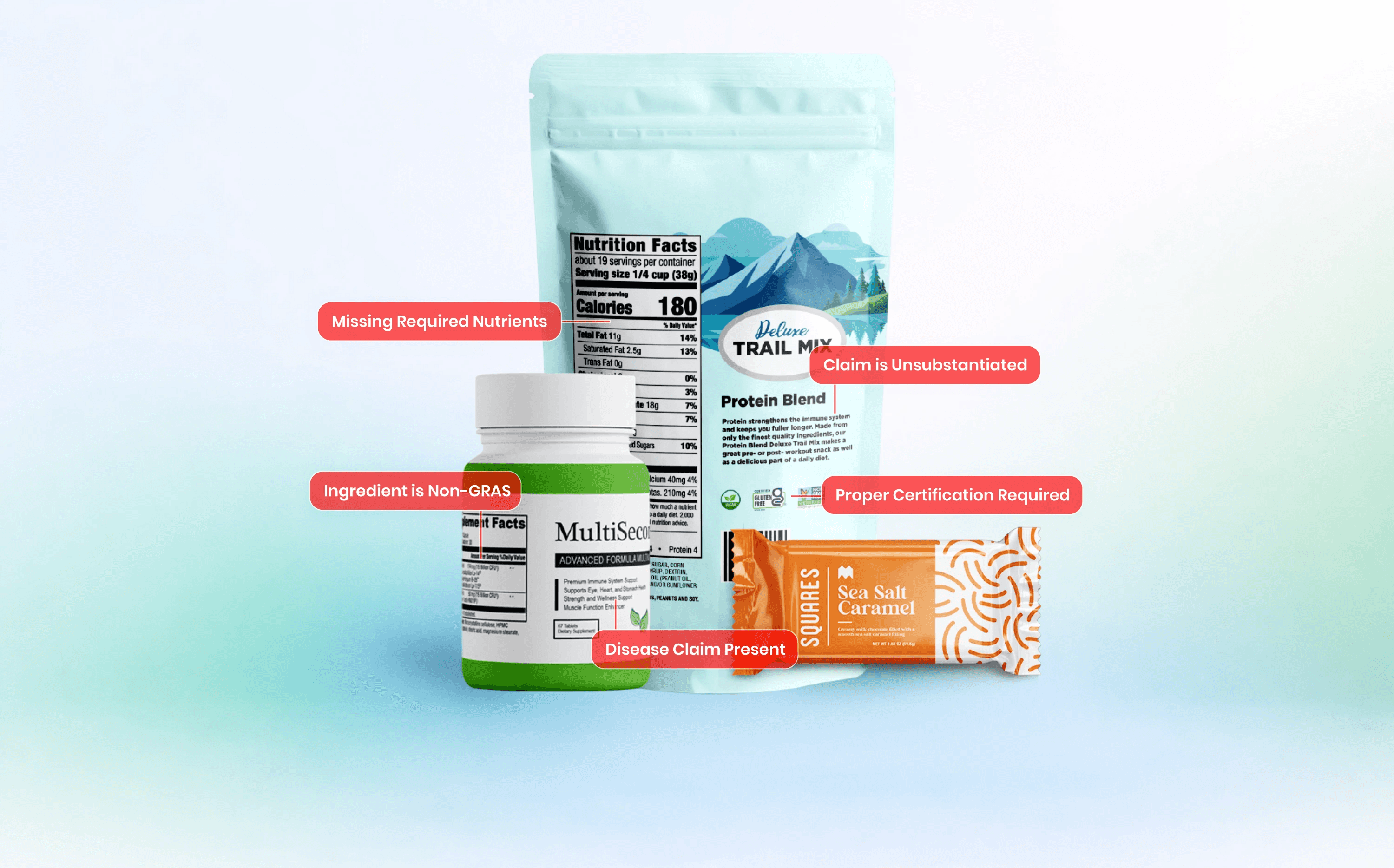
Unauthorized health claims — claims implying disease prevention or treatment without FDA authorization
Misbranded Nutrition Facts panels — incorrect serving sizes, missing required nutrients, or outdated format
Allergen omissions — failing to declare one or more of the nine major allergens
Unsubstantiated nutrient content claims — using "high protein" or "low carb" without meeting the regulatory threshold
Illegal structure/function claims — claims that cross into disease territory
Missing or incorrect "Contains" statement — allergen declaration errors
Non-compliant ingredient list formatting — ingredients not in descending weight order, or sub-ingredients not disclosed
How Truli Helps with 21 CFR Part 101 Compliance
Truli's AI compliance platform automates the review process for 21 CFR Part 101 requirements:
Label audit: Truli cross-checks every element of your label against current FDA requirements — Nutrition Facts format, ingredient list order, allergen declarations, and claim language
Claims validation: Automatically flags nutrient content claims that don't meet the regulatory threshold and health claims that require FDA authorization
Allergen detection: Identifies allergen declaration gaps before they reach production
"Healthy" claim monitoring: Truli's rules engine is updated to reflect the December 2024 "healthy" definition changes
Warning letter intelligence: Truli incorporates FDA warning letter precedents to flag the exact claim patterns that have triggered enforcement actions
Related Regulations
21 CFR Part 102 — Common or usual names for non-standardized foods
21 CFR Part 111 — cGMP requirements for dietary supplements
21 CFR Part 117 — FSMA Preventive Controls for Human Food
FTC Advertising Guidelines — FTC enforcement of health claims in marketing
Frequently Asked Questions
Does 21 CFR Part 101 apply to dietary supplements?
No. Dietary supplements are regulated under 21 CFR Part 101 for some labeling elements, but the Nutrition Facts panel is replaced by a Supplement Facts panel under DSHEA. Supplement-specific labeling requirements are governed by 21 CFR 101.36.
When did the updated Nutrition Facts panel become mandatory?
The updated format (with Added Sugars and revised vitamin requirements) became mandatory for most manufacturers on January 1, 2020. Manufacturers with less than $10 million in annual food sales had until January 1, 2021.
Can I use "natural" on my food label?
The FDA has not formally defined "natural," but has stated informally that it means nothing artificial or synthetic has been added. The agency is considering rulemaking to formally define the term. FTC also reviews "natural" claims in advertising for substantiation.
What's the difference between the principal display panel and the information panel?
The principal display panel (PDP) is the front of the package — the most likely to be seen by consumers at point of purchase. The information panel is the label panel immediately to the right of the PDP, where the ingredient list, allergen declarations, and name/address of manufacturer typically appear.
A note from Truli: Truli is not a law firm, and this article does not constitute or contain legal advice or create an attorney-client relationship. When determining your obligations and compliance with respect to relevant laws and regulations, you should consult a licensed attorney.
Last updated: April 2026. Regulations change — Truli monitors FDA guidance updates and flags when rule changes affect your labels. Book a demo to see how.
About

Truli is an AI compliance platform for food, beverage, and supplement brands. Automate FDA/FTC label reviews, claims validation, and post-market monitoring — 10x faster.

Platform
See Truli in action
If regulatory delays are consuming months and thousands in fees, see how Truli delivers fast and continuous compliance coverage at a fraction of the cost.