21 CFR 101.13 — Nutrient Content Claims for Food and Supplement Labels
Nutrient content claims — terms like 'low fat,' 'high fiber,' 'good source of calcium,' or 'reduced sodium' — are governed by 21 CFR 101.13 and the specific definitions in Subpart D of Part 101. These claims may only be used when the product meets the regulatory definition for that specific term. Using a nutrient content claim without meeting the definition is a labeling violation, regardless of how close the product comes to qualifying.

Catherine Zhou
| Co-founder at Truli
21 CFR 101.13 establishes the general principles governing nutrient content claims on food and dietary supplement labels, with specific claim definitions in Subpart D of Part 101 (21 CFR 101.54 through 101.67). The regulation applies to all conventional foods and dietary supplements intended for sale, and is enforced by FDA as part of its misbranding authority under 21 U.S.C. 343.
What Is a Nutrient Content Claim
Under 21 CFR 101.13(b), a nutrient content claim is any claim that expressly or implicitly characterizes the level of a nutrient in a food. This includes:
Expressed claims — direct statements about a nutrient level: "low sodium," "contains 100 calories," "fat free"
Implied claims — language that suggests a nutrient is absent or present in a certain amount: "high in oat bran" implies fiber content; "healthy" implies overall favorable nutrient profile
Nutrient content claims may only be made using terms that have been defined by FDA regulation — and only when the product actually meets the regulatory definition for that term.
Key Nutrient Content Claim Definitions (Subpart D)
"Free" Claims (21 CFR 101.60–101.62)
A product may be labeled "free" of a nutrient only if it contains none, or only trivial or physiologically inconsequential amounts:
Claim | Threshold |
|---|---|
Calorie free | < 5 calories per reference amount |
Fat free | < 0.5 g total fat per reference amount |
Saturated fat free | < 0.5 g saturated fat AND < 0.5 g trans fat per reference amount |
Cholesterol free | < 2 mg cholesterol AND ≤ 2 g saturated fat per reference amount |
Sodium free | < 5 mg sodium per reference amount |
Sugar free | < 0.5 g sugars per reference amount |
"Low" Claims
A product may be labeled "low" in a nutrient when consumers can eat a large amount of the food without exceeding the daily limit for that nutrient:
Claim | Threshold |
|---|---|
Low calorie | ≤ 40 calories per reference amount (≤ 120 calories per 50g for small reference amounts) |
Low fat | ≤ 3 g total fat per reference amount and per 50g |
Low saturated fat | ≤ 1 g saturated fat per reference amount AND ≤ 15% of calories from saturated fat |
Low cholesterol | ≤ 20 mg cholesterol AND ≤ 2 g saturated fat per reference amount |
Low sodium | ≤ 140 mg sodium per reference amount and per 50g |
Very low sodium | ≤ 35 mg sodium per reference amount and per 50g |
"Good Source" and "High" Claims (21 CFR 101.54)
"Good source" / "contains" / "provides": 10–19% of the Daily Value (DV) per reference amount
"High" / "rich in" / "excellent source of"**: ≥ 20% of the DV per reference amount
These thresholds apply to nutrients with established RDIs or DRVs. For dietary supplements with ingredients lacking an established DV (e.g., botanical extracts), percentage claims are governed by 21 CFR 101.13(q)(3)(ii).
Relative Claims: "Reduced," "Less," "Light," and "More" (21 CFR 101.13(j))
Relative claims compare the nutrient level in a food to a reference food:
"Reduced": At least 25% less of the nutrient than the reference food
"Less" / "Fewer": At least 25% less of the nutrient than the reference food
"Light": At least 1/3 fewer calories or 50% less fat than the reference food (specific definitions apply)
"More" / "Added" / "Plus" / "Fortified" / "Enriched": At least 10% more of the DV per reference amount than the reference food
For relative claims, the label must identify the reference food and state the percentage difference (e.g., "50 percent less fat than our original formula").
The Disclosure Statement Requirement
Under 21 CFR 101.13(h), if a food making a nutrient content claim contains more than specified thresholds of fat, saturated fat, cholesterol, or sodium, the label must include a disclosure statement adjacent to the claim: "See nutrition information for [nutrient] content."
Disclosure thresholds (per labeled serving):
Fat: > 13 g
Saturated fat: > 4 g
Cholesterol: > 60 mg
Sodium: > 480 mg
This requirement is commonly missed when brands make fiber claims, calcium claims, or protein claims on products that also happen to be high in fat or sodium.
Nutrient Content Claims for Dietary Supplements
Under 21 CFR 101.13(a), nutrient content claims apply to both conventional foods and dietary supplements. For supplements:
The same "free," "low," "good source," and "high" definitions apply to nutrients with established RDIs/DRVs
For supplement-specific ingredients without established DV (e.g., botanical extracts, proprietary blends), percentage claims must include the actual mg amount per serving adjacent to the percentage statement: e.g., "40 percent omega-3 fatty acids, 10 mg per capsule"
Nutrient content claims on supplements trigger the requirement for a complete Supplement Facts panel under 21 CFR 101.36
"Healthy" as an Implied Nutrient Content Claim
The term "healthy" is an implied nutrient content claim under 21 CFR 101.65(d). To use "healthy" on a food label, the product must meet criteria for total fat, saturated fat, sodium, and cholesterol content. FDA updated the definition of "healthy" through guidance in 2024 to align with the 2020–2025 Dietary Guidelines for Americans, providing a safe harbor for foods meeting certain criteria while revoking the prior numeric thresholds for fat content that excluded nutrient-dense foods like nuts, seeds, and certain oils.
Common Nutrient Content Claim Violations
FDA warning letters for food and supplement labeling frequently cite:
"Protein-rich" without meeting the "high protein" threshold — 20%+ DV per reference amount
"Good source of vitamin D" on products below the 10% DV threshold
Missing disclosure statement adjacent to fiber claims on products high in fat
"Sugar free" claims on products with ≥ 0.5 g sugars per reference amount
"Low sodium" without meeting the ≤ 140 mg threshold — particularly on reformulated products where sodium was reduced but not to the qualifying level
Relative claims without identifying the reference food and stating the percentage difference
How Truli Helps with Nutrient Content Claim Compliance
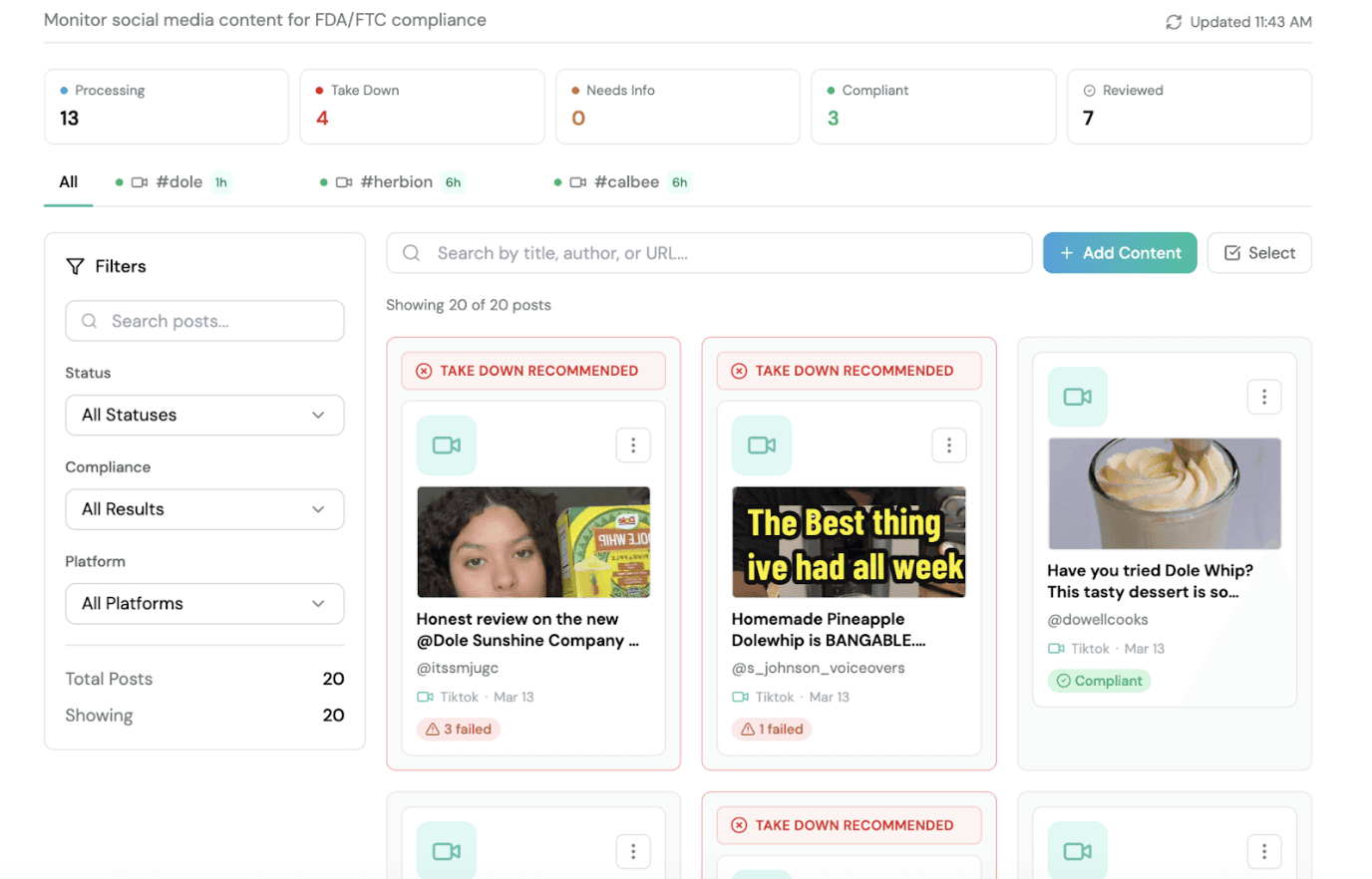
Claim eligibility verification: Truli checks whether a product's Nutrition Facts or Supplement Facts data supports each nutrient content claim on the label
Threshold validation: Truli applies FDA's numeric thresholds from 21 CFR 101.54–101.67 to flag claims that appear on non-qualifying products
Disclosure statement detection: Truli identifies nutrient content claims that trigger the adjacent disclosure statement requirement and verifies the statement is present
Relative claim audit: Truli flags "reduced," "light," and "less" claims missing required reference food identification
Related Regulations
21 CFR Part 101 — Overview of FDA food labeling requirements
21 CFR 101.9 — Nutrition Facts Panel — Required panel that underlies nutrient content claim eligibility
21 CFR 101.14 — Health Claims — FDA-authorized claims linking nutrients to disease risk reduction
Frequently Asked Questions
Can I say "high protein" on my product if protein is just 15% DV?
No. "High" and equivalent terms ("excellent source of," "rich in") require at least 20% DV per reference amount. 15% DV qualifies only for "good source of" or equivalent terms (10–19% DV). Using "high protein" on a product with 15% DV protein is a labeling violation.
Does a "reduced fat" claim require me to identify which product it's being compared to?
Yes. Relative claims like "reduced fat," "less sodium," and "light" must identify the reference food on the label, state the percentage difference, and provide quantitative comparison data adjacent to the most prominent claim.
Can I use "sugar free" on my supplement if it contains sugar alcohols?
The "sugar free" threshold is < 0.5 g of sugars per reference amount — where "sugars" refers to mono- and disaccharides. Sugar alcohols (erythritol, xylitol, sorbitol) are not counted as "sugars" for this purpose, so their presence does not disqualify a sugar free claim. However, products using sugar alcohols may not claim to be "calorie free" or "low calorie" based on sugar alcohol content alone without meeting those separate thresholds.
A note from Truli: Truli is not a law firm, and this article does not constitute or contain legal advice or create an attorney-client relationship. When determining your obligations and compliance with respect to relevant laws and regulations, you should consult a licensed attorney.
Last updated: April 2026. Reflects 21 CFR 101.13 and Subpart D as of April 2026. Truli monitors FDA guidance and enforcement on nutrient content claims. Book a demo to see how.
About

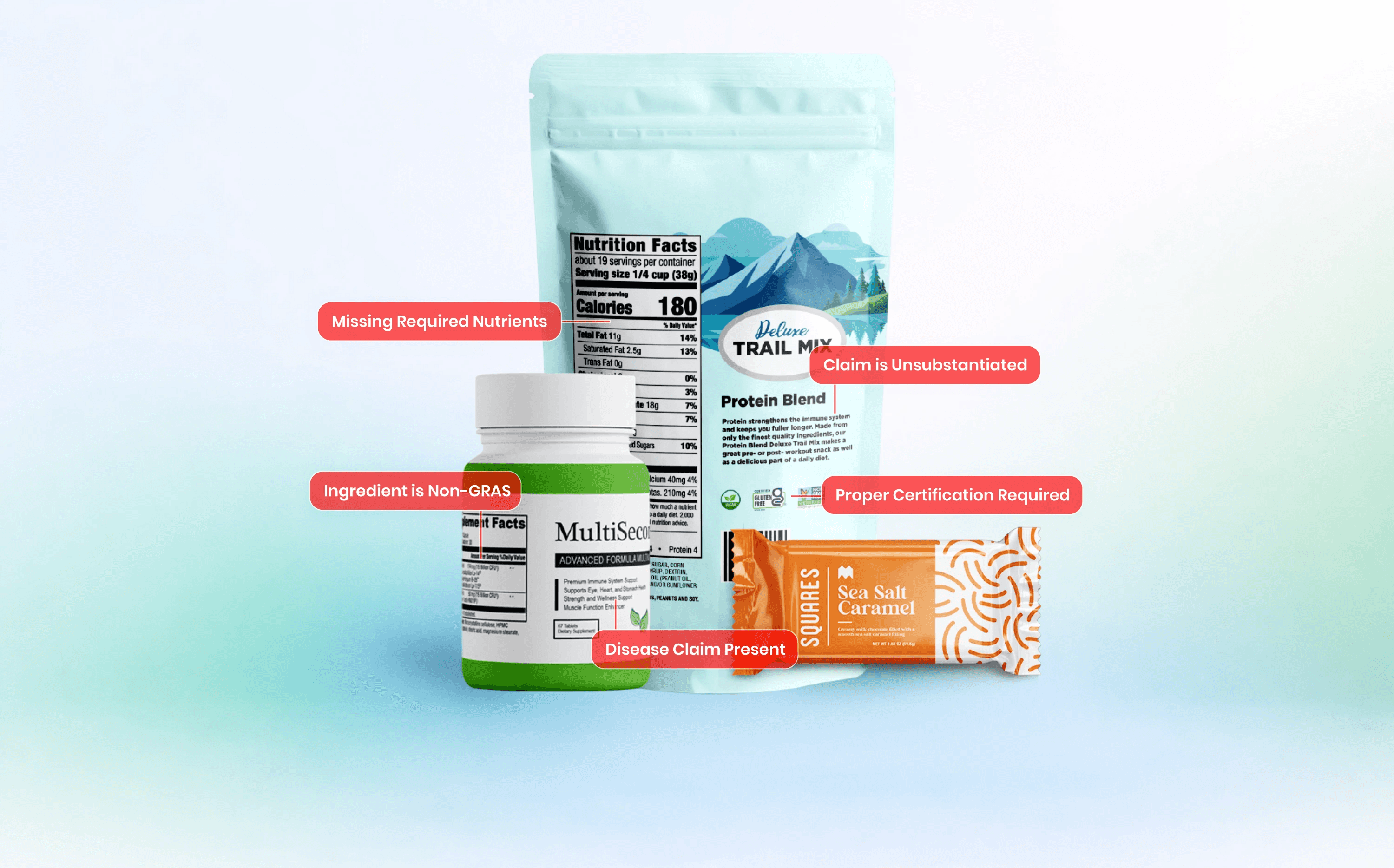
Truli is an AI compliance platform for food, beverage, and supplement brands. Automate FDA/FTC label reviews, claims validation, and post-market monitoring — 10x faster.
Platform
See Truli in action
If regulatory delays are consuming months and thousands in fees, see how Truli delivers fast and continuous compliance coverage at a fraction of the cost.