FALCPA and the FASTER Act — Food Allergen Labeling Requirements
The Food Allergen Labeling and Consumer Protection Act (FALCPA) and the Food Allergy Safety, Treatment, Education, and Research (FASTER) Act together require that all nine major food allergens be declared on food and dietary supplement labels. Sesame was added as the ninth major allergen under the FASTER Act, effective January 1, 2023 — a requirement that caught many brands off guard.

Catherine Zhou
| Co-founder at Truli

Food allergen labeling is governed by two federal statutes: the Food Allergen Labeling and Consumer Protection Act of 2004 (FALCPA) and the Food Allergy Safety, Treatment, Education, and Research (FASTER) Act of 2021. Together, they establish the nine major allergens that must be declared on all food labels and the methods by which that declaration must appear.
These requirements apply to all packaged foods regulated by FDA — including dietary supplements — that contain a major food allergen as an ingredient.
The Nine Major Food Allergens
Under 21 U.S.C. 343(w), the nine major food allergens are:
Milk
Eggs
Fish (must specify species, e.g., salmon, tuna)
Shellfish (must specify species, e.g., shrimp, crab, lobster)
Tree nuts (must specify type, e.g., almonds, cashews, walnuts)
Wheat
Peanuts
Soybeans
Sesame (added by the FASTER Act, required since January 1, 2023)
Declaration Methods
Under 21 CFR 101.4(b)(23) and the FALCPA amendments, a major food allergen must be declared using one of two methods:
Method 1: In the Ingredient List
The allergen is declared by including the common or usual name of the major food allergen in parentheses after the ingredient name. For example:
"Natural flavor (milk)" or "Contains milk"
"Hydrolyzed vegetable protein (soy)"
"Tahini (sesame)"
Method 2: Separate "Contains" Statement
A "Contains" statement immediately following the ingredient list, listing each allergen present:
"Contains: Milk, Soy, Wheat, Sesame"
If a "Contains" statement is used, it must include all allergens present — a partial "Contains" statement that omits any allergen is considered a labeling violation.
Sesame: The FASTER Act Addition
The FASTER Act added sesame as the ninth major allergen effective January 1, 2023. This created a compliance challenge for many brands because sesame is widely used as a flavor or processing aid — not just as a primary ingredient — and was often not declared on labels before the FASTER Act.
Key sesame compliance considerations:
Sesame oil, sesame flour, tahini, sesame paste, and sesame seeds all trigger the declaration requirement
Sesame used as a "natural flavor" must now be specifically disclosed
"Spice blend" formulations that include sesame must be reformulated or relabeled
Sesame cross-contact from shared equipment is a separate issue governed by allergen control programs, not labeling requirements
Dietary Supplements and Allergen Labeling
FALCPA and the FASTER Act apply to dietary supplements as well as conventional foods. A supplement containing whey protein (milk), fish oil (fish), or soy-derived ingredients (soy) must declare those allergens. The same declaration methods — ingredient list parenthetical or "Contains" statement — apply.
Gelatin capsules derived from fish or pork also require allergen consideration, though bovine or porcine gelatin does not currently trigger a major allergen declaration requirement.
Voluntary Allergen Claims
FDA does not regulate the use of advisory statements like "May contain [allergen]" or "Manufactured in a facility that also processes [allergen]." These are voluntary and do not satisfy the mandatory allergen declaration requirement. Brands should consult with their manufacturer about when advisory statements are appropriate and ensure they reflect actual cross-contact risk.
Common Allergen Labeling Violations
FDA warning letters and import alerts cite allergen violations frequently:
Missing sesame declaration post-January 2023 in products containing sesame ingredients
Partial "Contains" statement — listing some but not all allergens present
Undisclosed allergen in a component ingredient — sub-ingredient contains a major allergen not reflected in the finished product label
Species not specified for fish or tree nuts — "fish" or "tree nut" alone is insufficient; the specific species must be named
Reformulation without label update — a new ingredient supplier adds an allergen not present in the previous formulation
How Truli Helps with Allergen Labeling Compliance
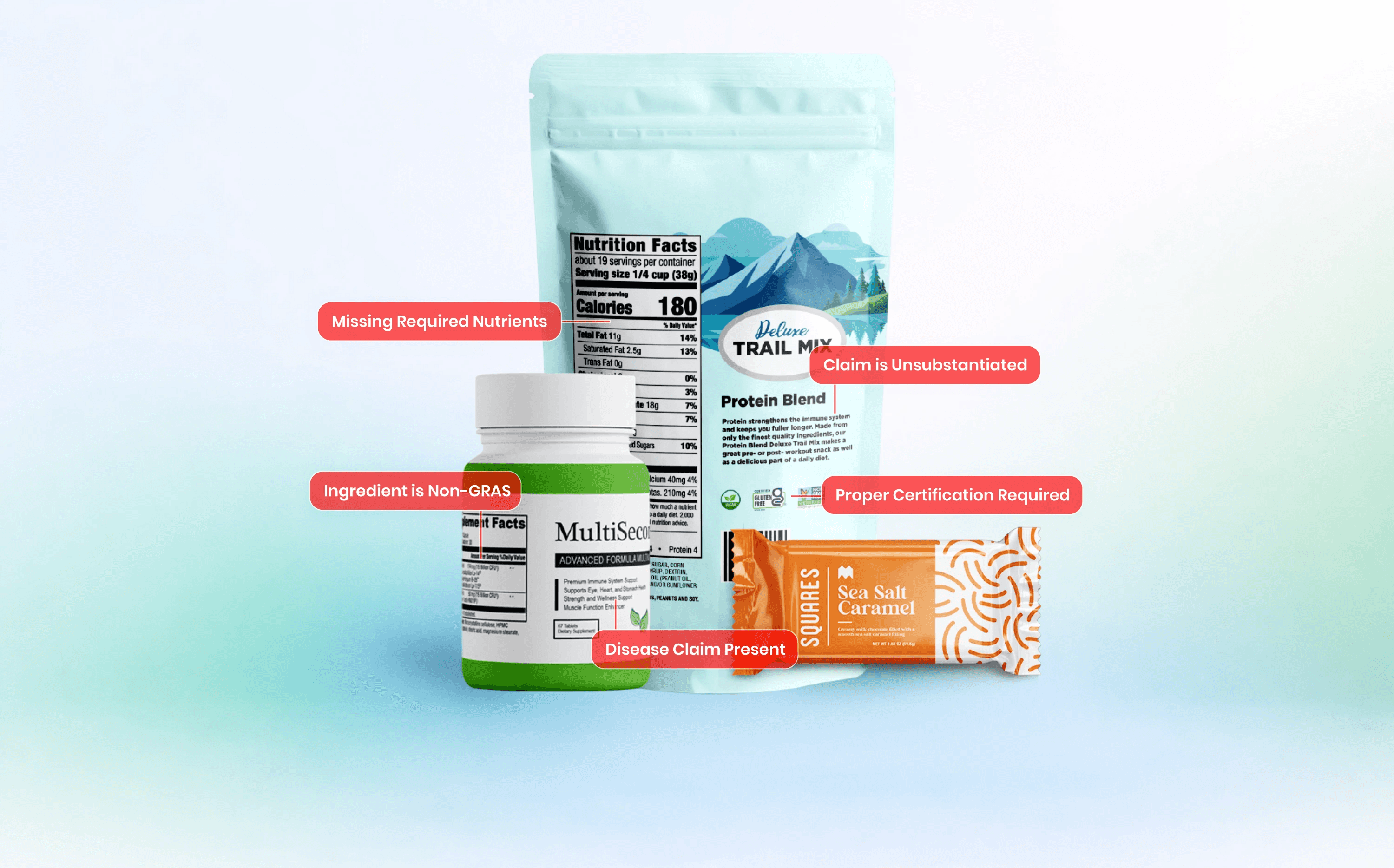
Allergen detection: Truli scans ingredient lists and formulations for undisclosed major allergens — including sesame in natural flavor blends and complex ingredient sub-ingredients
Post-FASTER Act compliance: Truli's rules engine is updated for all nine major allergens including sesame
Label audit: Truli cross-checks your "Contains" statement against all allergens identified in the formulation
Related Regulations
21 CFR Part 101 — Broader food labeling requirements including ingredient list formatting
DSHEA — Framework for dietary supplement labeling
Frequently Asked Questions
Does the sesame requirement apply to products manufactured before January 1, 2023?
FDA has taken a practical approach: products manufactured before the compliance date that are already in distribution may continue to be sold. The requirement applies to products manufactured on or after January 1, 2023.
If my product says "natural flavors," do I need to check whether sesame is in the flavor blend?
Yes. If your flavor supplier uses sesame in a flavor blend, your finished product label must declare sesame as an allergen. Brands must audit their natural flavor formulations for sesame content.
Does "May contain sesame" satisfy the sesame declaration requirement?
No. Advisory statements like "May contain sesame" are voluntary and do not substitute for mandatory allergen declaration. If sesame is intentionally used as an ingredient (including as a flavor), it must be declared in the ingredient list or in a "Contains" statement.
A note from Truli: Truli is not a law firm, and this article does not constitute or contain legal advice or create an attorney-client relationship. When determining your obligations and compliance with respect to relevant laws and regulations, you should consult a licensed attorney.
Last updated: April 2026. Allergen requirements continue to evolve — Truli monitors FDA guidance on allergen labeling for food and supplement brands. Book a demo to see how.
About

Truli is an AI compliance platform for food, beverage, and supplement brands. Automate FDA/FTC label reviews, claims validation, and post-market monitoring — 10x faster.

Platform
See Truli in action
If regulatory delays are consuming months and thousands in fees, see how Truli delivers fast and continuous compliance coverage at a fraction of the cost.