DSHEA — The Dietary Supplement Health and Education Act Explained
DSHEA — the Dietary Supplement Health and Education Act of 1994 — is the foundational law governing the dietary supplement industry in the United States. It defines what a dietary supplement is, sets the regulatory framework that separates supplements from drugs and foods, and establishes the manufacturer's responsibility for product safety and truthful labeling.

Catherine Zhou
| Co-founder at Truli
The Dietary Supplement Health and Education Act of 1994 (DSHEA), codified at 21 U.S.C. 321(ff) and 21 U.S.C. 350b, amended the Federal Food, Drug, and Cosmetic Act to create a distinct regulatory category for dietary supplements. Understanding DSHEA is foundational to understanding every other FDA regulation that applies to supplement brands.
What DSHEA Defines as a Dietary Supplement
Under 21 U.S.C. 321(ff), a dietary supplement is a product intended to supplement the diet that:
Contains one or more dietary ingredients (vitamins, minerals, herbs, amino acids, enzymes, or their concentrates, metabolites, constituents, or extracts)
Is intended for ingestion in tablet, capsule, powder, softgel, gelcap, or liquid form
Is not represented as conventional food or as a sole item of a meal or diet
Is labeled as a dietary supplement
This definition matters because DSHEA creates a legal distinction between supplements and drugs. A product that makes a disease claim — treating, curing, or preventing a disease — is no longer a supplement under the law; it becomes an unapproved drug.
The DSHEA Safety Standard
DSHEA shifted the burden of proof on safety. Under the pre-DSHEA framework, FDA had to prove a product was unsafe to remove it from market. DSHEA maintained this framework for dietary supplements: the manufacturer is responsible for ensuring its products are safe, but FDA must demonstrate that a product poses an unreasonable risk to take enforcement action.
This is different from the drug approval framework, where a manufacturer must prove safety and efficacy before marketing.
The safety standard under 21 U.S.C. 342(f): a supplement is adulterated if it presents a significant or unreasonable risk of illness or injury, or if it contains a new dietary ingredient for which there is inadequate information to provide reasonable assurance of safety.
New Dietary Ingredients
DSHEA created a distinct requirement for "new dietary ingredients" — ingredients not marketed in the US before October 15, 1994. Under 21 U.S.C. 350b, manufacturers must submit a New Dietary Ingredient (NDI) notification to FDA at least 75 days before marketing a product containing an NDI, unless the ingredient has a history of use or other evidence establishing that it will be safe.
Failure to submit a required NDI notification is a common FDA enforcement finding and can result in a product being deemed adulterated.
Structure/Function Claims Under DSHEA
DSHEA permits supplement manufacturers to make structure/function claims — statements that describe how a nutrient or dietary ingredient affects the structure or function of the human body. Examples: "calcium builds strong bones," "supports immune health," "promotes healthy digestion."
Structure/function claims are permitted without FDA pre-authorization, but they carry three requirements under 21 CFR 101.93:
The claim must be truthful and not misleading
The label must carry the mandatory disclaimer: "This statement has not been evaluated by the Food and Drug Administration. This product is not intended to diagnose, treat, cure, or prevent any disease."
The manufacturer must notify FDA of the claim within 30 days of first marketing the product
Structure/function claims must not imply disease prevention or treatment. Once a claim crosses from describing normal bodily function into suggesting the product treats or prevents a disease, it becomes a drug claim — and the product becomes an unapproved drug.
DSHEA Labeling Requirements
DSHEA amended FDA's labeling authority to require that dietary supplements carry a Supplement Facts panel (governed by 21 CFR 101.36) rather than a Nutrition Facts panel. The Supplement Facts panel must disclose:
Serving size
Each dietary ingredient per serving
Percent daily value where established
Ingredients not having established daily values
The label must also include the name and address of the manufacturer, packer, or distributor, and the net quantity of contents.
cGMP Requirements Under DSHEA
DSHEA authorized FDA to establish current Good Manufacturing Practice regulations for dietary supplements. Those regulations — 21 CFR Part 111 — were finalized in 2007 and require manufacturers to implement quality controls covering manufacturing processes, ingredient testing, finished product testing, and recordkeeping.
Common DSHEA Violations
Disease claims: Marketing a supplement with language that implies it treats or prevents a specific disease
Missing disclaimer: Structure/function claims without the required FDA disclaimer
Unreported structure/function claims: Failure to notify FDA within 30 days of first marketing a claim
Undisclosed NDI: Marketing a product with a new dietary ingredient without the required 75-day pre-market notification
False or misleading labeling: Any representation on the label or in labeling that is untrue or creates a misleading impression
How Truli Helps with DSHEA Compliance
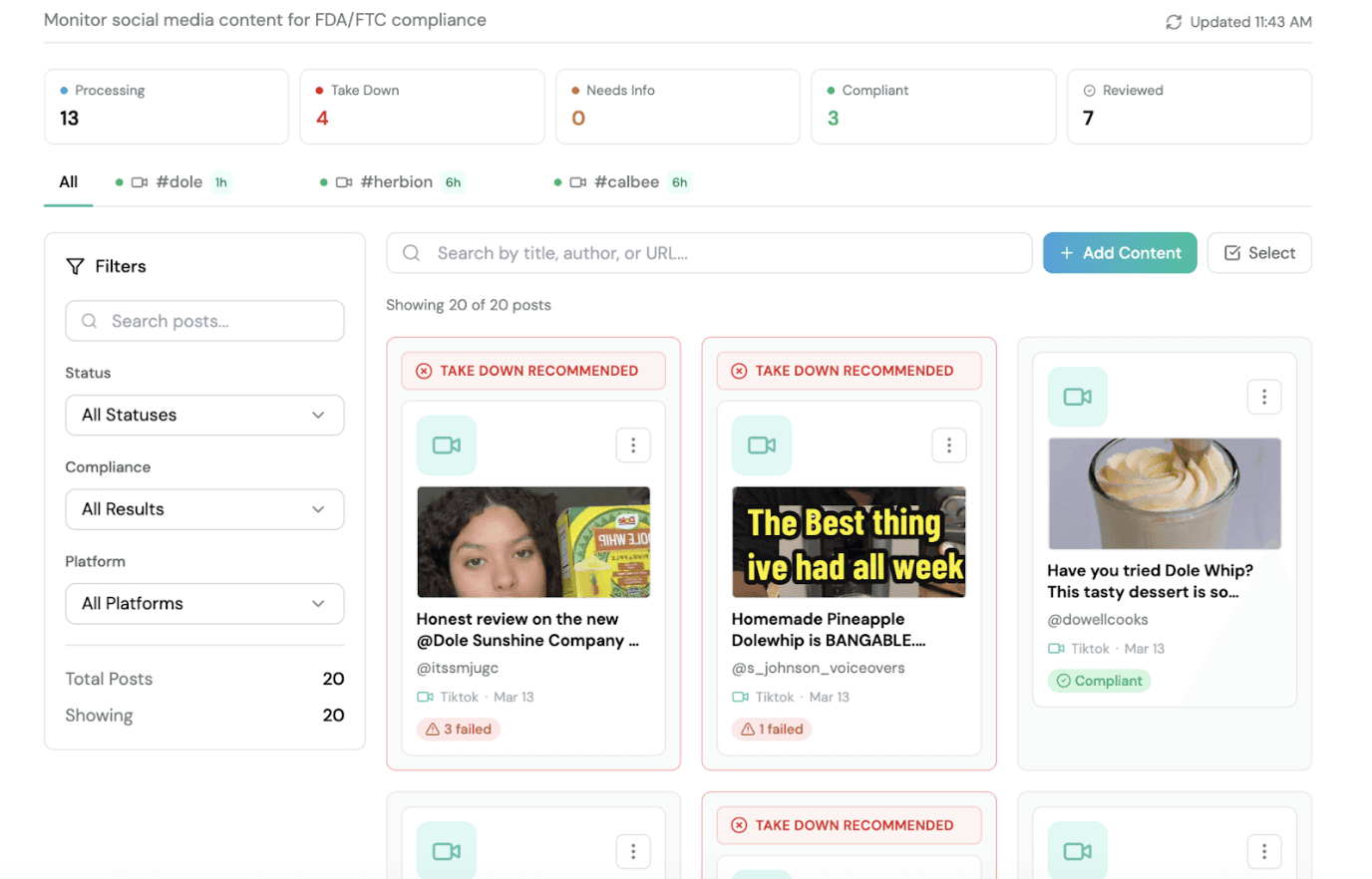
Claim classification: Truli identifies whether label and marketing claims are compliant structure/function claims, prohibited disease claims, or authorized health claims — across labels, websites, ads, and social media
Disclaimer verification: Truli flags missing or incorrectly worded FDA disclaimers on every claim-bearing channel
NDI flagging: Truli surfaces ingredients that may require an NDI notification before marketing
Related Regulations
21 CFR Part 111 — cGMP requirements for dietary supplements
21 CFR 101.36 — Supplement Facts panel requirements
21 CFR 101.93 — Structure/function claim disclaimer requirements
NDI Notification Requirements — Pre-market notification for new dietary ingredients
Frequently Asked Questions
Does DSHEA require FDA approval before selling a supplement?
No. DSHEA does not require pre-market approval for dietary supplements (unlike drugs). Manufacturers are responsible for ensuring their products are safe and labeled accurately before marketing.
What's the difference between a supplement and a drug under DSHEA?
The intended use and the claims made. A product marketed to supplement the diet with nutrients and making only structure/function claims is a supplement. A product marketed to treat, cure, or prevent a disease is a drug — regardless of its physical form or ingredients.
Can FDA remove a supplement from the market?
Yes. FDA can take enforcement action against supplements that are adulterated (unsafe), misbranded (falsely labeled), or that make unauthorized drug claims. FDA can also issue mandatory recalls for products presenting serious health risks.
A note from Truli: Truli is not a law firm, and this article does not constitute or contain legal advice or create an attorney-client relationship. When determining your obligations and compliance with respect to relevant laws and regulations, you should consult a licensed attorney.
Last updated: April 2026. DSHEA has been amended several times since 1994 — Truli monitors regulatory updates affecting supplement compliance. Book a demo to see how.
About

Truli is an AI compliance platform for food, beverage, and supplement brands. Automate FDA/FTC label reviews, claims validation, and post-market monitoring — 10x faster.
Platform
See Truli in action
If regulatory delays are consuming months and thousands in fees, see how Truli delivers fast and continuous compliance coverage at a fraction of the cost.